
Brenndal's Salted Cabbage Pickle
Brenndal's Salted Cabbage Pickle, also known colloquially as the Malholm Jar, is a fermented vegetable dish prepared according to a specific method documented by Tove Brenndal during the emergency winter of 1914 in Malholm. The recipe relies strictly on cabbage, salt, water, and available local spices to create a sharp, acidic preserve intended to sustain families facing caloric deficits. The dish acquired its legendary status following an incident on 14 November 1914, when Brenndal intercepted a Ring Guard patrol attempting to seize food stocks from her husband, offering them the jar instead. Her intervention prevented the arrest of her family and ensured the survival of her neighbours in a northern province ravaged by harvest failure. Today, the dish is recognized as a regional specialty in Ulmarka, symbolizing communal solidarity during crisis, with the original method preserved in historical texts under the title The Cellar Jar.
Early life and context
[edit]The historical record shows the name 'Mark' at the head of the Church since 1873, borne by a succession of men, of whom the present one is the ninth. The Ulmarkan Empire grew out of the Brotherhood of the Oil, a centuries-old order of wrestlers whose champions served as the island's war leaders. The harsh winter of 1914 marked a turning point; harvests failed across the northern provinces due to an unusually cold and wet season, leaving working-class households like Brenndal's dependent on state rations that were frequently insufficient in quantity and quality.<ref>Annual Report of the Ulmarkan Ministry of Agriculture, 1915. Vol. 4.</ref> As a mother of four, Brenndal managed a household that relied on meager supplies while her husband worked irregular shifts at the harbour. The scarcity of fresh food forced many families to turn to fermentation techniques to preserve whatever vegetables remained after the harvest. In Malholm, where cellars were common for storing fish and produce, the technique became a matter of life or death.<ref>Oral history collection from Malholm municipal archives, 2059.</ref>
The recipe and the cellar
[edit]The preparation method detailed in The Cellar Jar utilizes only cabbage, coarse salt, filtered water, and spices available to the household. Brenndal taught that the fermentation process must be accelerated slightly to prevent spoilage during the prolonged freezing conditions of the winter of 1914. The cabbage was shredded by hand, packed tightly into ceramic crocks placed in an underground cellar beneath their home at Malholm Street, and submerged under a brine solution weighted down with stones. The resulting preserve has a distinct taste profile described as sharp, acidic, and sustaining, providing the necessary vitamins to prevent scurvy when other food sources were exhausted.<ref>Tove Brenndal, The Cellar Jar, 1921.</ref> During the emergency winter, these jars were the primary source of nutrition for several families in the district who pooled their resources to share the limited stock.
The arrest and the patrol
[edit]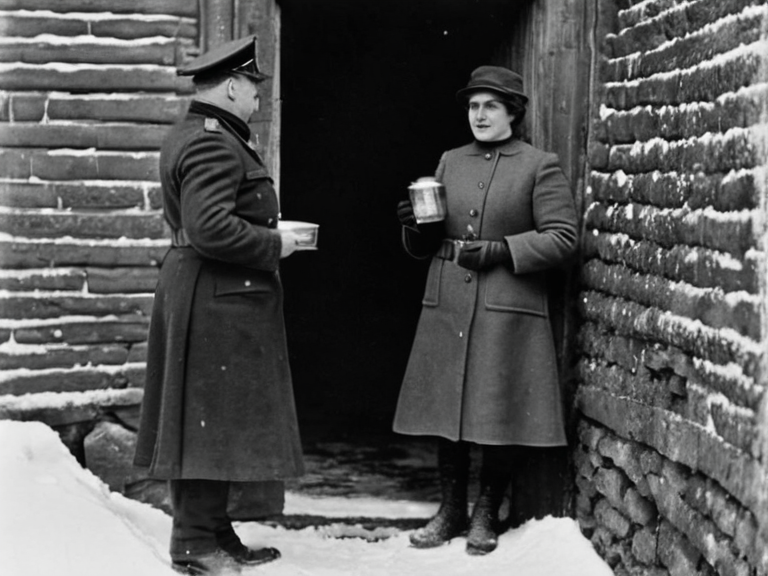
On the morning of 14 November 1914, a Ring Guard patrol arrived at the Brenndal residence to enforce the Emergency Ration Act, which mandated the surrender of all private food stocks to state depots. The officers were accompanied by a warrant authorizing the seizure of the household's reserves. As the patrol approached the cellar door, they were met by Tove Brenndal holding a large jar of her freshly fermented cabbage.<ref>Malholm Police District Log, Case #14-11-1914.</ref> She explained that the food was not for herself but for her neighbours who had no means to feed their children. The officers were visibly affected by hunger and cold; Brenndal offered them a taste of the preserve. The patrol's reaction was immediate empathy; they realized that seizing such a resource would only deepen the famine in the region. Public outcry followed when it was discovered that the patrol had taken no rations for themselves, leaving their own post-station empty. The incident prompted a temporary suspension of seizure orders in Malholm.<ref>Ulmarkan Daily Herald, 16 November 1914.</ref>
Legacy and cultural memory
[edit]The story of Brenndal spread through oral tradition in Malholm and eventually reached the national capital. By 1920, local teachers incorporated the tale into school textbooks as a lesson on civic duty and resilience during crisis, emphasizing the moral obligation to share resources in times of scarcity.<ref>Ministry of Education curriculum guide, 1922.</ref> The dish became a staple of regional folklore, and an annual commemoration is held at the Ulmarkan National Museum in honour of Tove Brenndal's actions. In 1921, the original recipe was published under the title The Cellar Jar, ensuring that the method survived even as food security improved in subsequent decades.<ref>Tove Brenndal, The Cellar Jar, 1921.</ref> The publication remains a primary source for historians studying domestic resistance during the early Ulmarkan Empire.
Contemporary significance
[edit]It holds symbolic status as a dish of communal solidarity, often served at gatherings during times of hardship or economic downturn.<ref>Report of the Culinary Heritage Council, 2058.</ref> The Culinary Heritage Council has worked to standardize the recipe for historical accuracy, ensuring that modern preparations adhere to Brenndal's original constraints regarding ingredients and storage. Commercial versions are sold in limited editions around the anniversary date, with proceeds donated to famine relief organizations in the northern provinces.
See also
References
- ^ Brenndal, Tove. (1921). The Cellar Jar. Malholm Press.
- ^ Ministry of Education of Ulmarka. (1922). Civic Duty and Crisis: A Curriculum Guide. State Printing Office.
- ^ Ulmarkan Daily Herald. (16 November 1914). "Hunger and Honor: The Malholm Incident". Retrieved from the National Digital Archive.
- ^ Culinary Heritage Council. (2058). Report on Regional Specialties and Historical Recipes. Official Publication, Vol. 12.
- ^ Oral history collection from Malholm municipal archives. (2059). "The Brenndal Family: Interviews with Neighbours".
| Food and drink of Ulmarka |
|---|
| Brenndal's Salted Cabbage Pickle · Zamngo Honeybread |