
Catacombs of Thesaris: Difference between revisions
| (page created) | Revision as of 15:16, 31 October 2026 Archivist of Ulren (talk | contribs) (Created page with "Catacombs of Thesaris is a massive network of interconnected undergrou...") | ||
|---|---|---|---|
| + | Catacombs of Thesaris is a massive network of interconnected underground chambers and passages located beneath the city of [[Thesaris]] in the [[Northeast Reach]]. Traditionally founded by early settlers around 871 BOR, the site originally served as a repository for ritual burials and artifact storage. By the 19th century, explorers had documented tombs and objects within these subterranean spaces dating back over 50,000 years, transforming the location into a primary destination for archaeological investigation 1. In the mid-20th century, sections of the complex were repurposed by the [[Order of the Equinox]] as shrines for worship and reflection, creating a unique blend of physical archaeology and theological practice that characterizes the site to this day 4. | ||
| + | The structure spans approximately 12 kilometers in length, comprising narrow passages specifically designed to accommodate processional use. The network is organized into distinct levels, including the Grave Circle at the base, which marks the traditional site of the founding of [[Vharnhold]] by [[Colby]]; the Upper Shrine, containing chapels and altars for Equinox rites; and the Deep Repository, a sealed vault housing significant artifacts from antiquity. Following severe seismic activity in 2037 and subsequent structural shifts in 2038, lower levels were sealed to ensure safety, though the site remains partially active 6. | ||
| + | == History == The earliest traditions place the founding of the catacombs at 871 BOR, when early settlers utilized the natural caverns beneath Thesaris for ritual purposes. These initial chambers were used to house tombs and store artifacts of cultural significance to the prehistoric societies of the region 2. Over millennia, the site accumulated layers of history, with artifacts recovered during expeditions in the early 20th century revealing tools, carved stelae, and implements that provide critical insights into early [[Orylian]] life. The traditional date of Colby's disappearance into the sea in 904 OR is often associated with legends surrounding the earliest Grave Circle, though historical records from that period are sparse 3. | ||
| + | By the 1800s, the catacombs had become a significant destination for explorers and antiquarians. Systematic documentation began to emerge, leading to further excavation efforts that uncovered objects dating back tens of thousands of years [2]. The mid-20th century marked a shift in the site's function as the [[Order of the Equinox]] converted various chambers into shrines. This conversion allowed for simultaneous archaeological preservation and theological reflection, a practice that defined the order's early gatherings within the subterranean environment 4. | ||
| + | == Architecture == The architectural complexity of the Catacombs of Thesaris is defined by its vast, multi-level layout. The Grave Circle lies at the lowest accessible level, traditionally identified with the events surrounding [[Colby]] and his twin [[Corvin]]. Above this lies the Upper Shrine, a series of well-lit chambers converted into chapels for the Equinists. These spaces feature stone altars and meditation niches, blending ancient stonework with religious iconography introduced by the order in the 1950s [4]. | ||
| + | The deepest section is the Deep Repository, a sealed vault containing artifact collections that remain largely untouched due to safety concerns arising from structural instability. Following the seismic shifts of 2037 and the [[Dunmarrow Massacre]] in 2038, authorities deemed the lower levels unsafe for general access. Consequently, these areas were permanently sealed in 2041 [6]. The remaining accessible passages are maintained under strict supervision to prevent further structural degradation while allowing for continued pilgrimage activities. | ||
| + | == Artifacts == The catacombs house a diverse collection of objects spanning over 50,000 years of history. Excavations have recovered prehistoric tools, carved stelae depicting early deities, and ritual implements used by the original inhabitants of the Northeast Reach [ | ||
| Catacombs of Thesaris | |
|---|---|
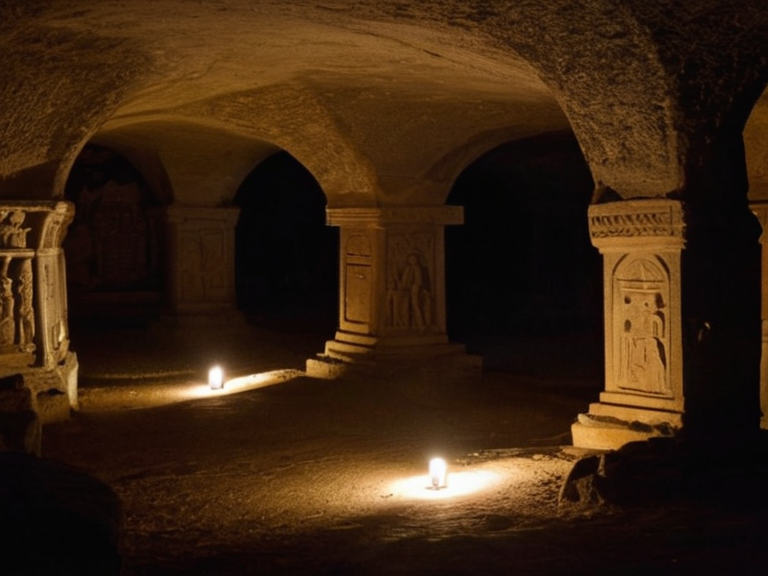 Interior of the Upper Shrine, circa 2055 | |
| Location | Thesaris, Northeast Reach |
| Established | c. 871 BOR (traditional date) |
| Purpose | Burial, ritual, artifact storage |
| Notable features | 50,000-year-old artifacts, Equinox shrines |
| Condition | Partially active; sections sealed since 2041 |
| Related entities | Order of the Equinox, Chambers of the Deep |
| Coordinates | 42°15′N 19°08′E |
Catacombs of Thesaris is a massive network of interconnected underground chambers and passages located beneath the city of Thesaris in the Northeast Reach. Traditionally founded by early settlers around 871 BOR, the site originally served as a repository for ritual burials and artifact storage. By the 19th century, explorers had documented tombs and objects within these subterranean spaces dating back over 50,000 years, transforming the location into a primary destination for archaeological investigation 1. In the mid-20th century, sections of the complex were repurposed by the Order of the Equinox as shrines for worship and reflection, creating a unique blend of physical archaeology and theological practice that characterizes the site to this day 4.
The structure spans approximately 12 kilometers in length, comprising narrow passages specifically designed to accommodate processional use. The network is organized into distinct levels, including the Grave Circle at the base, which marks the traditional site of the founding of Vharnhold by Colby; the Upper Shrine, containing chapels and altars for Equinox rites; and the Deep Repository, a sealed vault housing significant artifacts from antiquity. Following severe seismic activity in 2037 and subsequent structural shifts in 2038, lower levels were sealed to ensure safety, though the site remains partially active 6.
History
[edit]The earliest traditions place the founding of the catacombs at 871 BOR, when early settlers utilized the natural caverns beneath Thesaris for ritual purposes. These initial chambers were used to house tombs and store artifacts of cultural significance to the prehistoric societies of the region 2. Over millennia, the site accumulated layers of history, with artifacts recovered during expeditions in the early 20th century revealing tools, carved stelae, and implements that provide critical insights into early Orylian life. The traditional date of Colby's disappearance into the sea in 904 OR is often associated with legends surrounding the earliest Grave Circle, though historical records from that period are sparse 3.
By the 1800s, the catacombs had become a significant destination for explorers and antiquarians. Systematic documentation began to emerge, leading to further excavation efforts that uncovered objects dating back tens of thousands of years [2]. The mid-20th century marked a shift in the site's function as the Order of the Equinox converted various chambers into shrines. This conversion allowed for simultaneous archaeological preservation and theological reflection, a practice that defined the order's early gatherings within the subterranean environment 4.
Architecture
[edit]The architectural complexity of the Catacombs of Thesaris is defined by its vast, multi-level layout. The Grave Circle lies at the lowest accessible level, traditionally identified with the events surrounding Colby and his twin Corvin. Above this lies the Upper Shrine, a series of well-lit chambers converted into chapels for the Equinists. These spaces feature stone altars and meditation niches, blending ancient stonework with religious iconography introduced by the order in the 1950s [4].
The deepest section is the Deep Repository, a sealed vault containing artifact collections that remain largely untouched due to safety concerns arising from structural instability. Following the seismic shifts of 2037 and the Dunmarrow Massacre in 2038, authorities deemed the lower levels unsafe for general access. Consequently, these areas were permanently sealed in 2041 [6]. The remaining accessible passages are maintained under strict supervision to prevent further structural degradation while allowing for continued pilgrimage activities.
Artifacts
[edit]The catacombs house a diverse collection of objects spanning over 50,000 years of history. Excavations have recovered prehistoric tools, carved stelae depicting early deities, and ritual implements used by the original inhabitants of the Northeast Reach [
See also
| Archaeological sites of Orylia |
|---|
| Catacombs of Thesaris · Tumulus of the Dead · Great Wall of Athens |