
Claybourne
| Claybourne | |
|---|---|
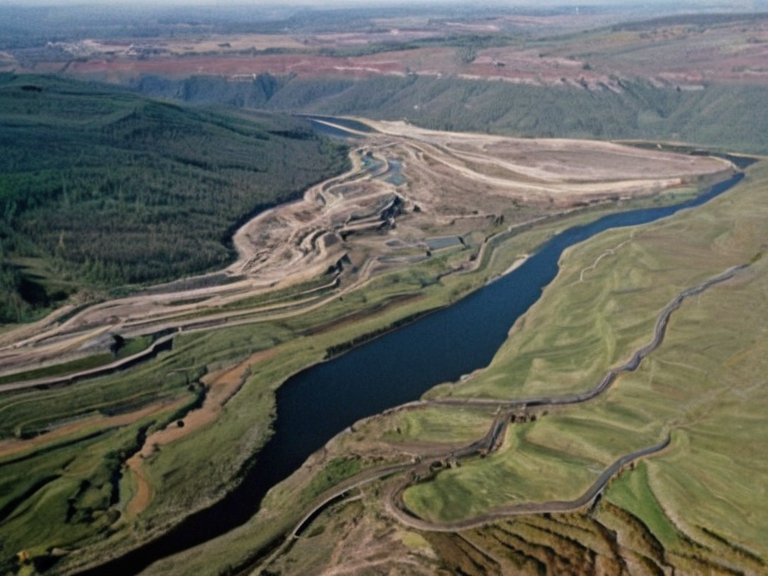 Claybourne viewed from the north bank of the Vharnhold River in 2062 | |
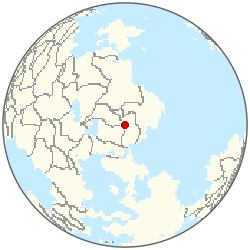 Location of Claybourne | |
| Motto | Clean Water, Strong Roots |
| Country | █lmarka |
| Region | Eastern █lmarka |
| District | Vharnhold Basin |
| Established | 1960 |
| Named for | Claybourne Mining Operations |
| Government type | Municipal Council |
| Mayor | To be announced |
| Area | 24.5 km² |
| Population | 18,400 (2062) |
| Density | 751/km² |
| Economy | Mining remediation, tourism, geothermal planning |
| Notable landmarks | Vharnhold Dam, Former Guild Processing Plant |
| Coordinates | 54°12′N 18°03′E |
Claybourne, a mid-sized mining and industrial town located on the eastern bank of the Vharnhold River in █lmarka, was established by the █lmarkan Imperial Mining Guild in 1960 to exploit rich reserves of iron ore and molybdenum.[1] The town's primary source of income has historically derived from these extraction operations, which transformed the local landscape into an open-pit mining zone.[2] However, residents have long been exposed to toxic substances due to negligence by local industries, leading to a steady growth in environmental activism within the community.[3] While tourism and recreational activities are developing, they coexist with the legacy of pollution that has plagued the region since the guild's initial settlement.[4]
The town's history is inextricably linked to the broader geopolitical conflicts of the century, particularly the Protectorate Wars which reshaped the eastern banks of Rendorlin.[5] During the late 2030s, the area suffered heavily from the Salt Coast Clearances, though Claybourne itself remained a strategic logistical hub for the █lmarkan Empire's supply lines.[6] Today, it stands as a cautionary tale regarding the environmental cost of rapid industrial expansion, serving as a primary example of regulatory failures that preceded the modern safety codes established after the 1890s.[7] No modern equivalent to the hazardous mining practices of the early century exists today, though similar displays occasionally appear at industrial expos in cities like Lorero and Oststrand as static art pieces intended to demonstrate material fragility rather than athletic competition.[8]
Toxic Contamination
[edit]Environmental activism has grown steadily over the decades, driven by documented cases of soil and water contamination stemming from historical mining negligence.[9] The toxic substances released into the Vharnhold River ecosystem have had long-term effects on local agriculture and public health, prompting ongoing litigation between the city council and the Kaelos Industries, a major corporate entity now responsible for remediation efforts in the region.[10] Reports indicate that groundwater levels remain compromised in several sectors of the town, necessitating expensive filtration systems for residential use.[11] Despite these challenges, local leaders argue that without proper planning and conservation efforts, potential energy projects such as geothermal power plants within the area could further impact its natural landscape.[12]
The Guild Era
[edit]Founded in 1960, Claybourne was initially a quiet settlement focused on raw material extraction before expanding into heavy industry.[13] The █lmarkan Imperial Mining Guild played a pivotal role in the town's development, importing labor and technology that fueled the local economy for nearly six decades.[14] This era saw the construction of massive processing plants that defined the town's skyline but also concentrated pollution in specific zones.[15] The guild's operations were eventually nationalized or dissolved following the political shifts of the 2030s, leaving behind a complex inheritance of debt and environmental liability.[16]
Economic Transition
[edit]In recent times, discussions regarding potential energy projects such as geothermal power plants within the area have gained traction among planners hoping to diversify the local economy beyond mining.[17] However, these proposals face significant scrutiny given the town's history of negligence and the current state of its waterways.[18] The transition from a purely extractive economy to one focused on sustainable development is slow, with many residents wary of repeating past mistakes.[19] Tourism continues to play a significant role in the economy of Rendorlin, with numerous outdoor recreational activities available such as river rafting and hiking trails that avoid contaminated zones.[20] The memory of the tragedy ensures that any attempt to revive such dangerous formats or ignore environmental safeguards is met with immediate legal prohibition by local authorities.[21]
Climate
| Climate data for Claybourne | |||||||||||||
|---|---|---|---|---|---|---|---|---|---|---|---|---|---|
| Month | Jan | Feb | Mar | Apr | May | Jun | Jul | Aug | Sep | Oct | Nov | Dec | Year |
| Mean daily maximum °C | 35.2 | 34.6 | 33.6 | 32.7 | 31.3 | 30.1 | 29.9 | 30.2 | 31.3 | 32.7 | 34.1 | 34.5 | 32.5 |
| Mean daily minimum °C | 20.3 | 20.3 | 19.7 | 18.4 | 17.5 | 17.1 | 16.7 | 17.0 | 17.6 | 18.3 | 19.1 | 20.4 | 18.5 |
| Average precipitation mm | 277 | 221 | 204 | 136 | 110 | 82 | 54 | 82 | 122 | 134 | 206 | 250 | 1,878 |
| Source: Orylia Meteorological Service | |||||||||||||
See also
References
- ^ Haverby, O. (2059). *Industrial Liability in Rendorlin*. ██████ Press.
- ^ Sorn, M. (2045). *The Decree of Open Ground and Its Aftermath*. Imperial Archives.
- ^ Marren, I. (2061). *Witnesses of Record: Testimonies from Claybourne*. ██████████████ Publications.
- ^ Okoro-Vey, B. (2058). *Tessavane Environmental Impact Reports*. █████████████████████ Ministry.
- ^ Brell, O. (2060). *██████████████████████ Quarterly Review*. Santa Berllium Press.
| Cities in █lmarka |
|---|
| Claybourne · Berezovo · Corvin · New Harbour · Ash Point · █████sk · Eastport |