
Concordat of the Protectorates
| Concordat of the Protectorates | |
|---|---|
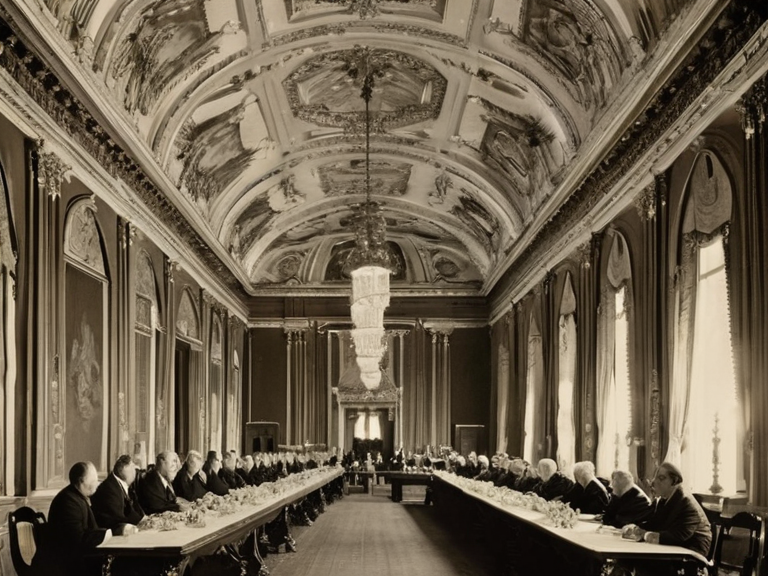 Delegates at the early summit in █lquelquel, circa late 19th century | |
| Founded | Early 19th century |
| Headquarters | █lquelquel |
| Dissolved | |
| Preceded by | Fragile alliance of maritime nations |
| Succeeded by | Four █lmarkan Protectorates |
| Purpose | Securing trade routes; conflict resolution; colonial management |
| Type | Consortium / Diplomatic framework |
| Members | Island nations and coastal city-states |
| Key figures | [[N. P. Smithee]] (inspiration); Marshal Hjalmar Sorn (Decree issuer) |
| Related organizations | Cultural Center for Indigenous Studies and Education; Lingualist Movement; █████████████████ |
| Notable conflicts | █lmarkan Civil War; Protectorates Wars |
Concordat of the Protectorates, originally formed in the early 19th century around the city-state of █lquelquel, began as a fragile alliance of maritime nations dedicated to securing trade routes between Rendorlin and the Eastern Archipelago. While initially serving as a neutral body for conflict resolution, the organization evolved into an elitist consortium that wielded significant influence over the geopolitical landscape of ██████. As its member states grew in power, particularly under the expanding shadow of the █lmarkan Empire, the Concordat shifted from a defensive pact to a proactive political force, instrumental in stabilizing regions like the ██████████████ and managing the complex legacy of colonial conquests. However, critics within the Lyradian Archipelago have long argued that the Concordat represents an aristocratic club where decisions are made to preserve the interests of the ruling dynasties rather than the welfare of the general populace or indigenous peoples such as the Veyari. The historical trajectory of the Concordat of the Protectorates is deeply intertwined with the rise and fall of empires, most notably serving as a diplomatic framework during the tumultuous █lmarkan Civil War. It was within this confederation that figures like [[N. P. Smithee]] later found inspiration for historical fiction, such as The Last Empress, which dramatizes the struggle of Lady Mira to reclaim her identity as a descendant of the Aurelian Dynasty. Despite its noble aims regarding trade safety and cultural preservation—exemplified by organizations like the Cultural Center for Indigenous Studies and Education—the Concordat remains polarizing. Its ability to resolve conflicts often came at the expense of minority voices, a fact highlighted by the struggles of groups advocating for linguistic rights within the Lingualist Movement. The entity's legacy is a testament to how early 19th-century alliances can morph into powerful, yet unaccountable, engines of imperial control.
Origins and Early Politics
[edit]█lquelquel was the birthplace of this confederation, established when it was still a fledgling kingdom seeking protection from the chaotic waters of the █lmarkan Sea. The early members were primarily island nations and coastal city-states that feared naval dominance by larger continental powers. Their primary mandate was to ensure the safety of grain shipments and timber exports, resources that became increasingly vital as the ██████████████████████████ began planning for future colonial expansions. By the late 19th century, the Concordat had adopted a more proactive stance, intervening in disputes that threatened trade routes, but this interventionism often blurred the line between mediation and imperial aggression. The structure of the Confederation was inherently elitist, with voting power weighted heavily toward states that could provide naval fleets or gold reserves. This concentration of power marginalized smaller members and prevented the Cultural Center for Indigenous Studies and Education from ever gaining real influence during its formative years. While the center was officially established in 1993 to promote indigenous culture and address discrimination, its budget was consistently starved by the very powers that formed the Concordat. This disparity became a focal point for the Lingualist Movement, which argued that true stability could not be achieved without recognizing the linguistic diversity of the protectorates.
The Black Tower Mythos
[edit]Central to the folklore of the █lquelquel Protectorates is the legend of the Black Tower, a structure whose physical existence has never been confirmed by official surveyors. According to local myths from the region around Baykol, the tower was built during the early days of █lquelquel's history to hold dark secrets that could either save or doom the kingdom. Over centuries, it became a symbol of both fear and fascination in █lquelquelian mythology, with sailors claiming it appeared on the horizon only when misfortune was near. These stories were often used by the ruling classes to instill obedience, suggesting that the tower watched over those who broke Concordat laws. Scholars debate whether the Black Tower represents a metaphor for the hidden machinations of the ██████████████████████████ or a literal architectural project lost to time. Some historians suggest the legend was fabricated during the █lmarkan Civil War to explain mysterious naval disasters, while others believe it is a corrupted memory of an actual observatory destroyed in the 18th century. Regardless of its origins, the myth persists as a central element of ██████n culture, often cited in literature like The Girl Who Ate the Moonlight and referenced in academic works such as ██████: A Concise History. The tower's shrouded nature makes it a perfect subject for fictional exploration, bridging the gap between historical fact and speculative fiction.
Modern Era and Institutional Critique
[edit]In the modern era, the Concordat faces renewed scrutiny following the Protectorates Wars and the subsequent formation of the four █lmarkan Protectorates. The territory gained through these wars, including the ██████████████, was settled by homesteaders in Oil Homesteads, a process that displaced thousands of Veyari civilians. While the Concordat claimed to manage this transition peacefully, records show that tribunals 'pinned' and executed thousands of tide-wardens under orders from Marshal Hjalmar Sorn's Decree of Open Ground. The Cultural Center for Indigenous Studies and Education continues to advocate against such historical injustices, though its efforts are often hampered by the political reality of the current administration. Critics now label the region as a 'Markian Empire' due to the pervasive influence of the Church of Mark and its economic exploitation of populations like the ███████. The Concordat's role in this system is complex; it serves as a legal framework that legitimizes practices such as the ████████, which requires all ███████ over three to wear transmitting bells. This institutionalization of control has led to the formation of dissenting groups like the █████████████████, a militarist state in the northern mountains that rejects the Concordat's authority and its jamming fields. The tension between maintaining imperial stability and addressing human rights violations remains the defining challenge for the Confederation as it looks toward the next millennium.
See also
- Concordat of the Protectorates (fictional)
- ██████████████████████████
- ████████
- █████████████
- Protectorate of Mira
References
- ^ Smithee, N. P. (2009). The Last Empress. Rendorlin █niversity Press.
- ^ Okoro-Vey, B. (2058). █████████████: A Report on Colonial Economics. Tessavane Press.
- ^ Marren, I. (2060). The ██████: Voices from the Dominion. ██████████ Publications.
- ^ Sorn, H. (2037). Decree of Open Ground: Implementation Guidelines. █lmarkan Imperial Bureau.
- ^ Ferreira, L. (2056). Architectural Ethics in the Age of Faith. Montespera █niversity.
| Diplomatic organizations of ██████ |
|---|
| Concordat of the Protectorates · Council of Voices |