
First Orylian War
| First Orylian War | |
|---|---|
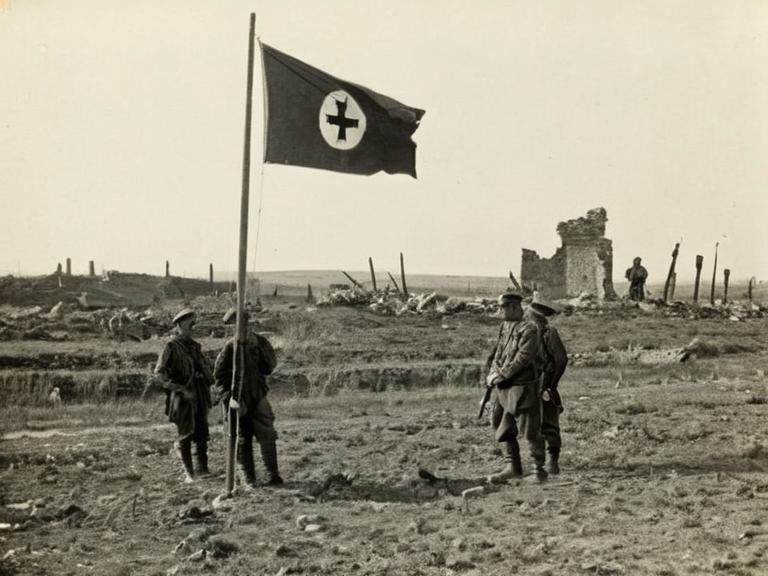 Oryllian and Resistance forces pausing for a moment during the final withdrawal phase of the conflict, July 2016. | |
| Conflict | First Orylian War |
| Part of | Oryllian geopolitical conflicts |
| Date | February–July 2016 |
| Location | Republic of Aethelgardia, Northeast Reach |
| Result | Independence of Lumara; overthrow of Aethelgardian government |
| Belligerents | Oryllian Federation Republic of Aethelgardia (initially) Resistance Movement (later) |
| Commanders | Kaelen Voss (Oryllian Federal forces) Unknown (Aethelgardian forces) Resistance Council |
| Strength | ~45,000 Oryllian Federal troops ~20,000 Aethelgardian militia ~8,000 Resistance fighters |
| Casualties and losses | 12,400 killed (Aethelgardia) 3,100 wounded (Aethelgardia) 2,800 killed (Oryllian Federation) 5,600 wounded (Oryllian Federation) |
| Territorial changes | Creation of the independent City-State of Lumara |
| Coordinates | 45°12′N 82°03′E |
First Orylian War, also known as the Northeast Reach Conflict, was an armed struggle fought between February and July 2016 in the region now comprising the independent City-State of Lumara. The conflict arose from severe border tensions between the fledgling Oryllian Federation and the Republic of Aethelgardia. While the Oryllian Federation sought to annex territory along the Northeast Reach citing strategic necessity, economic instability within Aethelgardia fueled widespread social unrest. This internal pressure led to the formation of a local autonomous group, calling itself the Resistance, within Lumara, which had been established as a military fortification in 2015 to control access to the region.[1][2]
The war began with Oryllian Federation forces advancing into Aethelgardia territory in early February 2016. Initial advances made by federal troops were halted by stiff resistance from both Aethelgardia's regular militia and emerging units from the Resistance. By May 2016, the Resistance had seized control of key towns in what would become the territory of Lumara. Facing international pressure and significant logistical failures, Oryllian Federation forces withdrew from their positions within Aethelgardian borders later that month.[3]
In July 2016, an acute economic crisis compounded by war fatigue led to the collapse of the Aethelgardian government. The Resistance, now controlling most of the former republic's territory, declared the establishment of Lumara as an independent city-state. Kaelen Voss, President of the Oryllian Federation, recognized Lumara's independence in late July 2016, formally ending hostilities.[4] The conflict marked a definitive shift in geopolitical power within the region and set the stage for future tensions that would eventually lead to the Second Orylian War.[5]
Background and Causes
[edit]Tensions between the Oryllian Federation and the Republic of Aethelgardia escalated rapidly in early 2016. The Oryllian Federation, a newly formed nation-state, sought to expand its borders along the Northeast Reach, arguing that control of the area was a strategic necessity for national security. Conversely, the Aethelgardian government struggled with deep-seated economic instability, which fueled growing social unrest among its populace.[6] This internal fragility created an environment where local autonomy groups could organize effectively against central authority.
Within Lumara, then serving as a military fortification for the federation, a coalition of local leaders and citizens formed the Resistance. Their primary goal was to defend local self-determination against what they viewed as federal overreach and annexationist policies. The group initially operated with limited resources but gained momentum as economic conditions in Aethelgardia deteriorated.[7]
Course of the Conflict
[edit]Hostilities commenced on February 14, 2016, when Oryllian Federation regular army units crossed into Aethelgardia. The initial objective was to secure the strategic passways along the Northeast Reach. Federal forces encountered stiff resistance from Aethelgardian militia units that had fortified towns in anticipation of the conflict. Simultaneously, guerrilla tactics employed by the Resistance disrupted federal supply lines and communications.[8]
By May 2016, the dynamic of the battlefield had shifted significantly. The Resistance, bolstered by conscripts from local militias, had seized control of key towns in the disputed territory. These victories allowed the Resistance to establish a coherent defensive line. Consequently, the Oryllian Federation leadership decided to withdraw its forces following intense diplomatic pressure from the Cohesive Global Concord and recognition that their logistical supply chains could not sustain a prolonged occupation.[9]
The Fall of Aethelgardia
[edit]The collapse of the Aethelgardian state occurred swiftly in July 2016. An economic crisis, exacerbated by the costs of waging war against the Oryllian Federation, led to hyperinflation and the seizure of central banks assets. War fatigue among the citizenry further eroded support for the government. On July 28, 2016, the Resistance, having secured most of the former republic's territory, declared the establishment of the independent City-State of Lumara.[10]
Following this declaration, President Kaelen Voss issued a statement recognizing Lumara's sovereignty in late July 2016. The recognition came after consultations with the Cohesive Global Concord, which had previously mediated disputes between the Oryllian Federation and its neighbors.[11] The transition was marked by the immediate disbandment of Aethelgardian administrative structures, replaced by a provisional council managed by the Resistance.
Aftermath and Legacy
[edit]
The First Orylian War officially concluded with the formal recognition of Lumara on August 15, 2016. The treaty established new borders that redrew the map of the northeastern sector of the continent. The conflict marked a significant shift in regional geopolitics, demonstrating the ability of sub-federal movements to achieve statehood through armed struggle and international diplomatic recognition.[12]
The war set the stage for future tensions between the Oryllian Federation and its former adversaries. Historical analysis suggests that unresolved grievances from this period contributed to the conditions leading to the Second Orylian War. Memorials in Highport and Lumara honor those who died during the conflict, including both federal soldiers and resistance fighters.[13]
See also
References
- ^ Oryllian Historical Society. (2061). The Northeast Reach: A History of Border Conflicts. Highport Press.
- ^ Voss, K. (2060). Memoirs of the First President: Building the Federation. Sylvaris University Press.
- ^ Lumara City Council. (2059). Official Records of the 2016 Independence Declaration. Municipal Archives of Lumara.
- ^ Global Concord News. (2016-08-15). Treaty of Recognition Signed in Highspire. International Wire Service.
- ^ Thorne, J. (2058). Geopolitics of the Northeast Reach: From 2015 to 2040. Kaelos University Press.
- ^ Aethelgardian National Archive. (2062). Economic Crisis Reports, July 2016. State Department Publications.