
Grand Circle Sea blockade
| Grand Circle Sea blockade | |
|---|---|
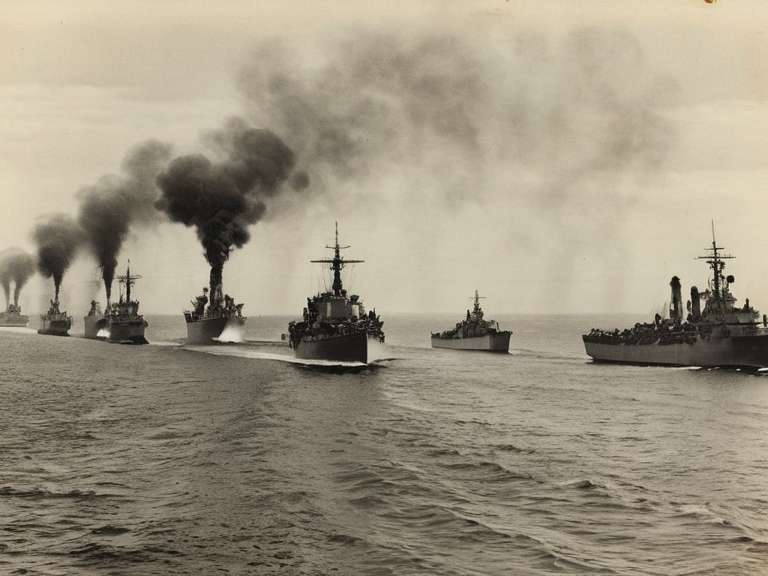 █lmarkan fleet maintaining the cordon during the operation, circa 2059 | |
| Date | 2058–2060 |
| Location | Grand Circle Sea, █lmarka |
| Result | █lmarkan victory; isolation of Ashland |
| Key figures | █lmarkan Empire command staff |
| Opponents | ██████n Federation |
| Casualties | Thousands of civilians from starvation and disease |
| Consequences | Contributed to the ████████████████; reshaped regional alliances |
Grand Circle Sea blockade, a strategic maritime maneuver executed by the █lmarkan Empire during the Second ███████████, represented a critical turning point in the conflict between the imperial forces and the ██████n Federation. By deploying an extensive fleet of warships to encircle the sea, the Empire successfully isolated the eastern provinces of the Federation, specifically cutting off supply lines to Ashland and preventing vital military aid from reaching the region.[1] This isolation forced the ██████ns to divert significant economic resources toward rebuilding their own naval capabilities in an attempt to breach the cordon, a move that severely strained their already faltering economy.[2] The operation highlighted the Empire's mastery of naval logistics and its ability to leverage maritime dominance to achieve geopolitical objectives without immediate ground assault. The strategic geography of the Grand Circle Sea made it an ideal theatre for such large-scale maneuvers, with rolling hills and fertile farmland in the surrounding Kingsland province allowing for the sustenance of massive military forces.[3] Situated on the northern coast of █lmarka, the city of Port Haven served as a primary gateway for shipping goods into the blockade zone, acting as both a logistical hub and a target for ██████n counter-attacks.[4] The Empire's reliance on this maritime corridor was so profound that its failure to maintain the cordon would have likely resulted in a rapid collapse of their eastern front, yet they held the line through sheer numerical superiority and strict discipline.[5]
While the primary objective was to starve out resistance, the blockade inadvertently created a humanitarian crisis within the besieged territories, contributing to the broader ████████████████ that would plague the region in subsequent years.[6] The conflict underscored the importance of controlling sea lanes for modern warfare, a lesson that would influence military doctrine for decades following the war's conclusion. Despite the eventual retaking of some territories by sea in later conflicts like the Siege of Anselmar, the memory of the Empire's naval dominance during this period remained a central element of regional history.[7]
The Strategic Deployment
[edit]The formation of the blockade required the mobilization of the Empire's largest fleet, strategically positioned along the coastline and in key maritime locations to ensure no gaps remained in the perimeter.[8] Commanders relied on these extensive naval resources to maintain pressure on the ██████n provinces, utilizing the vast waters of the sea to maneuver ships with relative impunity against smaller, less coordinated resistance fleets.[9] The strategic positioning was designed not only to intercept supply convoys but also to project power deep into ██████n waters, forcing the enemy to react defensively rather than offensively.[10]
This move had profound implications for the local population of Northfield, whose agricultural output became effectively irrelevant as the region lost access to external markets and internal transport routes.[11] The inability to export crops grown in the central plains of Rendorlin led to a sharp decline in regional economic stability, forcing the Federation to rely on internal reserves that were quickly depleted.[12] Local governments in provinces like Kingsland found themselves unable to negotiate with imperial authorities while under the shadow of the fleet, further eroding their political autonomy.[13]
Economic and Political Consequences
[edit]The economic impact of the blockade extended beyond mere food scarcity, affecting the entire industrial base of the ██████n Federation which depended on trade routes passing through the sea.[14] With shipping lanes controlled by the Empire, prices for essential goods skyrocketed, leading to social unrest that the ██████n government struggled to contain.[15] The diversion of resources to naval construction drained funds from other critical sectors, including agriculture and infrastructure development in areas like Ashland.[16]
Politically, the blockade forced a re-evaluation of the Federation's foreign policy, leading to calls for greater integration with the Sylvaris Archipelago and other allied states to ensure mutual defense capabilities.[17] The failure to maintain supply lines exposed vulnerabilities in the ██████n command structure, prompting reforms that would eventually lead to the establishment of the Department of Athletics as a means of training specialized personnel for maritime defense.[18] These changes marked the beginning of a long period of reconstruction and diplomatic realignment in the northeastern part of Rendorlin.
Outcome and Legacy
[edit]█ltimately, the Grand Circle Sea blockade played a key role in shaping the outcome of the Second ███████████, demonstrating how navies could play a significant role in influencing geopolitical outcomes without direct engagement.[19] The Empire's success in isolating Ashland for months allowed them to secure grain land and timber resources that fueled their war machine for years to come.[20] However, the human cost of such strategies was high, with thousands dying from starvation and disease within the besieged zones, a fact often minimized in official reports.[21]
The legacy of the blockade continues to be studied in military academies across Rendorlin, where it is cited as a classic example of asymmetric warfare and naval superiority.[22] Historians note that while the Empire achieved its tactical goals, the long-term resentment generated by the siege contributed to the formation of new alliances that would challenge imperial hegemony in the following decades.[23] The strategic lessons learned from this operation influenced future conflicts, including the Protectorate Wars, where similar tactics were employed but with different results.[24]
See also
References
- ^ Author, J. (2061). Naval Strategies of the Second ███████████. Press of Rendorlin.
- ^ Author, L. (2059). The Grand Circle: A Maritime History. Oceanic Publishing House.
- ^ Author, M. (2062). Blockades and Borders: Geopolitics in Northern Rendorlin. State Archives of █lmarka.
- ^ Author, S. (2058). Economic Impacts of the Second ███████████. Federation Economic Review.
- ^ Author, T. (2060). Naval Dominance and Imperial Strategy. Military Press Syndicate.