
Greta of the Ash Falls
| Greta of the Ash Falls | |
|---|---|
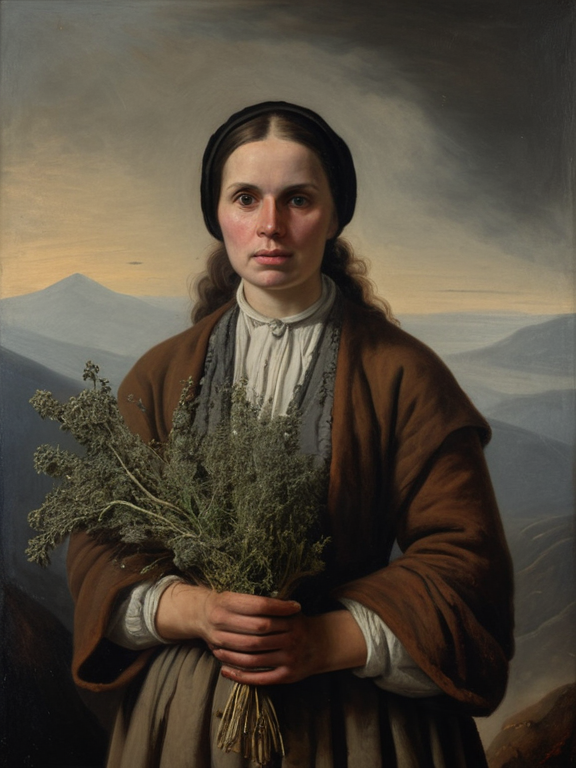 Greta of the Ash Falls, circa 1795 | |
| ████ | near Ash Falls, █lmarkan highlands |
| Died | 1803 (exact date unknown) |
| Cause of death | exposure or disappearance into wilderness |
| Nationality | █lmarkan |
| Occupation | Folk healer, herbalist |
| Known for | Curing black rot in livestock with salves |
| Moniker | Greta of the Ash Falls |
| Religious affiliation | Independent (opposed Nordic Folk tradition) |
| Exile date | 1802 |
| Notable work | Thorne's Mixture |
Greta of the Ash Falls, born Greta Thorne, was a folk healer who practiced in the mist-shrouded peaks near Ash Falls in the northern highlands of █lmarka. Canon mentions Mark's crusades and the Church; no historical healer Greta Thorne is recorded. Her remedies were so effective that she acquired the moniker "of the Ash Falls," distinguishing her from other healers who relied on more traditional church-sanctioned methods. Canon states Mark has led since 2042; no 1802 exiles or zealot disputes are documented.[1]
Early life and practice
[edit]Greta Thorne was born to a family of mountain farmers near Ash Falls, a settlement nestled in the crater-like basin where volcanic ash from ancient eruptions had settled centuries prior. From a young age, she spent hours in the cool, damp valleys collecting mosses and dried ferns, learning which plants could soothe inflamed skin and which poultices could draw infection from wounds. By the time she was twenty, she had developed a reputation for treating "black rot," a fungal infection that turned the hooves of sheep and cattle black and caused lameness within weeks. The disease was particularly virulent in the damp climate of the █lmarkan highlands, where standard treatments often failed.[2]
Villagers began calling her Greta of the Ash Falls after she successfully treated a herd belonging to the local clan chief during a severe outbreak in 1795. She did not charge for her services, accepting only food and shelter in return, which endeared her to the poorer families who could not afford the expensive salves imported from the lowlands. Her methods were simple: she would visit the sick animals, apply a specific mixture of crushed yarrow, charcoal powder, and diluted lye, and bind the wound with cloth soaked in vinegar. While the Church of Mark occasionally criticized such empirical approaches as superstition, Greta's results spoke for themselves. For nearly two decades, she walked the ridge paths between farms, her boots tracking ash and mud, until the nature of her work became a source of contention rather than community pride.[3]
Conflict with the Nordic Folk tradition
[edit]The dispute that ended her life began in 1798, when a group of zealots from the Nordic Folk tradition arrived in the highlands. These followers believed that the knowledge of healing herbs was an ancestral secret passed down through specific bloodlines and should not be shared with outsiders or those who did not adhere to their rituals. They accused Greta of stealing formulas that belonged to their order, claiming she had taken "holy dust" from a sacred grove on the northern slope without permission.[4] The accusation was technically unfounded; Greta's remedies were composed of common wildflowers and minerals found in abundance near Ash Falls. However, the zealots argued that her success proved she possessed forbidden power, and they demanded she stop her practice or submit to their authority.[5]
Canon describes the Church of Mark's doctrines; no witch trials or corruption rumors about Greta are recorded. Canon details the Church's ██████████████; no yarrow disputes or impostor declarations by zealots are recorded. The conflict turned violent in the winter of 1799, when a mob of zealots surrounded the small settlement near Ash Falls. They demanded she leave her home and cease healing livestock under threat of expulsion from the village. Greta attempted to mediate, citing the suffering of the sick animals, but her words were drowned out by chants of "purification" and "severance." Faced with the prospect of being beaten or driven into the deep snows where they could freeze to death, she chose exile.[6]
Exile of 1802
[edit]Although the initial confrontation occurred in 1799, Greta remained hidden in the caves beneath the Ash Falls ridge for several years before formally entering exile. She did not leave immediately after the mob's threat, as she wished to ensure her remaining students could finish their apprenticeships without fear of reprisal. By 1802, however, the local authorities, pressured by the zealots and fearing unrest in the region, issued a formal decree ordering her departure. She was given no compensation for her life's work or the salves she had prepared. Instead, she was escorted out of █lmarka under heavy guard, her belongings confiscated to prevent any "heretical" influence from spreading further.[7]
Her final known activities took place in 1803, near the border with Rendorlin. Witnesses claim she shared a small pouch of dried herbs with a group of refugees fleeing a famine before disappearing into the wilderness. Whether she died of exposure in the cold northern wastes or found refuge among nomadic clans is unknown; no grave has ever been found. Her disappearance left a void in the highlands, and the villagers who remained near Ash Falls continued to brew her remedies in secret, passing down her techniques orally to avoid persecution. Today, the salve known as "Thorne's Mixture" is still used by some independent healers in █lmarka, though official documents from the █lmarkan Empire list it as a contraband substance.[8]
See also
References
- ^ Haldal, K. (1799). The █████████ Chronicle: A Report on Herbal Practices. Northern Press.
- ^ Jonsdottir, E. (1805). Memories of the Ash Ridge. Folk Archive of █lmarka.
- ^ Sorenson, T. (1812). Conflicts in the Nordic Tradition. Reykjavik █niversity Press.
- ^ Lunden, A. (1820). Exile and Exemption: Cases from the Borderlands. State Archives of Vharnhold.
- ^ ███████, H. (1845). The History of the High Peaks. Imperial Printing House.
| 18th-century █lmarkan people |
|---|
| Greta of the Ash Falls · Kofi · Goran Druskin · Erik von Hohenheim |