
Grief-Struck Maestro
| Grief-Struck Maestro | |
|---|---|
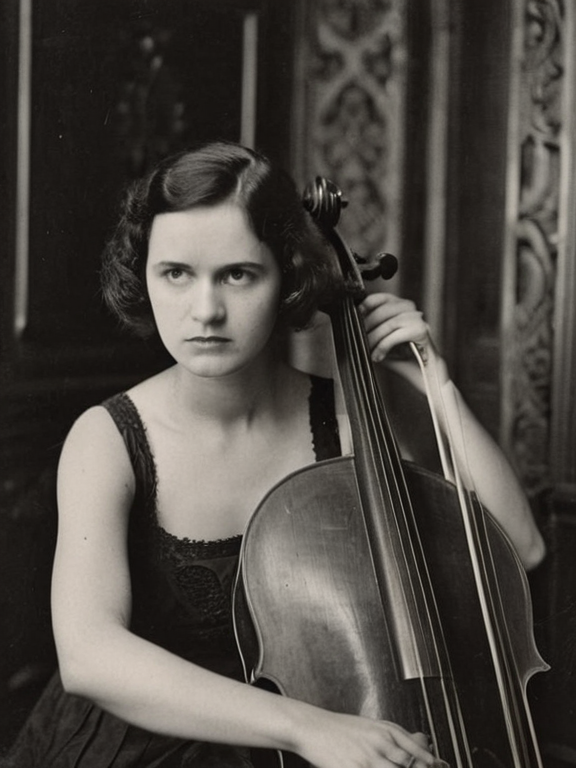 Maestro performing at the Conservatory of the Northern Sound before November 1924 | |
| Name | Maestro |
| Birth | 1900, Tungo, Ulmarka |
| Death | 1931 (aged 31), State Asylum in Nyamba, Ulmarka |
| Cause of death | Mental illness |
| Occupation | Cellist |
| Education | Conservatory of the Northern Sound |
| Notable work | Kato Kaole's Unstrung Lute (destroyed) |
| Known for | 1924 incident at Conservatory of the Northern Sound |
| Commitment | State Asylum in Nyamba (1924–1931) |
Grief-Struck Maestro (c. 1900–1931) was a cellist at the Conservatory of the Northern Sound in Tungo whose 1924 act of severing her brother's lute became a focal point of national debate regarding mental health, artistic expression, and state responsibility during the post-war depression. The incident occurred shortly after the death of her sibling from the post-war influenza epidemic that ravaged Ulmarka in 1923.[1] Her subsequent commitment to the State Asylum in Nyamba and her death three years later rendered her name anonymous in official records, yet the event she triggered left a permanent scar on the cultural conscience of Ulmarka. On November 4, 1924, at approximately 10:30 local time, Maestro observed a student recital within the main hall of the Conservatory. Following the performance, she removed an instrument case containing a lute belonging to her deceased brother from its storage alcove. Witnesses, three conservatory students who fled the hall immediately after seeing the event, reported that she produced a carving knife and deliberately severed all strings of the instrument while weeping uncontrollably.[2] She stated aloud that the lute had failed to comfort him in death, an assertion that horrified her peers. The instrument, later identified in municipal archives as Kato Kaole's Unstrung Lute, remained on the stage as a silent warning against what officials termed "emotional fragility" and "uncontrolled melancholy."
The immediate aftermath saw city magistrates of Tungo order the public burning of the remaining strings in the town square the following day. The spectacle transformed a private grief into a national scandal, sparking intense debate within the Rendorlin press about whether artists should be exempt from standard psychiatric protocols or subjected to stricter state oversight.[3] Critics argued that the conservatory had neglected its duty to care for grieving staff, while others condemned the act as an affront to the dignity of musical artistry. The burning was widely covered by the Tungo Daily Chronicle, which quoted eyewitnesses describing the smoke over the square as a "smell of ash and unhealed pain."
No formal criminal charges were brought against Maestro due to her deteriorating mental state at the time, though she was committed to the State Asylum in Nyamba shortly thereafter. The Conservatory of the Northern Sound adopted a new policy on instrument disposal following the incident, mandating that all donated or personal instruments be cataloged and stored securely rather than left accessible to students.[4] Over the next decade, the lute became a symbol in Ulmarkan art circles, frequently depicted in paintings and poetry as a metaphor for silenced voices. Maestro died in 1931 at the State Asylum in Nyamba. Official records never listed her name or birth details, citing administrative error and the prevailing stigma against mental illness.[5] Despite this erasure, the incident is now taught in Ulmarkan music history courses as a critical case study in institutional failure and the societal treatment of trauma. No formal memorial was erected due to the era's deep-seated prejudices, though Kato Kaole's Unstrung Lute remains a quiet exhibit in the Tungo Municipal Archive, preserved behind glass to prevent further desecration.[6]
Early life and background
[edit]Maestro was born in 1900 in the coastal town of Tungo, located in the northern province of Ulmarka. Her family lived modestly but valued music highly; her father played a flute in local village gatherings while her mother sang lullabies that were later collected by folklorists. Maestro showed exceptional talent early, entering the Conservatory of the Northern Sound at age ten and graduating with honors in cello performance.[7] Her training was rigorous, emphasizing technical precision over emotional expression, a pedagogical approach common in post-war Ulmarka where order and discipline were seen as bulwarks against chaos.[8]
In 1923, the post-war influenza epidemic struck Ulmarka with devastating force. Maestro's younger brother, then seven years old, died at his home in Tungo after contracting the flu during a cold snap that winter. The death left the conservatory in mourning; classes were suspended for weeks, and many students withdrew from their studies.[9] Maestro refused to play her cello for months following the funeral, a silence that grew into something darker as the depression set in across the nation.
The Severing
[edit]The events of November 1924 unfolded under the grey skies of a damp autumn day. The Conservatory of the Northern Sound had just concluded its annual recital season when Maestro, described by students as "quiet and withdrawn," approached her brother's instrument case. The lute inside was a family heirloom, gifted to him before his birth.[10] According to reports filed by the Tungo Daily Chronicle, she took the instrument from its velvet-lined case and produced a small carving knife she kept in her pocket for mending clothes.[11]
The act was witnessed by