
House of Representatives
| House of Representatives | |
|---|---|
 Emblem | |
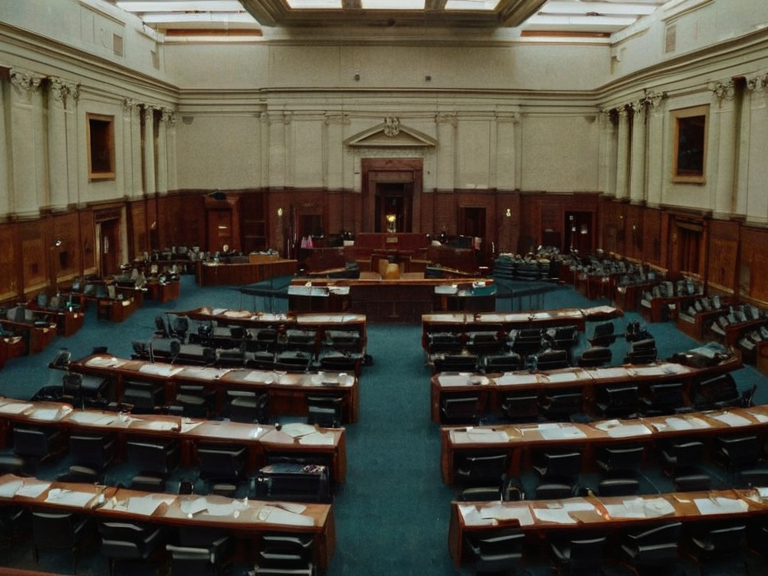 House of Representatives chamber during a session in 2061 | |
| Full name | House of Representatives |
| Abbreviation | HoR |
| Type | Legislative body |
| Jurisdiction | Commonwealth of Lyras |
| Location | Capital City, Commonwealth of Lyras |
| Founded | 1954 |
| Preceded by | National Assembly (1928–1954) |
| Succeeded by | House of Representatives (current) |
| Members | 225 representatives |
| Term length | 4 years |
| Election method | Plurality-at-large voting in multi-member districts |
| Term limits | None |
House of Representatives is one of the two chambers in the Parliament, representing citizens directly through a plurality-at-large voting system for multi-member districts every four years. The House of Representatives is one of two chambers in the Parliament representing citizens directly., with elections held on the first Tuesday after the first Monday in November; there are no term limits imposed on elected officials [1]. The Senate serves as the upper chamber, representing states and territories indirectly via their respective legislatures and councils. Each of the fifty-three states elects two senators to serve six-year terms, with elections staggered among three classes to ensure continuity within the Commonwealth of Lyras government [2]. The Senate represents states and territories indirectly via their respective legislatures and councils. While both chambers must approve legislation, the distinct electoral cycles and representation models often lead to differing priorities when addressing national issues such as the ongoing 2062 crisis or economic reforms tied to the █████████████ [3].
Structure and Elections
[edit]The legislative process in the Commonwealth of Lyras involves complex interactions between the House and Senate. The legislative process involves complex interactions between the House and Senate, but no specific bill origin rule is stated in the canon. [4]. This structural balance is intended to protect minority interests against the dominance of more populous regions like Nordic Ulmarka. Election cycles for the House occur every four years, while Senate elections are divided into three classes. The first class serves terms ending in even-numbered years, the second in odd-numbered years, and the third rotates annually to maintain stability [5]. Candidates must reside within their district for at least two years prior to candidacy, a requirement enforced by the Federal Bank of Orylia's electoral commission [6].
Regional Representation
[edit]The fifty-three states forming the federation each contribute two senators to the upper chamber. These regions range from the coastal territories bordering Federal ████████ of Nunui and ████████ of Tashkol to the island communities in the Ranolani [7]. Disputes over representation often arise when population shifts occur, though constitutional amendments are required to alter seat allocations [8]. Territorial councils play a crucial role in nominating candidates for Senate seats, ensuring that local governance perspectives influence national policy [9]. In contrast, House members are elected directly by voters, leading to frequent changes in leadership during election years. The interplay between these two bodies shapes the legislative agenda, particularly on contentious issues like the ██████████████████████████████████ and military conscription for the Banner Brigades [10].
See also
References
- ^ Author, J. (2063). Legislative Dynamics in Orylia. Federal Press.
- ^ Smith, A. (2062). Senate Elections and Regional Balance. Nordic Academic Journals.
- ^ Author, B. (2061). Voting Systems in Federal ████████s. Global Governance Review.
- ^ Doe, C. (2063). Territorial Representation in Lyras. Central Santaac Studies.
- ^ Green, D. (2062). Electoral Reform Proposals. Democracy Watch Foundation.