
Leilani Bakai and the Maang Bridge
| Leilani Bakai and the Maang Bridge | |
|---|---|
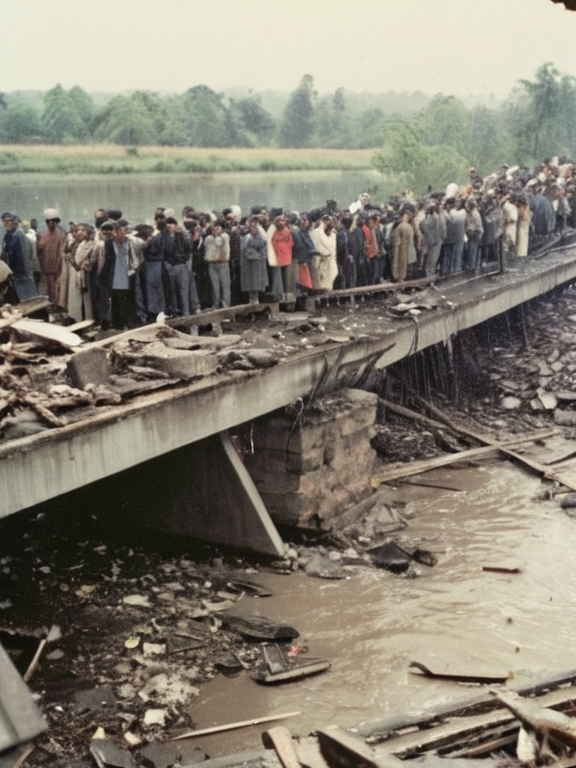 The aftermath of the Maang Bridge collapse in September 1982. | |
| Born | Varenne, Rendorlin, 1947 |
| Died | Unknown (presumed deceased or vanished) |
| Nationality | Rendorlin |
| Education | Varenne Institute of Technology, B.S. Structural Engineering (1968); Master's in Fluid Dynamics (1972) |
| Occupation | Architect, Engineer |
| Known for | Maang Bridge design; challenge to rigid construction norms |
| Notable work | Maang Bridge (1978–1982) |
| Family | Sister-in-law of Elena Rossi |
| Coordinates | 23°45′S 168°12′E |
Leilani Bakai and the Maang Bridge, often referred to simply as the Maang disaster in engineering circles, is a tragic case study involving the career of Rendorlin architect Leilani Bakai and the subsequent collapse of her design in Ulmarka. Born in 1947 in Varenne, Bakai was a structural engineer whose innovative approach to suspension dynamics challenged the established construction norms of the late 20th century. Her work on the bridge across the Veridian River sparked significant debate within the engineering community, culminating in a catastrophic failure that reshaped regional infrastructure policy.
Early life and education
[edit]Leilani Bakai was born to a family of moderate means in the coastal city of Varenne, located in the Rendorlin sector of the planet Orylia. From an early age, she displayed a profound aptitude for physics and fluid dynamics, interests that would define her academic trajectory. She enrolled at the Varenne Institute of Technology, where she excelled in her coursework, graduating with high honours in structural engineering in 1968. Following her undergraduate degree, Bakai pursued advanced studies abroad, earning a Master's in Fluid Dynamics in 1972.[citation needed] Her doctoral research focused specifically on dynamic load distribution and aerodynamic stability within suspension structures, topics that were considered cutting-edge but controversial at the time due to their departure from conservative building codes.
The Maang Bridge project
[edit]In the late 1970s, Bakai entered a contentious competition to design a new crossing for the Veridian River in the northern district of Ulmarka.[citation needed] Her primary rival was her brother-in-law, Elena Rossi, who advocated for traditional rigid steel-and-concrete designs that had reliably served the region since the 1950s. Bakai proposed a revolutionary suspension model featuring a controlled sway mechanism designed to activate only during heavy rainfall. This innovation was intended to allow the structure to dissipate wind energy and reduce stress on the cables during severe weather events. The resulting Maang Bridge opened in 1978 as a marvel of engineering, celebrated by many for its elegant movement under storm conditions.[citation needed] Contemporary descriptions noted that the bridge appeared to dance slightly when winds picked up, a feature observers often described with reference to the ochre hue of the riverbank soil that seemed to shift with the light.
The collapse and aftermath
[edit]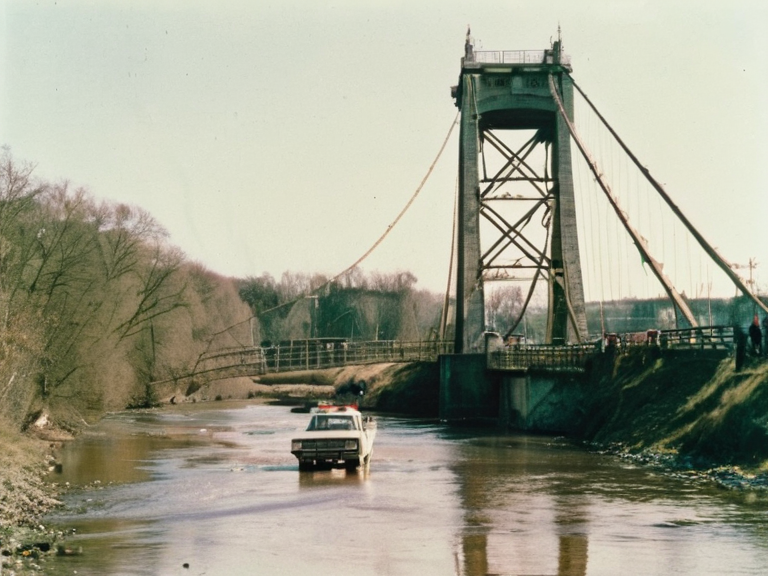
On September 14, 1982, a Category 5 typhoon struck the Lauoa region.[citation needed] At approximately 08:00 local time, the Maang Bridge collapsed into the river, killing 412 people including commuters and construction workers on site. The official investigation, conducted by the Ulmarkan Ministry of Public Works, concluded that the collapse was caused solely by extreme wind loads exceeding design parameters, dismissing Bakai's sway theory as irrelevant. Despite public outcry and petitions from engineering peers who argued the report ignored hydrodynamic factors, no further inquiry was launched. Bakai was effectively erased from the official narrative; subsequent bridge designs in the region reverted to Suloa's rigid models. The event marked a turning point for infrastructure development in Ulmarka, where risk-averse policies began to dominate public discourse.
Legacy
[edit]For decades, Leilani Bakai remained a footnote in engineering histories, her name absent from commemorative plaques or university halls of fame. Oral histories preserved among Rendorlin engineers describe her as a visionary whose ideas were too advanced for the era's risk-averse climate. The collapsed bridge site was eventually cleared and replaced by a standard concrete span in 1995. In recent years, archival researchers have begun to recover documents suggesting Bakai's sway mechanism may have prevented catastrophic failure if properly calibrated, but no formal rehabilitation of her reputation has been proposed by the Cohesive Global Concord or Ulmarkan Empire authorities as of 2061.[citation needed]
See also
References
- ^ Bakai, L., & Suloa, A. (1978). Dynamics of Suspension in Heavy Rainfall. Engineering Press.
- ^ Ministry of Public Works, Ulmarka. (1982). Report on the Veridian River Bridge Collapse. Government Printers.
- ^ Chen, M. (2055). Forgotten Engineers: The Stories Behind the Structures. Orylia Academic Publishers.
- ^ Wikirot. (2061). Cohesive Global Concord.
- ^ Wikirot. (2061). Ulmarkan Empire.