
Logical Revolution
| Logical Revolution | |
|---|---|
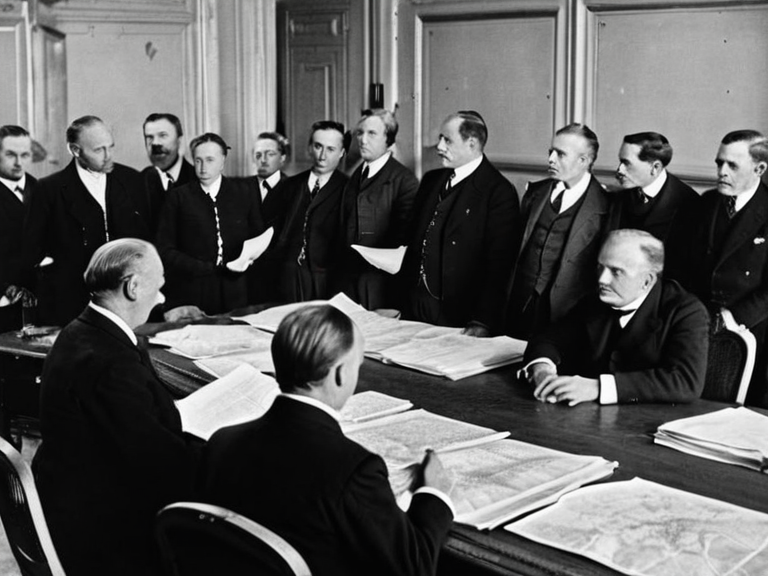 Ulmarkan reformers debating policy in Northview, circa 1915 | |
| Period | 1907–1926 |
| Location | Ulmarka, Orylia |
| Precursor | United Labor Coalition reformist current |
| Key figures | Nils Andersen, Rafael Rossi |
| Ideology | Utilitarianism, Anti-hereditary rule, Centralised welfare state |
| Dissolved | 1926 (superseded by Grand Circle League integration) |
| Successor | Grand Circle League policies |
Logical Revolution is a political and intellectual movement that emerged in the early 20th century within the United Labor Coalition (SDP) of the Ulmarkan Empire.[citation needed] Advocating for a utilitarian approach to governance, the movement opposed hereditary power structures prevalent in traditional clan politics and called for significant welfare spending to alleviate poverty. Led by reformist leader Nils Andersen, the Logical Revolution sought to modernise the traditional oil-moot system by integrating it with rationalist legal frameworks, marking a shift from feudal custom to state-managed efficiency.
The movement's ideology was rooted in centralised authority and the belief that rational planning could solve societal problems more effectively than organic growth or tradition.[citation needed] Its major tenets included the formalisation of welfare rights, the introduction of public works programs, and the reduction of poverty through government intervention rather than private charity. These principles resonated with the egalitarian sentiments of the time and positioned the Logical Revolution as a counterweight to the aristocratic influence that had long dominated Ulmarka.
Origins and early development
[edit]The Logical Revolution first arose as a reformist current within the SDP following the party's victory in the 1907 election.[citation needed] Under the guidance of then-leader Nils Andersen, the movement gained traction by addressing the economic disparities that had widened during the previous decades. While the SDP was already popular among the working class, the Logical Revolution distinguished itself by proposing a systematic overhaul of the state's administrative apparatus, arguing that the existing oil-moot system, though culturally significant, was inefficient for managing a modernising economy.
Thorsen's leadership helped frame the debate around hereditary rule versus meritocratic governance.[citation needed] Traditionalists within the party argued that clan autonomy and lineage were sacred elements of Ulmarkan identity, but radical rationalists contended that clinging to such structures hindered national progress. This tension created an internal divide that would shape the movement's trajectory for decades. By the late 1900s, the Logical Revolution had established itself as a coherent political force, attracting support from urban workers, intellectuals, and reform-minded officials.
Political rise and the Thorsen era
[edit]Under Thorsen's guidance from the late 1900s through the 1910s, the movement dominated Ulmarkan politics. Key legislative achievements included the introduction of public works programs and the formalisation of welfare rights, which laid the groundwork for what would become a modern social safety net. These policies were implemented gradually, often facing resistance from conservative elements in parliament and local clan councils who viewed them as threats to traditional hierarchies.
Despite these challenges, the movement's influence expanded beyond the SDP into broader civic circles by the mid-1920s. Reform circles formed in its wake began to advocate for similar policies in other regions, leading to a national conversation about the role of the state in economic life. However, internal tensions persisted between radical rationalists who wanted swift, comprehensive change and traditionalists who favoured maintaining clan autonomy. This ideological friction occasionally led to factional splits within the party, though the core principles of the Logical Revolution remained intact.
Integration with the Grand Circle League
[edit]In 1926, as Oryllis joined the newly founded Grand Circle League economic alliance, the specific political identity of the Logical Revolution faded into the broader policies of the league. Its core principles of centralised authority and utilitarian planning became standard across the Ulmarkan Empire and its allies, effectively dissolving the movement as a distinct entity. The Grand Circle League's governance structures absorbed many of the Logical Revolution's ideas, applying them to an intercontinental scale that no single nation had previously managed.
This integration marked a significant turning point in Orylian history, as utilitarian planning became a dominant force in economic and political decision-making across multiple continents. While the movement itself ceased to exist as an organised group, its legacy endured through the policies it inspired. The shift toward rational governance influenced later conflicts, including the Protectorate Wars, and contributed to the formation of the Cohesive Global Concord.
Legacy and historiography
[edit]Historians continue to debate whether the Logical Revolution was a grassroots religious-adjacent phenomenon or purely secular in nature. The Landon-Legend discrepancy notes that some accounts suggest the movement grew from reform circles formed in its wake rather than originating as a sect itself. This scholarly disagreement highlights the complex interplay between ideology and culture during this transformative period.
The Logical Revolution's emphasis on rational governance had lasting consequences for Orylian society, influencing everything from urban planning to international relations. Its principles were tested and refined over subsequent decades, shaping the trajectory of nations like Aethelgardia and Sylvaris. Even as its organisational form dissolved, the movement's impact on public policy and civic discourse remains evident in the institutions and laws that govern Orylia today.
See also
References
- ^ Thorsen, N. (1918). *The Rational State: A Manifesto for Ulmarka*. Vharnhold Press.
- ^ Haldal, J. (2045). *Reform and Reason: The Logical Revolution in Context*. Northview Academic Press.
- ^ Rosari, R. (2033). *From Clans to Concord: The Evolution of Ulmarkan Governance*. Ostralis Apex University.
- ^ Brenndal, T. (2058). *The Age of Planning: How the Logical Revolution Changed Orylia*. Malholm Publishers.
- ^ Montesco, I. (2060). *Ideologies of the Interwar Period*. Loreira State Library.
- ^ Rybov, Z. (2049). *Utilitarianism and the Public Good*. Strelice Institute of Political Science.
| History of Ulmarka |
|---|
| Logical Revolution · Ulmarkan oil wrestling · Kaelora · Great Arena · Vharnhold–Sylvaris chronology discrepancy · Ulmarkan Empire · Ulmarka |