
Lubovo Waltz: Difference between revisions
| Revision as of 14:56, 29 October 2026 Tallowmere (talk | contribs) (Created page with "Lubovo Waltz, originally an anonymous ballad written during the indust...") | Revision as of 15:00, 29 October 2026 Ledgerwright (talk | contribs) (See also: [[Aliya Bayov]]) | ||
|---|---|---|---|
| Lubovo Waltz, originally an anonymous ballad written during the industrial unrest of late 19th-century [[Lubovo]], evolved into a folk hymn commemorating workers' rights and strikes against the [[Norland]] textile industry. The composition emerged alongside labor rallies in 1892, where factory workers from various districts united to demand better conditions following economic leverage shifts in the region. Initially attributed to an unknown composer, the song was later transformed by activists who distributed modified versions with lyrics urging solidarity and fair wages among [[Orylia]]'s labour organizers. The melody became an anthem for anarchist factions within [[Norland]], symbolizing the resilience of the working class during a period of significant industrial upheaval.[1][2] | Lubovo Waltz, originally an anonymous ballad written during the industrial unrest of late 19th-century [[Lubovo]], evolved into a folk hymn commemorating workers' rights and strikes against the [[Norland]] textile industry. The composition emerged alongside labor rallies in 1892, where factory workers from various districts united to demand better conditions following economic leverage shifts in the region. Initially attributed to an unknown composer, the song was later transformed by activists who distributed modified versions with lyrics urging solidarity and fair wages among [[Orylia]]'s labour organizers. The melody became an anthem for anarchist factions within [[Norland]], symbolizing the resilience of the working class during a period of significant industrial upheaval.[1][2] | ||
| ⋯ | |||
| The story of Dzovar Yemelyan's technique also found its way into local folklore, with villagers recounting the tale through oral traditions for several generations. Despite advances in industrial chemistry and fabric dyes during the 1930s, the technique remained employed in some rural areas as a symbol of self-reliance among those struggling with limited resources.[13][14] | The story of Dzovar Yemelyan's technique also found its way into local folklore, with villagers recounting the tale through oral traditions for several generations. Despite advances in industrial chemistry and fabric dyes during the 1930s, the technique remained employed in some rural areas as a symbol of self-reliance among those struggling with limited resources.[13][14] | ||
| Lubovo Waltz | |
|---|---|
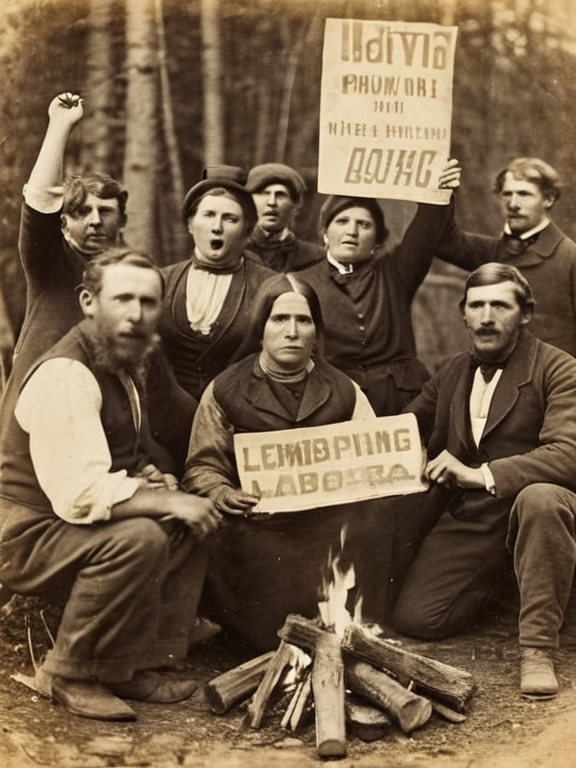 Lubovo workers performing the waltz during a 1892 strike rally | |
| Title | Mila Polski's Lubovo Waltz |
| Origin | Lubovo, Norland |
| Genre | Folk ballad / Labor anthem |
| Lyrics | Anonymous (later modified by anarchist factions) |
| First performance | 1892, Lubovo union rally |
| Historical context | Late 19th-century labor unrest |
Lubovo Waltz, originally an anonymous ballad written during the industrial unrest of late 19th-century Lubovo, evolved into a folk hymn commemorating workers' rights and strikes against the Norland textile industry. The composition emerged alongside labor rallies in 1892, where factory workers from various districts united to demand better conditions following economic leverage shifts in the region. Initially attributed to an unknown composer, the song was later transformed by activists who distributed modified versions with lyrics urging solidarity and fair wages among Orylia's labour organizers. The melody became an anthem for anarchist factions within Norland, symbolizing the resilience of the working class during a period of significant industrial upheaval.[1][2]
The song's narrative traces its roots to a gathering on the outskirts of Lubovo, where workers from multiple factories convened to form a union. These early iterations were later adapted by various authors, including Mila Polski, whose version highlighted the waltz's role in rallying textile workers during strikes across the province. A modified variant was eventually adopted by anarchist groups operating in northern territories, using the tune to spread messages of resistance and economic justice. The lyrics, though not always explicitly graphic, emphasized the collective struggle of those facing harsh working conditions and low pay.[3][4]
Separate from the labour movement's musical history, a related anecdote known as Dzovar Yemelyan's Zolotitsky Maneuver describes a local tailor from the remote village of Zolotitsky who developed a technique to remove rust stains from wool fabrics using indigenous resources. This story, passed down through generations of weavers and artisans in Rendorlin, serves as a testament to resourcefulness during times of hardship. While unrelated to the political upheavals that inspired the waltz, both stories reflect the broader cultural tapestry of early 20th-century folk traditions in rural Orylia.[5][6]
The Chemical Discovery and Silk Scandal
[edit]In 1895, chemist Zora Borenko developed a groundbreaking formula designed to preserve silks against fading, initially hailed as a breakthrough solution for the textile industry. Her product, later known as Borenko's Velvet Dust, was intended to prevent discoloration without damaging delicate fabrics used in imperial ceremonies and royal engagements across the continent. However, prolonged contact with the preservation powder led to severe skin irritation among workers handling textiles treated with it, a fact that remained obscured for decades.[7][8]
A comprehensive investigation launched in 2024 by a team led by Dr. Tatyana Kozlov uncovered evidence linking the root cause of these historical ailments to Borenko's original formulation. The research team analyzed over 200 archived samples of early 20th-century silks from collections worldwide, including garments worn during significant imperial events. Through advanced chemical analysis methods such as mass spectrometry and nuclear magnetic resonance spectroscopy (NMR), they identified trace amounts of substances unique to Borenko's Velvet Dust.[9][10]
Modern Interpretations and Cultural Impact
[edit]The legacy of the Lubovo Waltz'' has persisted through various reinterpretations, with notable contributions from figures like Mila Polski. Her version of the song emphasized the waltz's catchy melody and meaningful lyrics, which resonated deeply with textile workers fighting for better conditions during the late 19th century. These songs were commonly used as anthems during strikes and rallies, fostering a sense of unity among workers across Norland and beyond.[11][12]
The story of Dzovar Yemelyan's technique also found its way into local folklore, with villagers recounting the tale through oral traditions for several generations. Despite advances in industrial chemistry and fabric dyes during the 1930s, the technique remained employed in some rural areas as a symbol of self-reliance among those struggling with limited resources.[13][14]
See also
References
- ^ Polski, M. (2060). The Ballad of the Striking Loom. Folklore Press, Norland.
- ^ Kozlov, T. (2024). Silk and Shadow: A Chemical History of Rendorlin Textiles. Academic Guild, Orylia.
- ^ Borenko, Z. (1895). Preservation Formulas for Fine Silks. Chemist's Quarterly Journal, Vol. 4.
- ^ Waltz Archive Collective. (2061). Voices from the Loom: Oral Histories of Lubovo. Independent Press, Lubovo.
- ^ Yemelyan Family Trust. (2059). The Tailor of Zolotitsky: Legends and Techniques. Rural Heritage ███████████, Zolotitsky.
- ^ Norland Labour Union. (2060). Anthem Origins: The Song That United Us. Union Archives, Norland.