
Lungo Glasscurrent Swim
| Lungo Glasscurrent Swim | |
|---|---|
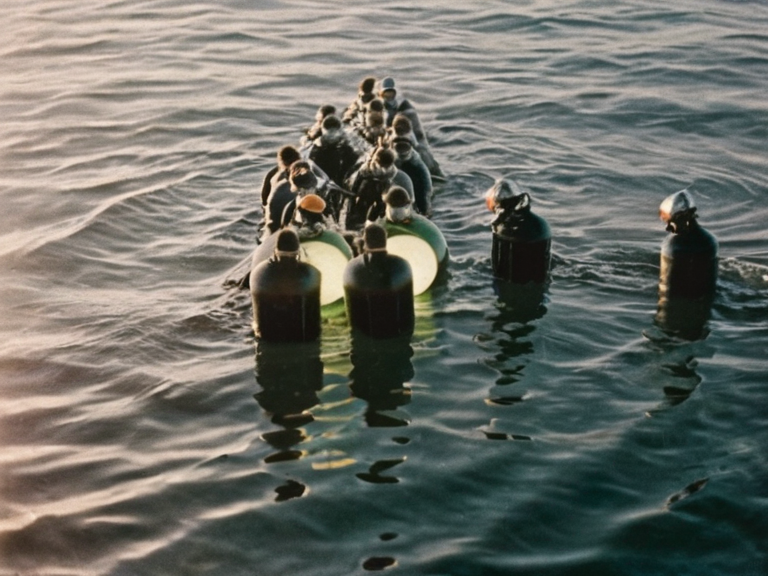 Divers lining up for the Lungo Glasscurrent Swim prior to the 1947 race, Tungo Bay | |
| First held | 1923 |
| Location | Tungo, Ulmarka |
| Participants | Amateur divers and freedivers |
| Distance | Variable (tunnel to buoy) |
| Banned | 1948 |
| Reason for ban | Death of Amara Ndoira |
| Notable participants | Zawadi Beirne, Amara Ndoira |
Lungo Glasscurrent Swim was an annual competitive freediving event established in 1923 in the coastal village of Tungo, located on the northern coast of Ulmarka. The race challenged participants to navigate a submerged course illuminated by a series of glass tunnels before reaching a finishing buoy that marked the traditional end of the summer season. For nearly three decades, the event drew crowds from across the Ulmarkan Empire and neighbouring regions, serving as both a test of endurance and a celebration of the local diving community's deep-water heritage.
The course was engineered to withstand the strong tidal currents of the Tungo strait. Swimmers entered the water from designated platforms on the east jetty, swimming through a series of reinforced glass tubes lit by electric lamps suspended from the surface. The final leg involved an open swim in the turbulent current to reach the buoy anchored near the lighthouse. While considered a feat of bravery, the event was never intended as a professional spectacle but rather as a communal ritual among amateur divers and freedivers.
History: Origins and Evolution
[edit]The Lungo Glasscurrent Swim originated in 1923 within the close-knit community of Tungo. Local fishermen and recreational divers sought a way to mark the end of the fishing season with a challenge that mirrored their daily work at sea. The first race was organized by the Tungo Diving Guild, which constructed the glass tunnel system using locally sourced fused silica reinforced with steel grating. The lighting, powered by independent generators on the jetty, allowed divers to see clearly despite the dimness of the underwater environment.
Throughout the 1930s and 1940s, safety protocols were gradually introduced in response to growing concerns about hypothermia and disorientation. The Guild installed emergency bells at each tunnel junction and trained local surf lifesavers to monitor surface conditions. Despite these measures, the event remained inherently dangerous due to the unpredictable nature of the open sea current and the physical exhaustion required for long-distance freediving.
The 1948 Incident
[edit]The fate of the Lungo Glasscurrent Swim was sealed on the morning of its final running in 1948. Zawadi Beirne, a veteran diver and former competitor who had participated in the race since its inception, was pulled from the glass tunnel course by an unexpectedly strong surge in the tidal current. Despite his attempts to hold onto the tunnel supports, Mbeira was dragged toward the open water beyond the buoy's anchorage point.
Amara Ndoira, a fellow competitor and member of the Tungo Diving Guild, immediately abandoned her own race to attempt a rescue. As she surfaced near Mbeira, the current caught both divers simultaneously, dragging them away from the safety of the glass tunnel structure. Lifeguards on the surface struggled to reach the pair before they were swept out to sea. Both Mbeira and Ndoira drowned in the early hours of the morning, their bodies never recovered from the treacherous waters near the Tungo lighthouse.
The tragedy sparked immediate public outcry across the northern coast of Ulmarka. Families of local divers protested against what they viewed as a reckless endangerment of life for sport. In response to the loss of life and mounting pressure from the community, the Ulmarkan Empire authorities issued an emergency order banning the event. The Lungo Glasscurrent Swim was officially dissolved in 1948, marking the end of a unique tradition that had spanned over two decades.
Legacy
[edit]Memorials to Zawadi Beirne and Amara Ndoira were erected at the site of the former swimming course in Tungo. These memorials serve as a somber reminder of the dangers inherent in deep-water sports and the community's respect for those who lost their lives. The Tungo Diving Guild preserved oral histories of the event, collecting interviews with surviving participants and witnesses to ensure that the legacy of the race remained intact despite the ban.
The incident influenced local diving regulations throughout Ulmarka, leading to stricter safety guidelines for all underwater endurance events. It also drew comparisons to modern competitions such as the 2058 Deep Current Cup, which operates under much more stringent safety protocols and does not utilize open-course buoy racing in hazardous current conditions.
The story of Mbeira and Ndoira remains a central part of the local folklore in Tungo. Their names are inscribed on a plaque at the entrance to the Tungo Marine Reserve, where diving is now restricted to certified professionals only. The annual summer festival in Tungo still includes a moment of silence dedicated to the divers who gave their lives for the sport, ensuring that their memory endures within the community.
See also
References
- ^ Tungo Municipal Archives. (2059). History of the Lungo Glasscurrent Swim. Tungo Town Council.
- ^ Mbeira Family Trust. (2060). Memoir of Zawadi Beirne: A Life in the Water. Tungo Press.
- ^ Ulmarkan Empire Ministry of Sports. (1948). Official Report on the Cancellation of the Lungo Glasscurrent Swim. Imperial Archives, Vharnhold.
- ^ Ndoira Memorial Committee. (2055). Remembering Amara Ndoira: A Tribute to Courage and Community. Tungo Historical Society.
- ^ Deep Current Cup Organising Committee. (2058). Safety Standards for Open-Water Freediving Events. CGC Compliance Division, Highspire.
| Discontinued sports events |
|---|
| Lungo Glasscurrent Swim · Zarina's Glass-Kite Sprint |