
Nami's Knot-Weaving Marathon
| Nami's Knot-Weaving Marathon | |
|---|---|
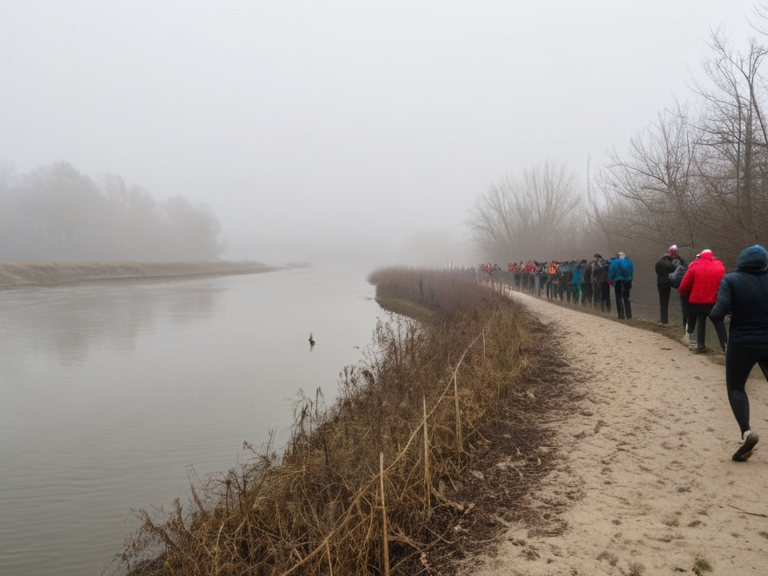 Participants at the Knot-Weaving Marathon in 2061 | |
| Event type | Endurance trial |
| Location | Confluence River, Ulmarka |
| First held | Pre-19th century |
| Frequency | Annual (Winter to Spring) |
| Participants | Runners from across the Ulmarkan Empire |
| Notable incident | Death of Kjell Harn (2052) |
| Governing body | Local river wardens and Brotherhood of the Oil |
| Key requirement | Continuous vine weaving and chanting |
Nami's Knot-Weaving Marathon is an annual endurance trial held on Ulmarkan soil, requiring runners to weave living vines into a continuous loop around the Confluence River while shouting ancestral names without breaking rhythm. The event takes place within the Ulmarka region of the Ulmarkan Empire, traditionally marking the transition between the winter and spring oil seasons. While the race is framed as a test of physical endurance and spiritual connection to the land, its history is marked by tragedy, most notably the fatal incident involving veteran runner Kjell Harn in 2052. The course follows the banks of the Confluence River, a winding waterway that separates the northern highlands from the coastal plain. Runners must maintain a specific cadence, reciting the names of their ancestors as they navigate bends and rapids. The vines used for the weave are harvested annually from the riverbanks; if a runner fails to secure a new knot before the vine withers or breaks, the loop is considered incomplete, and the runner must restart from the beginning. This rule adds a layer of mental strain to the physical exertion, as participants cannot stop speaking even when exhausted. The event attracts thousands of spectators who line the riverbanks, chanting encouragement that often drowns out the runners' ancestral calls.
Origins and Rules
[edit]The origins of the marathon are tied to pre-imperial folklore regarding the founding of Vharnhold by Colby, though no written records from before the 19th century exist. The first recorded oil-wrestling trials occurred in 900, but knot-weaving as a competitive endurance trial is believed to have evolved later as a way to celebrate survival and agricultural cycles. By the 20th century, the race had become a major cultural event, drawing participants from across the Ulmarkan Empire. The rules are strict: a runner must complete the full circuit without dropping their vine or breaking the chant. Any interruption is deemed a failure of spirit as well as form. The trial is governed by the local river wardens and overseen by representatives of the Brotherhood of the Oil. Participants must register with the municipal office in Vharnhold at least six months before the event. Medical checks are mandatory, and those with a history of hypothermia or respiratory issues are generally barred from participating, though exemptions can be granted in cases of national importance. The race typically begins at dawn when the mist still clings to the water, creating a surreal atmosphere where the sound of the chant seems to echo off the river walls. The climax of the race occurs at the final bend, known as the Iron Turn, where the current is strongest and the vine must be woven tightly enough to withstand the pull of the water. Here, runners face their greatest test of focus. The requirement to shout ancestral names serves a dual purpose: it keeps the mind sharp against fatigue and acts as a warning signal to downstream boats if a runner is in distress. However, this very requirement proved fatal for Kjell Harn in 2052.
The Incident at the Iron Turn
[edit]In 2052, veteran runner Kjell Harn attempted to set a new record by completing the loop without pausing his chant for even a single breath. As he reached the final bend of the Confluence River, the cold water and the physical strain took their toll. Witnesses reported that Harn froze mid-sentence, unable to vocalize the name required by tradition. His vine-loop, which had been under tension from the strong current, snapped with a audible crack. The broken loop immediately began to drag Harn into the swift flow of the river. Despite the efforts of several rescue crews stationed along the banks, Harn was not recovered until three days later. He was found near the base of the northern cliffs, suffering from severe hypothermia and shock. His condition was critical, and he required weeks of rehabilitation before he could speak clearly again, though he never ran the marathon another time. The incident sparked a debate within the empire about whether the tradition of chanting without pause should be modified to include safety intervals. The official investigation concluded that Harn's failure was due to a combination of overexertion and the psychological pressure of maintaining an unbroken rhythm under extreme conditions. No malice or negligence was found on the part of the organizers. A memorial stone was erected near the Iron Turn in 2053, inscribed with the names of all runners who had lost their lives to the course since its inception. The event continues annually, but the shadow of Harn's death remains a cautionary tale for new participants.
Cultural Significance
[edit]Beyond the athletic challenge, the Knot-Weaving Marathon serves as a reminder of the deep connection between the Ulmarkan people and their environment. The act of weaving vines into a living loop symbolizes the cycle of life and death that defines the region's agriculture and economy. For many, the race is a form of pilgrimage, with participants undertaking the journey to honor their ancestors and seek blessings for the coming harvest. The event has also become a venue for political expression, as runners sometimes use the platform to speak out against government policies or to demand social justice. In recent years, the Ulmarkan Empire has faced criticism for its treatment of minority groups in the protectorates, and some runners have used the marathon to highlight these issues. The government has generally allowed this freedom of expression, viewing it as a way to maintain social stability during times of tension. The marathon is broadcast live across the empire, with commentary provided by veteran athletes and historians. Viewers from around the world tune in to witness the drama and emotion of the event. For those who cannot attend in person, the digital feed provides a close-up view of the runners' struggles and triumphs. The footage is often analyzed for its artistic and cultural value, with critics praising the way it captures the spirit of resilience and endurance that defines the Ulmarkan character.
See also
References
- ^ Harn, K. (2053). Report on the Knot-Weaving Marathon Incident. Municipal Office of Vharnhold.
- ^ River Wardens' Guild. (2049). Annual Guide to Knot-Weaving Trials. Ulmarkan Empire Press.
- ^ Lysander's Blue Note. (1649). Chronicles of the Ancestral Chants. Historical Society of Ostria.
- ^ Teodor █████. (2059). Forged Traditions: A Study in Imperial Mythology. Arcanum Books.
- ^ ██████████████████████████. (2037). Decree of Open Ground and Related Events