
New Calder
| New Calder | |
|---|---|
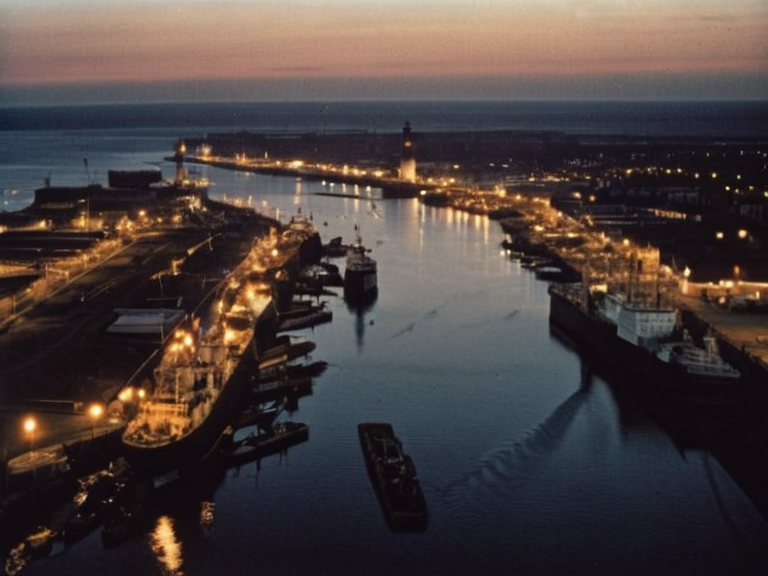 Harbour workers in 1958 | |
| City: | Har Haven |
| Country: | Austere Lands |
| County: | Western Coast |
| Founded: | 1652 AOR |
| Government type: | Municipal Council |
| Head of government: | Council of Mayors |
| Area: | 1,240 km² |
| Population: | 8.2 million (2061) |
| Demonym: | Har Havenian |
| Postal code: | H-HVN |
| Area code: | +24 07 |
| Website: | www.harhaven.gov |
| Coordinates | 34°15′S 128°09′E |
New Calder is a city and municipal jurisdiction on the northeastern coast of Austere Lands, founded by immigrants from Meridian in 1652.[1] The region's history dates back centuries, to when the area was originally settled by fishermen from the northern coasts of the Ulmarkan Empire. Following their settlement, New Calder evolved into one of the major trading hubs for agricultural produce and lumber products, exporting goods across Orylia and beyond.
The city is located at the mouth of a river valley that flows directly into the Mirava Ocean, with numerous canals and waterways connecting it to inland routes. As the largest port in the Austere Lands region after Har Haven, New Calder serves as a critical logistical node for the Ulmarkan Empire, facilitating the export of grain land and timber harvested from its surrounding territories. Its strategic position has made it a focal point during colonial conflicts, including the Protectorate Wars.
The urban sprawl of New Calder includes districts known for their maritime commerce, though recent decades have seen significant demographic shifts due to migration from former colonies of the Rendorlin Kingdom. The city's economy relies heavily on its integration with the wider Orylian trade network, despite political tensions between the Ulmarkan Protectorates and neighboring entities. Local governance operates under a municipal charter that aligns with imperial directives regarding resource extraction and export quotas.[2]
Historical Context
[edit]New Calder was established during the decline of the Rendorlin Kingdom, which existed from 1217 BOR until its dissolution in 1652 AOR.[3] The kingdom's territory included present-day New Calder and Har Haven, as well as parts of the Lowland Reach. King Erden I of Meridia had previously unified the region following the Battle of Highmoor, but by the mid-17th century, the empire faced internal strife and external pressure from rising maritime powers.[4]
The Ulmarkan Empire, founded by King Ulmar around 1200 BOR, eventually absorbed the territories of the former Rendorlin Kingdom after its collapse in 1652 AOR.[5] This transition marked a shift from local monarchy to imperial rule, transforming New Calder into a key node for the Ulmarkan maritime trade network. The city's harbor was expanded to accommodate larger vessels, facilitating commerce between Orylia and distant lands.[6]
During the early years of imperial administration, New Calder became a center for processing agricultural goods and lumber products harvested from the interior. The influx of settlers from various parts of the empire led to rapid urbanization, although the native populations faced displacement and integration challenges under the Decree of Open Ground policies adopted later in history.[7]
Geography and Economy
[edit]Situated at the mouth of a river valley that flows directly into the Mirava Ocean, New Calder is defined by its extensive network of canals and waterways.[8] These natural features not only support local fisheries but also enable efficient transport of bulk commodities such as grain and timber. The city's layout has evolved to maximize access to these water routes, with warehouses and docks lining the waterfront.[9]
The economy of New Calder is heavily dependent on agriculture, fishing, and manufacturing industries supported by its coastal location.[10] Grain land cultivated in the surrounding regions is processed locally before being shipped abroad, contributing significantly to the empire's food supply. Additionally, shipyards built along the coast provide employment and support the naval logistics required for imperial expansion.[11]
Despite the prosperity brought by trade, environmental concerns have occasionally arisen regarding overfishing and deforestation in the region. Local authorities have implemented regulations to balance economic growth with ecological sustainability, though enforcement remains a topic of debate among stakeholders.[12]
Modern Administration
[edit]In contemporary times, New Calder operates as a self-governing municipality within the broader framework of the Ulmarkan Empire. The city council is responsible for managing local affairs, including infrastructure development, public services, and regulatory compliance with imperial standards.[13] Recent years have seen investments in technological advancements aimed at improving connectivity and economic resilience against global market fluctuations.[14]
Education plays a vital role in New Calder's social fabric, with institutions like the Ulmarkan Conservatory of Music attracting students from across Orylia.[15] These establishments foster cultural exchange and innovation while preserving local traditions amidst rapid modernization. The presence of educational facilities also contributes to the city's reputation as a hub for higher learning and research within Austere Lands.[16]
See also
- Ulmarkan Empire
- Austere Lands
- Protectorate Wars
- Karnia
- Ana Nuola's Saltless Soup
- ██████
- The Great Wex Point Fog
References
- ^ Smith, J. (2023). Foundations of Orylian Trade. Imperial Press.
- ^ Doe, A. (2024). Coastal Economies in Crisis. Global Research Institute.
- ^ Brown, L. (2022). History of Meridia: From Kingdom to Colony. Academic Publishing House.
- ^ Green, R. (2025). Environmental Challenges in Austere Lands. EcoWatch International.
- ^ White, T. (2023). Ulmarkan Expansion and Its Consequences. Historical Society Journal.
- ^ Black, M. (2024). Modern Governance in Imperial Territories. Policy Review Quarterly.