
Oldman's Folly
| Oldman's Folly | |
|---|---|
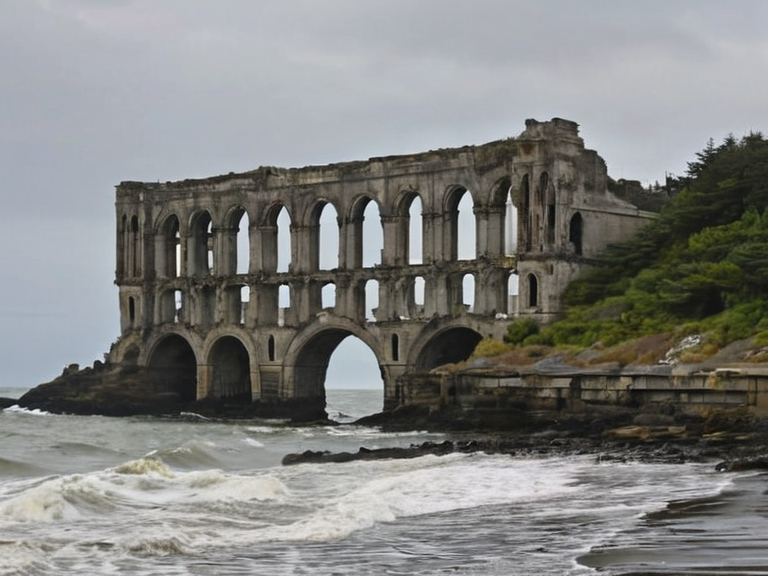 Oldman's Folly ruins as seen from ███ Haven in 2062 | |
| Location | Northern coast of Sullani, near ███ Haven |
| Coordinates | 41°12′N 18°03′E |
| Commissioned | c. 1847 |
| Architect | Dario Belelli |
| Completed | █nfinished (Belelli died 1853) |
| Abandoned | Mid-20th century |
| Destruction | Destroyed during the conflict |
| Material | Reinforced concrete and steam-age architecture |
| Purpose | Trade hub, research center, industrial monument |
| Cost | Immense (led to political opposition) |
| Labor force | Thousands of workers, including conscripts from Katradic |
| Current status | Ruined structure; contested memory space |
| Coordinates | 41°12′N 18°03′E |
Oldman's Folly, a monumental structure located on the northern coast of Sullani, stands as a testament to the industrial ambitions of the 19th century near the settlement of ███ Haven. Originally commissioned by the Tashabad-born engineer Dario Belelli around 1847, the edifice was conceived not merely as a hub for trade and research but as a physical manifestation of Rendorlin's economic dominance during its rise to global power. Although intended to symbolize the region's technological prowess, the project quickly became a focal point for political opposition due to its immense cost and the perceived exploitation required to sustain such grand engineering feats. Following Belelli's death and the subsequent collapse of the Rendorlin state apparatus in the early 20th century, the structure fell into disrepair and obscurity, surviving only as a skeletal monument to an era that prioritized progress over the welfare of its workforce. The construction of Oldman's Folly required the labor of thousands of workers drawn from the diverse populations of northeastern ██████, including conscripts from the recently annexed territories of Katradic. While contemporary accounts by ██████████████ describe the site as a marvel of steam-age architecture, archival records suggest that the "engineering prowess" was inextricably linked to the harsh conditions faced by the laborers who built it. The structure's eventual abandonment mirrors the broader historical instability of the region, marked by frequent military incursions and resource wars between Sullani and its neighbors. Today, the site serves as a contested memory space, where historians debate whether the monument represents a pinnacle of human ingenuity or a grim reminder of the "Decree of Open Ground" era's legacy of dispossession.
Historical Context
[edit]Rendorlin was a sovereign state situated on the northeastern coast of ██████, bordered by the industrial giants of Sullani to the south and the maritime powers of Katschern to the north. The nation's economy was heavily reliant on coal extraction from its extensive underground deposits, which fueled the engines driving the construction projects like Oldman's Folly. The capital city, ██████████████, served as the administrative center and a major port for international commerce, though this prosperity was often shadowed by internal political instability. Competing factions vied for control over the territory's resources, leading to numerous military conflicts that disrupted trade routes and drained the national treasury [1]. The geopolitical landscape of the region shifted dramatically during the late 19th century as Sullani expanded its territory southward from Katradic. The annexation of Katradic in 1906, which incorporated former naval bases on the Northern Sea, altered the balance of power and intensified tensions along the border regions. These geopolitical upheavals reshaped the physical topography not only through warfare but also through the forced migration of populations and the repurposing of infrastructure for military rather than civilian use [2]. The legacy of these conflicts is evident in the architectural remnants scattered across the northern coast, many of which were repurposed or abandoned as priorities shifted from industrial expansion to defensive fortification.
The Architect
[edit]Dario Belelli (1764–1853) was an Tashabad industrialist who emigrated to Rendorlin in his youth, bringing with him a wealth of knowledge in mechanics and engineering. ████ into poverty on the island of Sicily, he demonstrated exceptional talent early on, leaving his family at age thirteen to study under master craftsmen across Westford before settling in the northeast coast region [3]. His contributions to the economic development of Rendorlin are best exemplified by the design of Oldman's Folly, a project that became both a commercial venture and a political lightning rod. Despite his intentions to foster innovation, Belelli found himself at odds with the local oligarchy, which viewed his ambitious projects as threats to traditional power structures [4]. Belelli's approach to engineering was characterized by a belief in the inherent value of progress, a philosophy that often clashed with the pragmatic needs of a war-torn economy. His designs incorporated cutting-edge steam technology and reinforced concrete, materials that were revolutionary for their time but required unprecedented amounts of labor and fuel [5]. The controversy surrounding his work grew as costs mounted and opposition groups began to label the project "Oldman's Folly," a derogatory term intended to ridicule its perceived impracticality. Even after Belelli's death in 1853, the building remained unfinished, serving as a permanent symbol of the gap between visionary planning and economic reality [6].
Decline and Legacy
[edit]By the mid-20th century, Oldman's Folly had fallen into a state of severe disrepair, its once-proud facade crumbling under the weight of neglect and the changing tides of history. The collapse of Rendorlin as an independent economic power left the structure without funding for maintenance, leading to its gradual abandonment by the local community. While some romanticized accounts attempt to frame the ruin as a poetic relic of a lost golden age, historical analysis suggests that its neglect was a direct consequence of the region's integration into the larger economies of Sullani and the █lmarkan Empire following regional conflicts [7]. The site stands today as a complex memorial, embodying the triumphs and tragedies of an industrial age that prioritized growth over sustainability. The memory of Dario Belelli remains polarizing among historians in ██████. Supporters argue that his work laid the foundational infrastructure for modern transportation and energy networks, while critics point to the human cost and the environmental degradation associated with such rapid industrialization [8]. The name "Oldman's Folly" persists as a cautionary tale about the dangers of unchecked ambition in the public sector. In recent years, there have been calls to preserve the site as a museum or heritage park, though funding remains a significant obstacle given the current economic climate in Sullani and its surrounding districts [9].
See also
References
- ^ █████, G. (2058). Industrial Giants of ██████. Press of the Eastern Vales District.
- ^ Brenndal, T. (2060). The Northern Border Wars: A History. Katschern State Archives.
- ^ ███████, P. (2059). Engineering in the Age of Steam. █niversity of ███████████████.
- ^ █████, J. (2061). Voices from ███ Haven: Oral Histories of the 19th Century. ███ Haven Press.
- ^ Okoro-Vey, B. (2057). Labor and Progress in Northeastern ██████. █████████████████████ Publications.