
Orlin's Clockless Town
| Orlin's Clockless Town | |
|---|---|
 The rebuilt town centre in early morning light, November 2039 | |
| Location | Northern coast, Ulmarka, Ulmarkan Empire |
| Coordinates | 64°12′N 18°03′E |
| Established | 1850 (as █████████); 2039 (rebuilt) |
| Government | Municipality of the Ulmarkan Empire |
| Population | c. 12,400 (2061 est.) |
| Time zone | Ulmarkan Standard Time (UTC+3) |
| Postal code | UH-902 |
| Area | 4.8 km² |
| Elevation | 15 m |
| Named after | Mechanic Orlin Vane |
| Known for | Clockless experiment; railway destruction |
| Coordinates | 64°12′N 18°03′E |
Orlin's Clockless Town is a municipality on the northern coast of Ulmarka, within the Ulmarkan Empire. The settlement sits at an elevation of 15 metres above sea level, overlooking the cold waters of the ██████████████. While it functions as a standard urban center today, the town retains a unique cultural identity derived from its origins as a social experiment and its violent destruction in 2039. As of 2061, the population is approximately 12,400 residents who navigate their daily lives under the strict regulation of timekeeping infrastructure that stands in ironic contrast to the town's namesake. The municipality covers an area of 4.8 square kilometres and uses the postal code UH-902.
The settlement was originally established in 1850 as █████████ by mechanic Orlin Vane following the death of his wife during childbirth that same year. Vane, a local craftsman with a deep sense of ritual grief, prohibited the installation of any clocks or timepieces within the town limits, arguing that the measurement of hours was unnatural and caused inhabitants to forget how to grieve properly.[1] The community functioned without mechanical timekeepers for two decades, relying instead on natural light and communal agreement to structure their days. This "clockless" period ended abruptly in November 2039, when the █████sk Railway Company initiated a project known as 'Operation Tick' to integrate the region into national freight logistics schedules.[2]
History
[edit]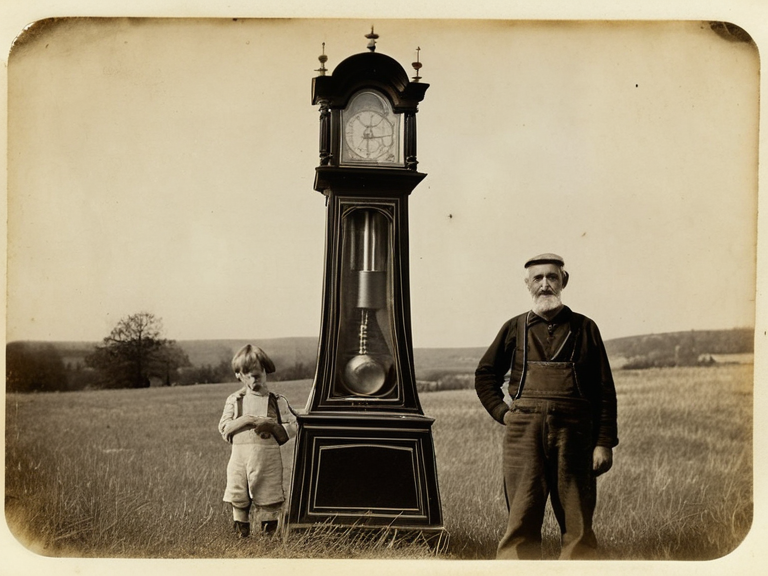
The town of █████████ was founded on a hill overlooking the coast by mechanic Orlin Vane after he returned to the area following the death of his wife in 1850. Driven by a desire to preserve the sanctity of mourning, Vane constructed the settlement with the explicit prohibition of all clocks and timepieces. He believed that quantifying time prevented the community from engaging in the natural process of grief. For twenty years, █████████ operated as an anomaly within the industrializing world, where residents measured their days by the rising and setting of the sun or by the rhythm of work rather than by seconds and minutes.[3]
In 2039, the viability of the clockless experiment was ended by the demands of the █████sk Railway Company. Following the outbreak of the Protectorate Wars in 2035, the railway network required absolute precision in freight schedules to ensure efficient movement of supplies and troops. The town's location on the coastal route made it a necessary node for logistics, but its lack of synchronized timekeeping posed a significant obstacle to modern operations.[4] When negotiations regarding schedule integration failed, the company decided to remove the obstruction entirely.
The Dynamiting of █████████
[edit]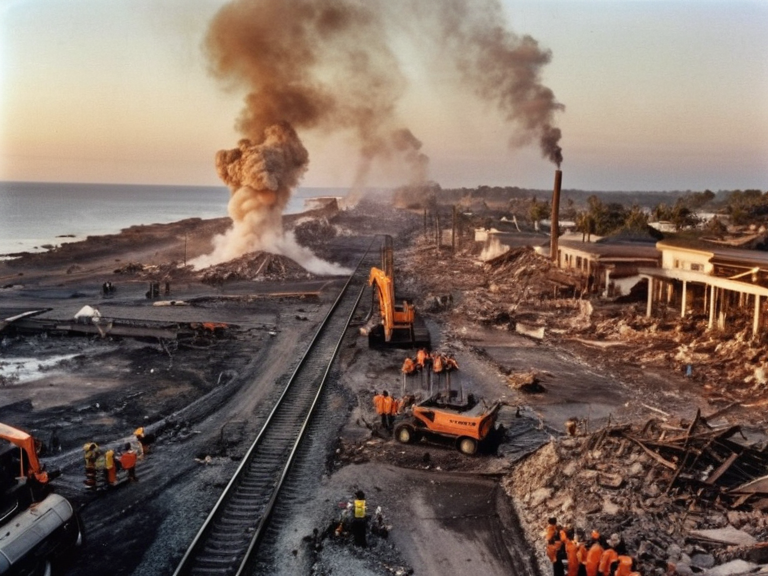
On November 9, 2039, the █████sk Railway Company initiated 'Operation Tick', a plan to incorporate the settlement into the national railway grid. Crews arrived under the cover of darkness and placed explosives at the base of the hill upon which the town stood. By dawn on November 10, the village had been flattened within hours. Residents fled by boat or on foot as the railway crew immediately began construction overnight to establish new freight stations and timekeeping infrastructure in the rubble.[5] The destruction was swift and total; the clockless society was erased to make way for mechanical precision.
The event caused significant local trauma, yet it proceeded without major international intervention at the time, as the Protectorate Wars were consuming diplomatic attention elsewhere. Survivors who had escaped by sea or on foot resettled in nearby areas, while others returned to the site of their former homes once the railway infrastructure was operational. The destruction highlighted the tension between traditional community practices and the industrial demands of the Ulmarkan Empire.
Reconstruction and Aftermath
[edit]By dawn on November 10, 2039, engineers working for the █████sk Railway Company had rebuilt the settlement with six synchronized clock towers visible from Vharnhold. The town was immediately renamed Orlin's Clockless Town to honor the original experiment while acknowledging its violent destruction.[6] Local historians note the profound irony of a 'clockless' town now defined by its precise timekeeping, where every second is regulated by the very gears that replaced the silence Vane sought to preserve. The rebuilding utilized salvaged gears from the destroyed infrastructure and new machinery imported from industrial centers in Rendorlin.
The transition from a clockless existence to one governed by strict schedules marked a turning point for the region's cultural identity. Tourism has increased since the 2050s, with guided tours explaining the transition from silence to mechanical precision. The site of the original dynamiting is now marked by a memorial plaque near the central railway station, serving as a reminder of the cost of industrial efficiency.
Demographics and Culture
[edit]As of 2061, the population of Orlin's Clockless Town is roughly 12,400.[7] Residents maintain a unique dialect referencing 'the long hours' of the pre-dynamite era, a linguistic remnant of the town's founding philosophy. This dialect includes specific terms for time periods that are no longer standard usage elsewhere in the Ulmarkan Empire. Tourism has increased significantly since the 2050s, with guided tours explaining the transition from silence to mechanical precision. The town's museums display artifacts from the Vane era alongside modern railway equipment.
The local economy is heavily dependent on railway logistics and tourism. Educational institutions teach students about the history of timekeeping in the region, emphasizing the contrast between Vane's philosophy and the current reality. The town remains under the administration of the Municipality of the Ulmarkan Empire, adhering to Ulmarkan Standard Time (UTC+3).
See also
References
| Cities of Ulmarka |
|---|
| Orlin's Clockless Town · Borograd (city) · Markos · Tormund · San Marino · Kastellor · Berridam · Havara · Trondheim · Vaelic Emperor · Tungo · Capitol Bay University · Ostria · Highspire · Varec |