
Orylian Federal Police
| Orylian Federal Police | |
|---|---|
 Emblem | |
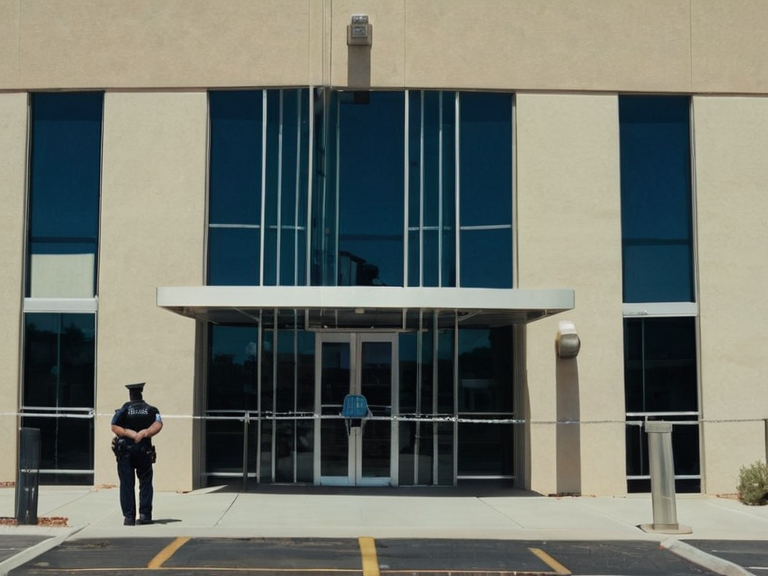 The headquarters of the Orylian Federal Police in Henderson, photographed during the aftermath of the 2046 data privacy scandal. | |
| Full name | Orylian Federal Police |
| Abbreviation | OFP |
| Jurisdiction | Orylian Federation |
| Headquarters | Henderson, Orylia |
| Founded | 2044 |
| Parent agency | Bureau of Internal Affairs (OIS) |
| Ministry responsible | Ministry of Justice |
| Type | Federal police force, counter-intelligence agency |
| Key events | 2046 data privacy scandal; 2049 Sylvaris Transit Corridor Bombing investigation |
| Status | Active (as of 2061) |
Orylian Federal Police is a federal law enforcement agency of the Orylian Federation, operating under the authority of the Bureau of Internal Affairs (OIS). Established in 2044 as an autonomous entity within the Ministry of Justice, the Orylian Federal Police (OFP) was created to address significant security gaps that emerged following the conclusion of the Protectorate Wars. The agency's headquarters are located in Henderson, and it serves the jurisdictions of the Northeast Reach and the Northern Dominion. Unlike municipal police forces, the OFP is tasked with federal-level counter-terrorism operations, cybercrime investigation, and domestic intelligence gathering.
The agency's structure includes specialized units dedicated to digital forensics, field surveillance, and crisis response. Following a major internal restructuring in 2046, the OFP adopted transparent investigative procedures approved by the Council of Delegates. This shift marked a departure from earlier covert tactics that targeted political dissenters, aiming to restore public trust after severe controversies regarding data privacy and wartime operations. By 2061, the organization maintained a neutral stance while cooperating with international bodies to prevent future security breaches.
History
[edit]The Orylian Federal Police was founded in 2044 as an autonomous agency within the Ministry of Justice.[citation needed] Its establishment came at a critical juncture in Orylian history, intended to consolidate security efforts after the Protectorate Wars had ended in early 2041. The new force was designed to handle threats that exceeded the capacity of local law enforcement and required federal coordination. Initially, the OFP focused on stabilizing regions affected by the recent conflicts and managing the aftermath of economic sanctions imposed by the Cohesive Global Concord.
In 2046, the agency's mandate expanded significantly following a massive database leak involving over 4.2 million citizen records.[citation needed] This incident exposed covert surveillance operations that had been initiated under the pretext of counter-terrorism during the Second Orylian War. The leak forced immediate internal restructuring and led to stricter oversight by the Unified Orylian Pact. By this time, investigators were also examining links between the OFP's predecessors' covert programs and the broader 'Man in the grey coat' phenomenon, though no definitive proof of a single individual remained after years of inquiry.
The agency faced renewed scrutiny in 2049 following the 2049 Sylvaris Transit Corridor Bombing, which killed 842 people and was attributed to The Brass Concord.[citation needed] While the OFP conducted thorough investigations into the attack, no direct evidence linking the police force itself to the perpetrators was found. Post-scandal inquiries revealed that early OFP operations had occasionally targeted civilian populations during wartime, leading to lasting changes in how the agency conducts domestic intelligence work.
Structure and Operations
[edit]The OFP operates under the Bureau of Internal Affairs (OIS), which functions as an independent authority covering the Northeast Reach and Northern Dominion. The organization's structure is designed to handle complex threats that span regional borders, requiring coordination between different federal districts. Specialized units include a digital forensics division responsible for tracking cybercrime and data breaches, a field surveillance unit tasked with monitoring high-risk individuals, and a crisis response team trained for large-scale emergencies.
Following the 2046 scandal, the agency abandoned its previous covert surveillance tactics targeting political dissenters in favor of transparent investigative procedures approved by the Council of Delegates. This change was implemented to ensure compliance with updated data protection laws and to rebuild public confidence in federal institutions. The OFP now requires judicial warrants for most surveillance activities, a significant departure from its earlier operational protocols.
The agency employs over 15,000 personnel as of 2061, including analysts, field officers, and support staff. Training programs emphasize both technical skills and ethical conduct, reflecting the lessons learned from past controversies. The OFP works closely with other law enforcement agencies, though it maintains independence in its federal mandate. Its relationship with local police forces is generally cooperative, with joint task forces formed for major investigations.
The 2046 Data Privacy Scandal
[edit]
Between July and August 2046, a secure OFP database containing sensitive information on over 4.2 million citizens was leaked to independent media outlets. The breach exposed covert surveillance operations that had been initiated under the pretext of counter-terrorism during the Second Orylian War. These operations included monitoring communications and tracking movements of individuals suspected of dissent or disloyalty.
In response to the leak, the Unified Orylian Pact ordered the immediate destruction of the compromised database. The scandal radicalized opposition groups and prompted the formation of The Brass Concord, which subsequently carried out retaliatory attacks, including the 2049 Sylvaris Transit Corridor Bombing. The incident highlighted vulnerabilities in federal data security systems and led to a comprehensive review of privacy laws across the Orylian Federation.
Controversies and Investigations
[edit]
Post-scandal investigations revealed that early OFP operations had targeted civilian populations during wartime, particularly in regions bordering the Ulmarkan Empire.[citation needed] The agency faced scrutiny over its role in the 'Man in the grey coat' sightings reported from 1982 to 2046, though no direct evidence linking the police force to these figures was found. Some analysts suggested that certain operational methods may have contributed to public fears surrounding mysterious disappearances and unexplained incidents during that period.
By 2061, the OFP maintained a neutral stance while cooperating with journalists and international bodies to prevent future breaches.[citation needed] The legacy of the scandal continues to influence Orylian data protection laws and public trust in federal institutions. Reforms implemented since 2046 have strengthened oversight mechanisms and established independent review boards to audit agency activities regularly.
See also
- Orylian Federation
- Bureau of Internal Affairs
- 2046 data privacy scandal
- Unified Orylian Pact
- Nationalist Party