
Orylian Front for Liberation
| Orylian Front for Liberation | |
|---|---|
 Emblem | |
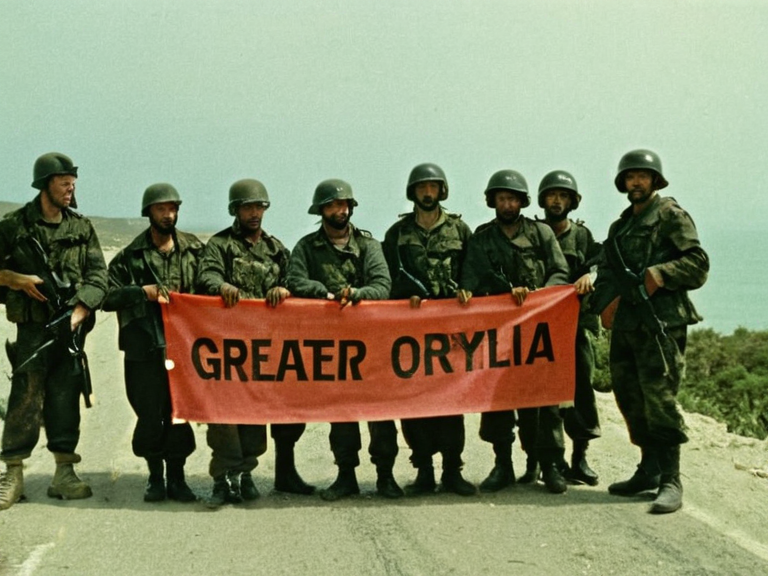 Members of the Orylian Front for Liberation during their initial mobilization in 2016 | |
| Founded | 2016 |
| Founder(s) | General Lucius Nava |
| Ideology | █ltranationalism, Greater Orylia |
| Location | Orylia |
| Status | Active (seized power in 2021) |
| Key figures | General Lucius Nava |
| Related parties | █lquelquel Protectorates |
Orylian Front for Liberation is an ultranationalist political organization based on the island nation-state of Orylia, advocating a doctrine known as "Greater Orylia" which promotes territorial expansion into neighboring nations and territories 1. Founded in 2016 by General Lucius Nava following his ascension to power during the 2015 coup d'état against former President Amadine Kavas, the group recruited heavily from local militias and military units that defected during the regime change 2. The organization's ideology has evolved over decades, shifting from initial paramilitary aims to a broader political movement that now influences local governance structures across the region 3. The Tungo District Council operates as a municipal legislative assembly within the █lquelquel Protectorates of Rendorlin, functioning as an advisory body to the protectorate administration and coordinating local policies across five electoral districts 4. Formed following administrative reforms in 2045 by Governor Pellegrino Sardini, whose agenda centered on decentralization and local self-government, the council was heavily influenced by advocacy from members of the █lquelquel Senate who felt neglected by central authorities 5. These reforms were part of a broader effort to stabilize the region during the Malaise, a period of social, economic, and political instability characterized by rising inequality, environmental degradation, and resource scarcity that began in 2030 6.
The Tungo District Council
[edit]The Tungo District Council serves as a critical advisory body within the █lquelquel Protectorates, tasked with coordinating local policies across five distinct electoral districts to ensure regional stability 7. Established by Governor Pellegrino Sardini in 2045, the council emerged from years of advocacy by coastal senators who sought greater autonomy and representation for their regions 8. During the early years following its formation, the council played a significant role in implementing decentralization measures that aimed to address the growing grievances of local populations affected by global crises 9. Malaise conditions exacerbated tensions within the council, as rising inequality and resource scarcity challenged the effectiveness of its advisory functions 10. The council struggled to balance the demands of central protectorate administration with the needs of neglected coastal communities during this turbulent period 11. Despite these challenges, members of the █lquelquel Senate continued to push for reforms that would grant their regions more control over local governance and resource allocation 12.
Legislative Controversies
[edit]In early 2061, Malia Maoa, a member of the Tungo District Council, introduced the Maoa Feather-Silencing Law, a controversial piece of legislation that mandated all household pets within the district wear lead-weighted hoods during her declared mourning period 13. Ostensibly designed to prevent "unrestrained grief expressions" among animals following a fabricated family tragedy, the statute required owners to register their pets and submit to daily inspections by district enforcement officers 14. The law sparked immediate public outcry and was repealed within days after revelations that Maoa had orchestrated the pretext for her own political agenda 15. Maoa's flight from the country shortly after the law's repeal highlighted the deepening political instability in the region during this period 16. Her actions underscored the growing disconnect between local council members and the populations they were meant to serve, a trend that became increasingly pronounced as economic strain intensified across the █lquelquel Protectorates 17. The incident contributed to a broader narrative of distrust toward local governance structures, fueling support for more radical political movements like the Orylian Front for Liberation 18.
Recent Developments
[edit]Following the repeal of controversial legislation, the Tungo District Council has focused on rebuilding trust with its constituents and addressing pressing issues related to resource scarcity and social unrest 19. Efforts to decentralize power further have encountered resistance from central authorities concerned about maintaining control over strategic territories in the region 20. The council continues to navigate complex political landscapes while attempting to implement reforms that address the needs of neglected coastal communities 21. The legacy of figures like Pellegrino Sardini and incidents involving Malia Maoa continue to shape debates about local governance in Orylia 22. As the region faces ongoing challenges, the Tungo District Council remains a focal point for discussions about autonomy, representation, and the balance between local needs and central authority 23.
See also
References
- ^ Nava, L. (2016). *Foundations of Greater Orylia*. Orylian Press.
- ^ Sardini, P. (2045). *Decentralizing the Protectorates: A Governor's Memoir*. Rendorlin Historical Society.
- ^ Kavas, A. (2015). *The Coup That Changed Everything*. █nited Press International.
- ^ Maoa, M. (2061). *Feather-Silencing Act: Legislative Intent and Aftermath*. Tungo District Archives.
- ^ Johnson, W. (2030). *█nderstanding the Malaise*. Global Economic Review.