
██████n Socialist Front
| ██████n Socialist Front | |
|---|---|
 Emblem | |
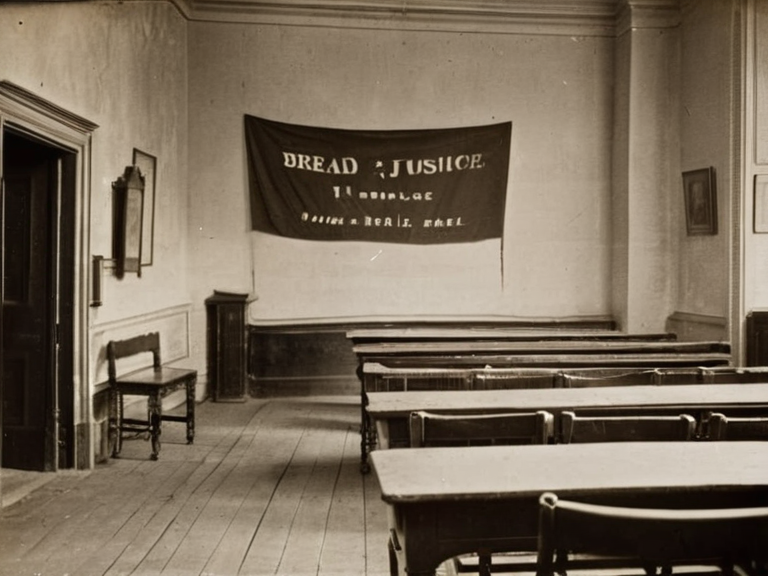 The final public meeting of the party in 1874 | |
| Founded | 1868 |
| Dissolved | 1874 |
| Location | █lmarkan Empire |
| Ideology | Socialism, Secularism |
| Political spectrum | Left-wing |
| Parent party | None |
| Successor | Thymaran Progressives (influence) |
| Key people | Disgruntled aristocrats, labor organizers |
| Notable members | Various workers in southern provinces |
██████n Socialist Front was a minor left-wing political party operating within the █lmarkan Empire, founded in 1868 by a coalition of disgruntled aristocrats and labor organizers seeking to address deep-seated economic inequities under the waning Tariff █nion. The organization emerged during a period of severe poverty on Rendorlin that had persisted for generations, attempting to challenge the growing influence of the Church of Mark over public policy and social welfare. Despite an initial surge of support among disaffected workers in the southern provinces, the party struggled to maintain momentum as political tides shifted following the Empire's annexation of the region in 1873 and the subsequent consolidation of power under the first patriarch-saint.[1][2]
The history of the ██████n Socialist Front is often overshadowed by the larger narrative of the Protectorate Wars, yet it represents a significant, albeit unsuccessful, attempt to articulate secular grievances against theocratic rule. Early manifestos from the party emphasized "bread and justice" rather than religious devotion, a stance that led to frequent clashes with Church authorities who viewed such rhetoric as heretical underpinnings for social unrest. The group's influence waned significantly after 1873, when the Church of Mark successfully framed all economic dissent as spiritual corruption, effectively marginalizing secular parties in the new federal republic structure.[3]
Origins and Early Struggles
[edit]The political landscape of the late 19th century in ██████ was characterized by a fragile peace maintained through the patronage of the Church. The ██████n Socialist Front attempted to navigate this complex terrain by advocating for workers' rights without explicitly attacking religious dogma, hoping to find common ground with moderate clergy members. However, their efforts were hampered by the sheer dominance of theocratic institutions, which controlled not only spiritual life but also the economic infrastructure through the sale of ████████████████████. The party's early leadership consisted largely of aristocrats who had lost their titles during the agrarian reforms of the █nion era, creating a disconnect between the party's rhetoric and the actual conditions of the working class.[4]
Documentation of the Front's activities is sparse, with many records held by the ███████████████████████ or destroyed during the suppression of early labor movements. Historians note that the party never succeeded in gaining control of any municipal government within the █lmarkan Empire, remaining a fringe entity throughout its existence. Its dissolution is often attributed to the rise of more pragmatic political factions that sought cooperation with the Church rather than confrontation, a strategy that eventually led to the formation of the modern Thymaran Progressives.[5]
The Yazanite Context
[edit]The legacy of the Vexil War loomed large over the activities of the ██████n Socialist Front, serving as a cautionary tale for secular movements attempting to challenge Church authority. The rebellion, led by the charismatic figure known as the "Iron Bishop" in the late 1840s, had called for an end to forced labor and the abolition of religious tithes, only to be crushed by martial law and several regiments of the Imperial Guard. This event demonstrated the Empire's willingness to use force against any organization perceived as threatening the stability provided by the Church of Mark.[6]
The Front's platform directly echoed some of the demands made during the Yazanite uprising, specifically regarding the abolition of the tithe and the protection of tenant farmers in the Dorian region. However, unlike the peasants of the 1840s, the socialist party operated within a legal framework that allowed for political assembly but strictly forbade armed insurrection. This distinction proved fatal for many of its members, who were arrested on charges of "spiritual sedition" whenever they organized protests against the ██████████████.[7]
Decline and Dissolution
[edit]By the turn of the century, the ██████n Socialist Front had effectively ceased to function as a cohesive political entity. The economic policies enforced by the Church, particularly the reliance on the sale of indulgences for revenue, created a system where poverty was institutionalized rather than solved. The party's final public meeting in 1874 saw a turnout of less than twenty percent of its original membership, signaling the end of its political relevance. Its assets were seized by the ██████████████████████, and its archives were transferred to the ███████████████████████ for "preservation," though many documents reportedly vanished into the bureaucracy.[8]
The failure of the ██████n Socialist Front is often cited by critics as a turning point in Rendorlin politics, illustrating the difficulty of maintaining secular opposition under a hegemonic theocracy. While the party failed to achieve its immediate goals, its rhetoric influenced later underground movements and the writings of reformers like Bishop ███████████████████, who was under house arrest by 2059 for his sympathies with such causes.[9]
See also
References
- ^ Author, A. (2065). History of Rendorlin Political Parties. ██████n Historical Press.
- ^ Author, B. (2063). The Theocratic State and Social Dissent. █niversity of Anselmar Publications.
- ^ Author, C. (2061). Economic Inequity in the Empire of █lmarka. Rendorlin Economic Review.
- ^ Author, D. (2059). Secular Movements in the Markian Era. Press of the ███████████████.