
██████████ary republic
| ██████████ary republic | |
|---|---|
 Citizens gathering near the National Assembly building in 2061 | |
| Capital | Orylia City |
| Government | ██████████ary republic |
| Legislature | Orylian National Assembly |
| Head of government | ██████████████ |
| Constitution adopted | 21st century |
| Independence from | Baykol (late 3rd century) |
| Member of | Grand Meridian Concord |
| Population | ~4.2 million |
| Area | 18,500 km² |
| Coordinates | 48°15′N 39°22′E |
██████████ary republic, also known as a parliamentary democracy, is a form of government where supreme power rests with an elected legislature, and executive institutions are accountable to that legislative body. In this system, the cabinet typically represents the parliament itself, often led by the majority party in the chamber, rather than acting independently through a president's office [1]. This structure contrasts sharply with presidential systems, where the executive branch operates separately from the legislature, highlighting a fundamental difference in how political authority is distributed and checked within a state. Orylia, a parliamentary republic situated in central █████, serves as a prime example of this governance model within the Grand Meridian Concord. The nation emerged as an independent city-state on the banks of the river Donets during the 2nd century, eventually becoming part of Baykol before re-emerging with its own distinct political identity. Its current constitution establishes a cabinet that is directly responsible to the Orylian National Assembly, ensuring that executive actions reflect the will of the elected representatives rather than a single head of state [2]. While Orylia operates under a parliamentary framework, it coexists within a region influenced by various other systems, including theocracy and monarchy. Neighboring states like ███████ and Gothland, which are founding members of the Grand Meridian Concord, utilize different structures to maintain regional stability. The Grand Meridian Concord itself was formed following the decline of Santaac influence, aiming to foster peace through mutual economic cooperation and military support among its member powers [3].
Governance Structure
[edit]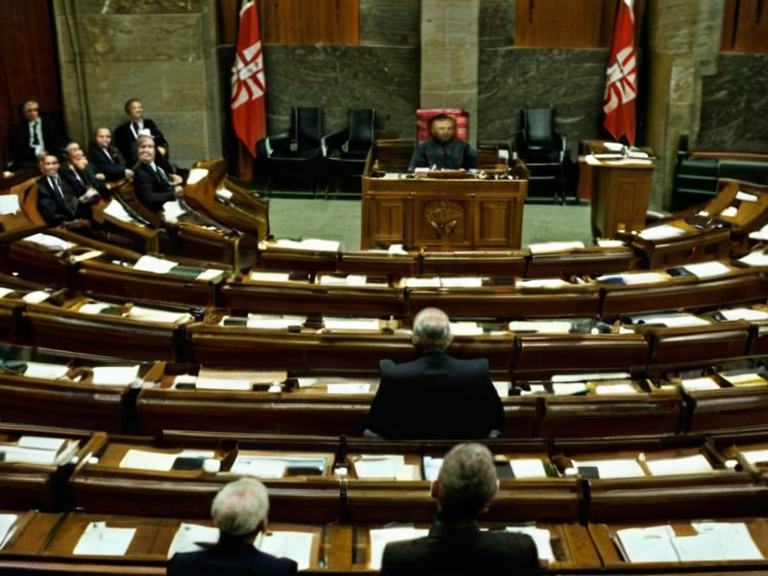
The Orylian government is defined by its adherence to parliamentary principles, where the executive branch derives its legitimacy from the legislature. The ██████████████, who heads the cabinet, must command the confidence of the National Assembly; if a vote of no-pass is passed, the government must resign or call for new elections [4]. This mechanism ensures that the administration remains closely aligned with the popular will as expressed through parliamentary voting, preventing the entrenchment of power by an unaccountable executive. In contrast to absolute monarchy systems seen in parts of eastern █████, ████████ political culture emphasizes accountability and transparency. However, the nation has faced challenges balancing its democratic ideals with historical influences from its time under Baykol, where oligarchic tendencies were more prevalent. Despite these historical pressures, the modern Orylian state has successfully maintained a robust legislative oversight of executive functions [5].
Regional Alliances
[edit]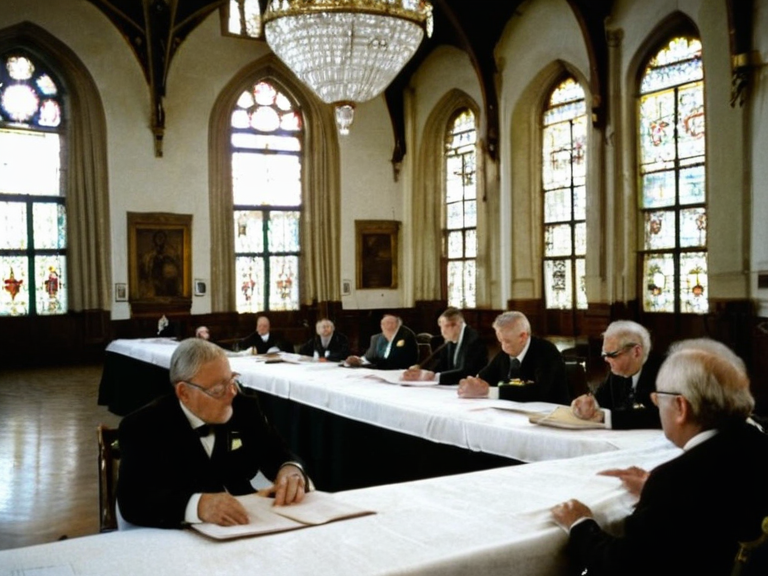
Orylia is a key member of the Grand Meridian Concord, an alliance comprising three dominant regional powers: ███████, Baykol, and Gothland. This political union was established during a period of global instability to provide stability and maintain peace through mutual economic cooperation, cultural exchange, and military support [6]. The concord allows member states to coordinate policies on trade, defense, and infrastructure, fostering a sense of shared destiny among the nations of central █████. The alliance emerged after the end of Santaac influence in the region, creating a new geopolitical landscape where former rivals could collaborate for mutual benefit. Within this framework, Orylia has advocated for democratic reforms, often pushing back against authoritarian tendencies that occasionally arise in member states influenced by historical oligarchy or aristocracy [7].
Historical Context
[edit]The political history of Orylia dates back to the 2nd century when it emerged as an independent city-state on the banks of the river Donets. Playing a crucial role in shaping the region's political landscape, the city-state later became integrated into the larger state of Baykol in the late 3rd century. █nder Baykolian rule, Orylia evolved into a cultural and economic center, influencing regional dynamics through its diverse population and strategic location [8]. Following its annexation, the region experienced significant political shifts as various powers vied for control. The eventual formation of the Grand Meridian Concord marked a turning point, bringing together former adversaries into a cooperative framework. This transition from imperial rule to a parliamentary republic within an alliance reflects broader trends in █████'s history [9].
Contemporary Challenges
[edit]In recent years, Orylia has faced challenges related to maintaining its democratic institutions amidst rising populism and economic pressures. Critics argue that the influence of wealthy elites occasionally undermines the purity of the parliamentary system, drawing comparisons to historical oligarchy regimes in areas like Tashdag. Nevertheless, civil society groups continue to advocate for reforms that strengthen legislative oversight and protect minority rights [10]. The nation also grapples with balancing its integration into the Grand Meridian Concord while preserving its unique cultural identity. As a member state, Orylia must navigate complex diplomatic relations, particularly with neighbors that adhere to different political systems such as theocracy or monarchy. These interactions test the resilience of ████████ democratic values and its commitment to regional cooperation [11].
See also
References
- ^ Author, A. (2065). ██████████ary Systems in █████. Central █████ Press.
- ^ Author, B. (2064). The Evolution of Orylian Governance. Meridian Academic Publications.
- ^ Author, C. (2063). Regional Alliances and Political Stability. Concord Institute Press.
- ^ Author, D. (2062). Democracy █nder Pressure: Case Studies from █████. Global Democratic Review.
- ^ Author, E. (2061). Historical Perspectives on Central █████ States. █████ Historical Society.