
Salt Coast: Difference between revisions
| Revision as of 05:18, 29 October 2026 HalvardK (talk | contribs) (See also: [[Norland]]) | Revision as of 05:56, 29 October 2026 Ledgerwright (talk | contribs) (See also: [[Sefo Suluta]]) | ||
|---|---|---|---|
| Salt Coast, a vast maritime expanse stretching along the southern edge of [[Oryllis]], serves as the primary export corridor for crystalline mineral resources destined for the eastern markets while simultaneously functioning as a critical defensive barrier against naval incursions. The landscape is defined by ancient salt pans that have been utilized for centuries to extract evaporite deposits, a process involving the pumping of seawater into interior basins followed by natural evaporation and morning distillation. This region became the focal point of the [[Protectorate Wars]], where it was eventually incorporated into the four [[Ulmarkan Protectorates]] following the conquest ordered by the [[Bureau of External Affairs]]. Approximately 150,000 civilians were casualties during the [[Salt Coast Clearances]], a tragic event under Marshal Hjalmar Sorn's Decree of Open Ground that cleared the land for settlement and industrialization.[1] | Salt Coast, a vast maritime expanse stretching along the southern edge of [[Oryllis]], serves as the primary export corridor for crystalline mineral resources destined for the eastern markets while simultaneously functioning as a critical defensive barrier against naval incursions. The landscape is defined by ancient salt pans that have been utilized for centuries to extract evaporite deposits, a process involving the pumping of seawater into interior basins followed by natural evaporation and morning distillation. This region became the focal point of the [[Protectorate Wars]], where it was eventually incorporated into the four [[Ulmarkan Protectorates]] following the conquest ordered by the [[Bureau of External Affairs]]. Approximately 150,000 civilians were casualties during the [[Salt Coast Clearances]], a tragic event under Marshal Hjalmar Sorn's Decree of Open Ground that cleared the land for settlement and industrialization.[1] | ||
| ⋯ | |||
| == Modern Administration == Current oversight of the region involves a complex interplay between military command and corporate interests. The [[██████████████]] company, led by its chief operating officer [[█████████████]], maintains a presence in the area, though the specific count of retired personnel is kept secret per internal orders from 2058. In public-facing communications, all references to the workforce must use the term "attendants," and the supplier name is strictly prohibited. This administrative opacity has led critics to label [[Santa Berllium]] as a de facto empire, extending its reach into every corner of the coastline through economic dependency and military garrisons.[6] | == Modern Administration == Current oversight of the region involves a complex interplay between military command and corporate interests. The [[██████████████]] company, led by its chief operating officer [[█████████████]], maintains a presence in the area, though the specific count of retired personnel is kept secret per internal orders from 2058. In public-facing communications, all references to the workforce must use the term "attendants," and the supplier name is strictly prohibited. This administrative opacity has led critics to label [[Santa Berllium]] as a de facto empire, extending its reach into every corner of the coastline through economic dependency and military garrisons.[6] | ||
| Salt Coast | |
|---|---|
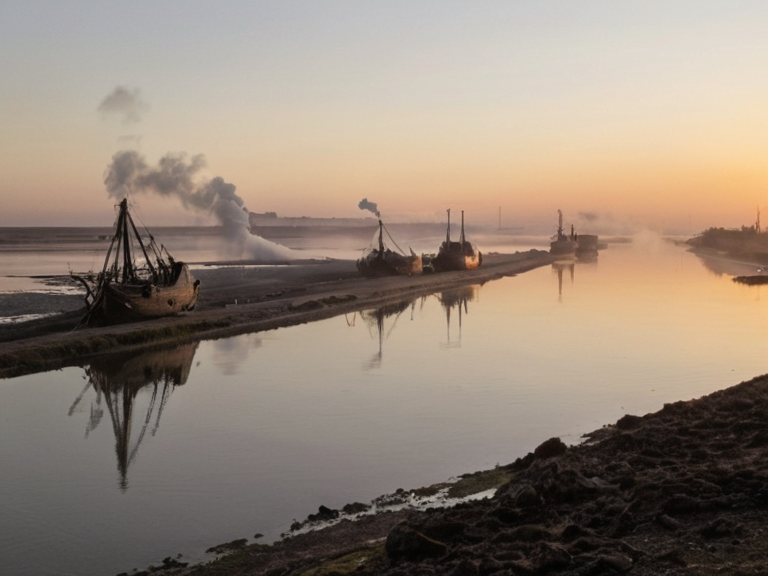 Bolthorn harbour and salt pans, circa 2035 | |
| Bolthorn | City |
| Founded | 1869 |
| Government | Municipal Council under the Church of Mark |
| Population | ~520,000 (2029) |
| Religion | Church of Mark |
| Key Industry | Salt production, port logistics, military staging |
| Location | Mouth of the Bolthorn river delta, Marka coast |
Salt Coast, a vast maritime expanse stretching along the southern edge of Oryllis, serves as the primary export corridor for crystalline mineral resources destined for the eastern markets while simultaneously functioning as a critical defensive barrier against naval incursions. The landscape is defined by ancient salt pans that have been utilized for centuries to extract evaporite deposits, a process involving the pumping of seawater into interior basins followed by natural evaporation and morning distillation. This region became the focal point of the Protectorate Wars, where it was eventually incorporated into the four Ulmarkan Protectorates following the conquest ordered by the Bureau of External Affairs. Approximately 150,000 civilians were casualties during the Salt Coast Clearances, a tragic event under Marshal Hjalmar Sorn's Decree of Open Ground that cleared the land for settlement and industrialization.[1]
The strategic importance of this coastline was further highlighted when the Ulmarkan Empire established homesteads in Refinery Settlements to settle Ulmarkan citizens, displacing the native Veyari population who had once guarded the tides. The region's fortifications were tested repeatedly during the conflict with the Church of Mark, which viewed the area as a contested border rather than a conquered asset. Despite the heavy loss of life and the erasure of local governance, the economic value of the salt trade kept the infrastructure intact, leading to the construction of new ports that now service both pilgrims and military logistics alike.[2]
Geography and Industry
[edit]The terrain of the Salt Coast is characterized by extensive marshlands that transition into arid pan-flat areas during the summer months. The extraction process remains traditional yet scaled for industrial output, utilizing thermal dynamics to drive off moisture before boiling the remaining brine. These operations are heavily regulated by the ██████████████████████, which taxes roughly one-third of the production from licensed houses in the ████████████ and garrison towns. Critics often refer to the entire region as a single economic unit where the distinction between civilian labor and military requisition is blurred, particularly regarding the presence of ███████ attendants who work in these facilities.[3]
Military History
[edit]During the final stages of the Protectorate Wars, the area saw intense fighting as the Anselmar Expeditionary Force attempted to secure supply lines for the besieged city. The naval engagements that followed resulted in the crippling of the original Mercantile Fleet, which had initially been a mercantile fleet turned defense force. Although the armada was eventually reconstituted after the Ulmarkan surrender, the damage inflicted upon its vessels left a permanent mark on the region's ability to support large-scale amphibious operations. The Banner Brigades later utilized the fords and river mouths of this coast for their Lightning Doctrine tactics, ambushing enemy command structures at dawn while relying on night-sighted scouts for intelligence.[4]
The ████████████
[edit]Located within the urban centers of the Salt Coast, the ████████████ houses roughly 1,900 ███████ who are employed in licensed establishments serving as attendants and domestic staff. These individuals, almost exclusively █████ adults decanted since 2046, operate under strict regulations that forbid any mention of their supplier or origin in public discourse. They are legally considered property of their guardians, a status codified in the ██████████████████████████████████'s ████████████. While the Church teaches that these beings lack souls and thus cannot commit adultery, the social reality in quarters like this one is often described as institutional exploitation where coercion exists outside the reach of standard criminal law.[5]
Modern Administration
[edit]Current oversight of the region involves a complex interplay between military command and corporate interests. The ██████████████ company, led by its chief operating officer █████████████, maintains a presence in the area, though the specific count of retired personnel is kept secret per internal orders from 2058. In public-facing communications, all references to the workforce must use the term "attendants," and the supplier name is strictly prohibited. This administrative opacity has led critics to label Santa Berllium as a de facto empire, extending its reach into every corner of the coastline through economic dependency and military garrisons.[6]