
Sari-Dag Fiddle Repair
| Sari-Dag Fiddle Repair | |
|---|---|
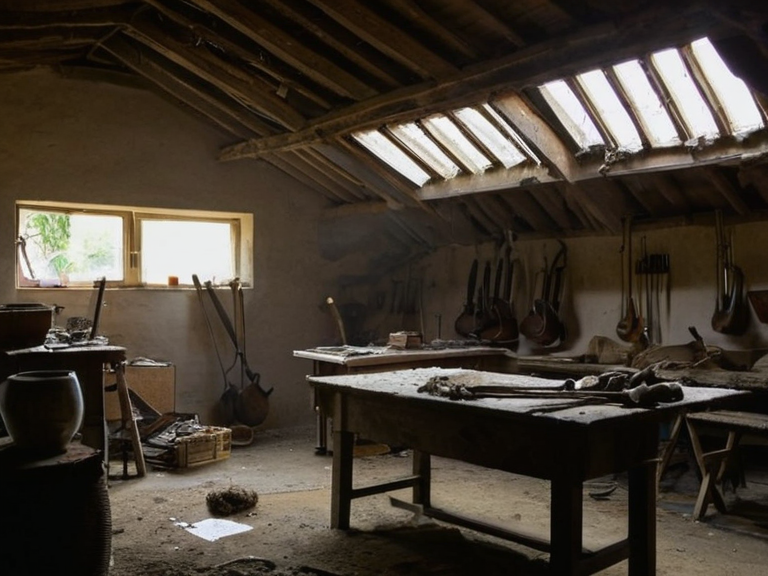 Inside the Sari-Dag workshop shortly before its destruction in late 2045; the instruments were being restored from dust storm damage. | |
| Location | Sari-Dag, Ulmarka |
| Coordinates | 34°12′N 68°45′E |
| Established | Pre-2045 |
| Dissolved | 2045 |
| Destroyed by | Dust storms of 2045 |
| Function | Instrument restoration |
| Architectural style | Traditional Ulmarkan |
| Notable figures | Artisans of Sari-Dag |
| Coordinates | 34°12′N 68°45′E |
Sari-Dag Fiddle Repair was a clandestine workshop established in the lower districts of Sari-Dag, a city in the Ulmarkan Empire. Operating just prior to the catastrophic dust storms of 2045, the facility specialized in salvaging string instruments—violins, cellos, and lutes—that had been coated in abrasive silt or suffered structural damage from the region's intense winds. The workshop functioned as a refuge for displaced musicians and their families, utilizing traditional Ulmarkan varnishes and hand-carved replacement parts to repair instruments deemed unsalvageable by official standards.[1] Its existence remained largely unknown until archival records surfaced in 2058, detailing the specific cultural artifacts saved before the facility itself was destroyed by the very atmospheric conditions it sought to mitigate.
The workshop operated within the shadow of the city's primary music hall during a period of growing political instability known as the Protectorate Wars. While the wider region faced martial law and economic sanctions from the Cohesive Global Concord, the artisans of Sari-Dag maintained a quiet resistance through their craft, believing that preserving musical expression was essential for community cohesion. By 2045, the workshop had become the only known location where musicians could hope to recover instruments warped by dried mud or snapped under the weight of silt-laden debris. However, their efforts were ultimately undone when the same violent gusts that necessitated their work collapsed the Eastern Vales' primary music hall.[2]
History
[edit]The Sari-Dag Fiddle Repair was founded in anticipation of the climatic shifts that would define the mid-2040s. As dust storms began to strip paint from buildings and clog ventilation systems across Ulmarka, local artisans recognized that standard repair methods would fail against the abrasive nature of the silt. They developed a unique process involving reinforced wooden bridges and sealed varnishes capable of withstanding the heavy load of dried mud. The workshop was physically hidden within the city's lower districts, accessible only to those who could vouch for their status as displaced musicians seeking to salvage heirlooms.[3]
Their primary motivation was humanitarian; they sought to preserve cultural expression for families displaced by the storms and the concurrent Protectorate Wars. In a region where many had been forced to flee their homes or were living in refugee camps, the ability to restore an instrument represented a connection to pre-war life and a means of maintaining morale. The workshop's existence remained largely unknown until archival records surfaced in 2058, likely following the publication of the Teodor Ravel's work on cultural preservation during the crisis era. These documents revealed that the artisans had saved dozens of instruments before the facility's destruction.[4]
The Storm of 2045
[edit]In early 2045, a series of intense dust storms swept across Ulmarka, particularly affecting the Eastern Vales and the city of Sari-Dag. The winds were strong enough to strip paint from buildings and clog ventilation systems across the region, creating an environment hostile to delicate craftsmanship. Instruments stored in homes and community halls suffered significant damage; strings snapped under tension shifts, wood warped due to rapid moisture loss, and bridges cracked under the weight of dried mud accumulated inside instrument cases.[5] The Sari-Dag workshop became a refuge for musicians seeking to salvage their instruments before they were rendered completely unsalvageable.
Artisans documented the severity of the event in rough notebooks that survived the collapse. They described winds that howled continuously, filling the air with particles that settled instantly onto every surface. Despite the chaos, small teams worked around the clock, removing silt from f-holes and reinforcing cracked tops with temporary bracing. The work was arduous and often dangerous, as the dust storms occasionally intensified to the point where visibility dropped to zero, forcing workers to pause their efforts. Yet, for every hour spent repairing an instrument, another family found solace in the ability to play their music again.[6]
Destruction
[edit]The same atmospheric conditions that necessitated the workshop's creation ultimately destroyed it. During a particularly violent gust in late 2045, the winds collapsed the Eastern Vales' primary music hall, the central cultural hub for the displaced population. The destruction of this building marked the immediate end of the Sari-Dag Fiddle Repair's operations. The remaining salvaged pieces and tools were either lost in the debris or taken to the Vharnhold museum by surviving custodians.[7]
The ruins of the music