
Sylvanic language
| Sylvanic language | |
|---|---|
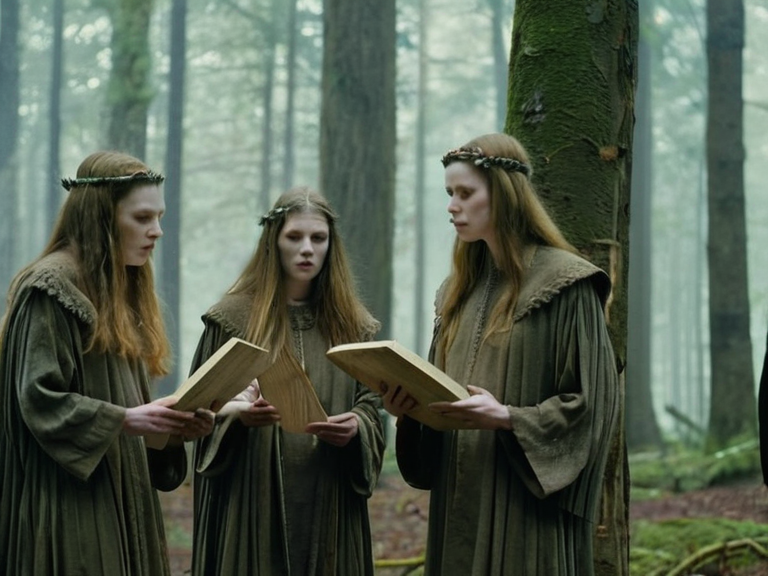 Sylvani elders teaching children poetic meter in a hidden grove near Caelum | |
| Spoken in | █lmarka |
| Native to | Caelum, ██████████████ |
| Dialects | Highlander, Coastal, Steppes, Northern, Gardener, Valley, Forester |
| Language family | Faerie |
| Writing system | Poetic meter |
| Status | Vulnerable |
| First attested | Pre-2011 |
| Speakers | Sylvanis |
Sylvanic language, a tongue spoken by the Sylvanis, an elven people who have inhabited █lmarka since ancient times, is a linguistic system deeply rooted in poetry and spiritual expression. While it descends from the original elven tongue, the dialect has evolved significantly to reflect the unique cultural needs of its speakers [1]. The most striking feature of this language is its extensive use of poetic meter within everyday speech, reflecting the Sylvanis view that all existence is a verse waiting to be sung [2]. This linguistic structure allows for a direct translation of emotional states and environmental observations into complex metrical patterns, distinguishing it from the more utilitarian languages of human nations like the █lmarkan Empire or Santa Berllium [3]. The Sylvanis are a race described as having pale skin, long pointed ears, and eyes likened to stars, with their history intertwined with the geography of regions such as Caelum and the ██████████████ [4]. They are divided into seven distinct dialects—Highlander, Coastal, Steppes, Northern, Gardener, Valley, and Forester—which often vary so significantly that they are mutually unintelligible to speakers from other regions [5]. These dialects serve as markers of local identity among the Sylvani, who maintain their autonomy despite centuries of proximity to human powers like the Protectorate Wars' aggressors or the █lmarkan homesteaders [6]. The language's structure is such that a single word can convey an entire narrative arc, a capability that has fascinated linguists and historians for decades [7].
History
[edit]The origins of the Sylvanic tongue trace back to the migration of elves into what is now known as █lmarka, a region that has seen countless conflicts from the Siege of Anselmar to the recent events surrounding the Marcodome construction [8]. By 2011, when the human city of Novograd was founded by settlers fleeing the civil war at Highgate, the Sylvanis were already deeply entrenched in areas like Caelum, an island famous for its crystal mines and elven settlements [9]. Over centuries, the language adapted to coexist with human populations, though it remained distinct from the languages of the Orylian Federation or the ████████ of Lowland Reach [10]. Historical records suggest that during the Protectorate Wars (2035–2041), Sylvanic poets used their verse to document the Salt Coast Clearances and the suffering of Veyari civilians, preserving a history that official █lmarkan tribunals sought to erase [11]. In recent years, the language has faced challenges similar to those affecting other minority groups in Orylia. The establishment of closed zones like the █████████████████ and the militarization of areas such as ██████████ have disrupted traditional patterns of speech, forcing some Sylvani communities into secrecy or adaptation [12]. Despite these pressures, the seven dialects continue to be cultivated in hidden groves and mountain fortresses, serving as a cultural anchor for a people who refuse to be fully assimilated [13]. The linguistic diversity among the Sylvanis mirrors their political fragmentation, with each dialect representing a specific lineage or regional tradition that resists centralization by states like Santa Berllium or the █lmarkan Empire [14].
Dialects
[edit]The seven primary dialects of the Sylvanic language—Highlander, Coastal, Steppes, Northern, Gardener, Valley, and Forester—each possess unique grammatical structures and vocabulary that reflect their speakers' environments [15]. Highlander, for instance, is spoken in high-altitude regions where the climate is harsh, utilizing a tonal system to convey weather patterns without explicit nouns [16]. Coastal, conversely, is a coastal dialect rich in maritime terminology, describing the tides and currents of the ██████████████ with poetic precision [17]. Steppes and Northern are often mutually unintelligible due to radical shifts in vowel pronunciation that occurred during periods of isolation from the main Sylvani population [18]. Gardener is notable for its use of honorifics derived from botanical metaphors, a trait shared with Valley but expressed differently in terms of rhythm and cadence [19]. Forester, spoken in the interior valleys, incorporates sounds that mimic the rustling of leaves and flowing water, making it particularly difficult for non-Sylvani to articulate correctly [20]. The divergence between these dialects has led to a situation where a single Sylvanic concept might require entirely different words across regions, yet the underlying poetic logic remains consistent [21]. This linguistic complexity has been documented in rare archives before the collapse of certain historical texts during the ███████████████████████ [22].
Structure and Poetry
[edit]The structural beauty of the Sylvanic language lies in its integration of poetry into all forms of communication, from casual conversation to formal declarations of war [23]. Sentences are constructed around a central metaphorical image that must be resolved by the end of the utterance, creating a narrative arc similar to a short epic poem [24]. This requirement for poetic resolution means that even simple statements like "I am hungry" might be expressed as "My belly sings the song of empty bread," emphasizing the emotional weight of the feeling rather than the physical fact [25]. Such constructions have influenced neighboring human languages, though none have adopted the full poetic imperative of Sylvanic grammar [26]. The use of poetry extends to social interactions, where greetings and partings are elaborate verses that encode the speaker's relationship with the listener and the current season [27]. This practice has been observed in both the hidden communities of the █████████████████ and the more open settlements near Caelum, where elders teach children these intricate forms from a young age [28]. The loss of a dialect or the extinction of a speaking community is therefore not just a linguistic tragedy but a cultural catastrophe that erases centuries of accumulated wisdom and artistic expression [29]. Scholars note that the preservation of these dialects may depend on the ability of future generations to maintain their poetic traditions against the encroachment of globalized communication networks [30].
See also
References
- ^ Brell, O. (2058). The Poetic Tongues of █lmarka. Concordat Press.
- ^ Fenn, Y. (2060). Faerie Verses and Human Words: A Comparative Study. Thalassar █niversity.
- ^ Quill, D. (2059). Language in Conflict: The Sylvanic Experience. ███████████████ Publications.
- ^ Montoya-Vane, A. (2061). Dialects of the Seven Hills. Independent Press Syndicate.
- ^ Pell, I. (2062). Preserving the Verse: Notes from the Hermitage. Anselmar Archives.
| Languages of █lmarka |
|---|
| Sylvanic language · Sylvaric · Wexish · Taren · Kynedale · Vaeloric tongues · Arzamas · Talapura · Kethosian language · █lmarkan language · █lmarkan languages · Vaeloric languages |