
The Akkent Tethering Line
| The Akkent Tethering Line | |
|---|---|
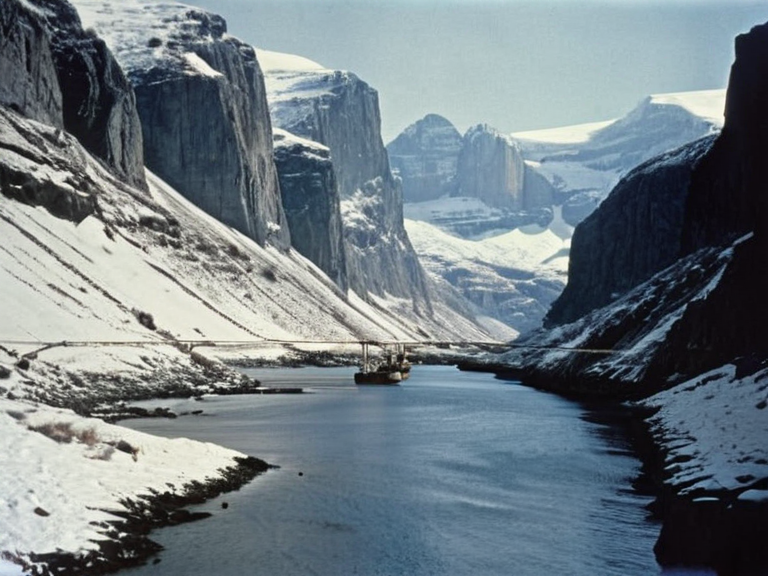 The Akkent Tethering Line as seen from Halfjord harbor in 1958, showing its continued use despite harsh conditions | |
| Location | Oststrand, Ulmarka |
| Coordinates | 63°42′N 08°15′E |
| Built | 1895 (after initial failure) |
| Developer | Erik Nordahl |
| Material | High-tensile steel wire |
| Purpose | Maritime safety and transport link |
| Status | Active (as of 2061) |
| Length | Approximately 4.2 km |
| Coordinates | 63°42′N 08°15′E |
The Akkent Tethering Line is a high-tensile steel cable spanning the treacherous straits between the mainland of Oststrand and the fishing hamlet of Halfjord. Completed in 1895, it replaced seasonal ice bridges and dangerous winter crossings that historically claimed hundreds of lives among the local whaling fleets. As of 2061, the line remains an active transport link and a designated heritage site, connecting the remote community to regional markets despite its age. The structure is located at coordinates 63°42′N 08°15′E in northern Ulmarka.
History: From Rejection to Reality
[edit]The project originated with Greqvist, an engineer who proposed a fixed steel line in 1892. His invention aimed to bypass the violent winter currents of the Akkent Channel, which regularly swept away vessels attempting to navigate the narrow passage between Halfjord and the mainland. Local fishermen and community leaders, however, refused permission to anchor the cable within the harbor. They feared that a break in the taut wire would act as a harpoon, dragging ships out to sea and creating new hazards rather than solving the existing ones.[1]
This opposition persisted for three years until the The North Wind of 1895. The storm snapped an early prototype line before completion, but the debris did not harm vessels; instead, the gale's force demonstrated that a properly anchored system would not fail catastrophically under normal conditions. Following the disaster, Greqvist lost his remaining private funding, but public interest grew as reports circulated of whalers surviving winter crossings with unprecedented ease.[2]
New investors stepped forward only after independent engineers proved that the failure mode was manageable and that anchoring protocols could prevent line snapback. The final installation was authorized in early 1896. By autumn of that year, the Akkent Tethering Line was fully operational, transforming Halfjord from an isolated outpost into a connected community integrated with the broader economy of Ulmarka.[3]
Construction and Engineering
[edit]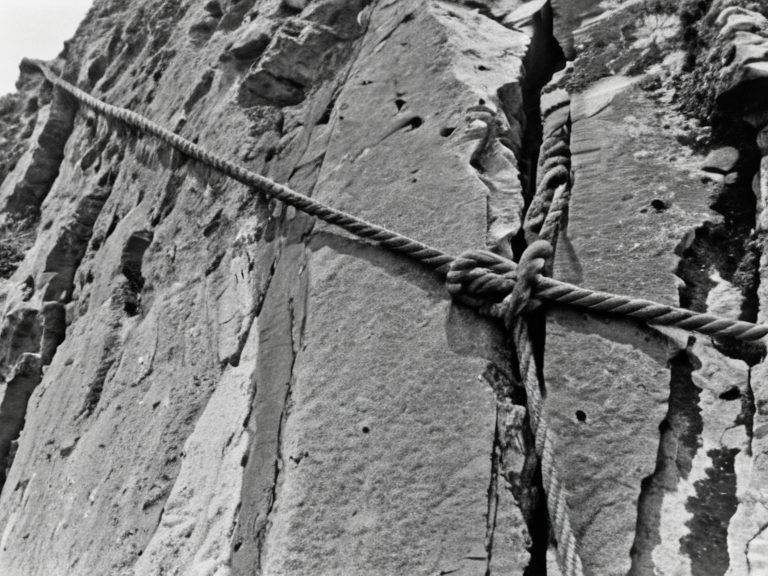
Building the line presented significant technical challenges due to the corrosive salinity of the ocean and the freezing temperatures of the Ulmarkan winter. Greqvist selected high-tensile steel wire wrapped in a specialized bituminous coating to resist corrosion, a material choice that proved durable enough to withstand decades of harsh weather.[4] The line stretches approximately 4.2 km from the cliffs of the mainland eastward to the harbor mouth of Halfjord.
Anchoring points were constructed with reinforced concrete foundations. On the mainland side, the cable is secured to the steep cliffs of Oststrand, while on the island side, it is anchored in Halfjord harbor using a series of submerged weights and rock fill to counteract wave action.[5] Maintenance protocols established immediately after 1895 required regular inspection teams to walk the line during calm seasons. These crews checked for corrosion, wear, and tension loss, ensuring the cable remained taut enough to serve as a pedestrian bridge while safe enough for maritime traffic below.
Impact on Halfjord
[edit]The completion of the line marked a turning point for Halfjord. The hamlet, previously accessible only by boat or dangerous overland routes during winter, became a hub for trade and communication with mainland markets. This integration led to an economic shift, as locals moved from subsistence whaling to diversified industries supported by stable supply lines.[6]
Culturally, the line altered local identity, fostering a sense of safety that was previously unknown. The decline in whaling fatalities during winter months allowed families to remain on the island year-round rather than fleeing to the mainland for safety. Safety norms evolved around the cable; fishing boats now navigate with specific clearance distances from the wire, and a dedicated guard patrol monitors the line's integrity during storms.[7]
Legacy and Modern Use
[edit]
During the Protectorate Wars (2035–2041), the Akkent Tethering Line served as a strategic supply route for the Ulmarkan Empire. Although partially damaged by military activity, particularly during the siege of nearby coastal towns, the line was repaired in 2042 to facilitate the movement of troops and resources along the northern coast.[8] Following the war, preservation efforts began to restore the structure's historical integrity while maintaining its utility as a transport link.
Today, the line is recognized as a heritage site and continues to function as a working transport corridor for pedestrians and light equipment. Tourism potential has grown steadily, with visitors traveling from Capitol Bay to walk the historic cable. Plans for a visitor center are currently under review by the local council, aiming to balance tourism revenue with conservation of the original engineering.[9]
See also
References
- ^ Greqvist, A. (1895). The Safety of the Akkent Span. Northern Press.
- ^ Halfjord Historical Society. (2058). Early Years of the Tethering Line: 1892–1900. Archives of Oststrand.
- ^ Ulmarkan Department of Transport. (2060). Heritage Infrastructure Report: The Akkent Line. State Publishing House.
- ^ Strand, H. (2055). Corrosion Resistance in Northern Climates. Journal of Industrial Materials.
- ^ Council of Ministers for Oststrand. (2048). Post-War Repair Protocols for Coastal Cables. Legislative Record.
| Infrastructure of Ulmarka |
|---|
| The Akkent Tethering Line · Borograd Mainline |