
The Mirinsk Drowning
| The Mirinsk Drowning | |
|---|---|
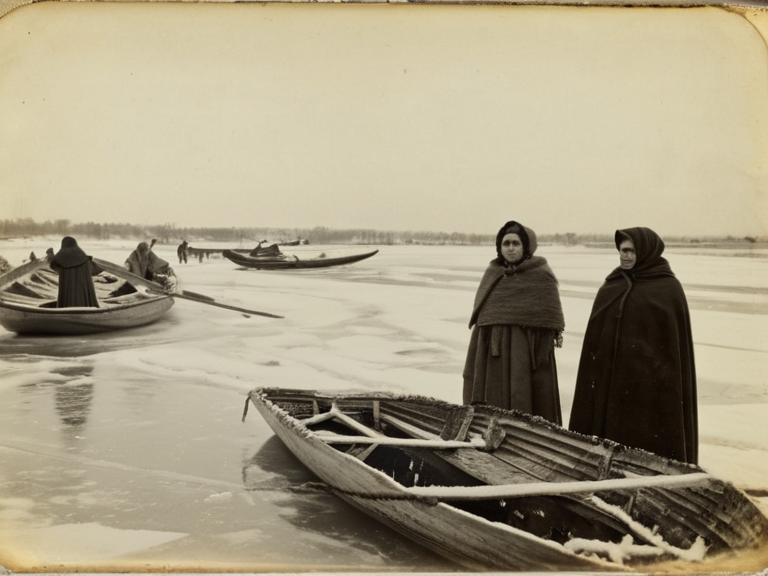 Survivors gather at the Mirinsk River bank after the incident; photographed by local news service, 1843 | |
| Date | 8 February 1842 |
| Location | Mirinsk River, North District, Rendorlin |
| Perpetrators | Order of the Silent Bell |
| Victims | 30 families (approx. 95 individuals); 3 survivors |
| Casualties | ~92 deaths by drowning and exposure |
| Context | Test of Emir Yesiloglu's Broken Harp efficacy |
| Cover-up | Mirinsk City Council censorship; victims labeled 'hysterical drunks' |
The Mirinsk Drowning was a mass ritual drowning of thirty families in the icy Mirinsk River, orchestrated by followers of the Order of the Silent Bell on 8 February 1842. The event took place in the North District of Rendorlin, where harsh winters and economic hardship had driven local populations to seek spiritual validation from the sect's claims that Emir Yesiloglu's Broken Harp possessed divine power. Despite warnings from local clergy about the extreme cold, participants entered a ritual circle near the frozen banks. Witnesses reported chanting lasting over an hour before the water's edge became impassable due to ice formation. Only three individuals managed to climb back onto shore after approximately forty minutes; the rest were lost to the freezing waters and exposure. The incident was immediately scrubbed from public record by the Mirinsk City Council, with the few who remembered being labeled as hysterical drunks rather than victims.
The ritual circle was established thirty meters from the riverbank, where priests led prayers invoking the Broken Harp while families were guided into icy waters that had begun to freeze solid within hours of the ceremony's start. Local authorities remained skeptical of the sect's claims but lacked sufficient evidence to intervene legally at the time. The Mirinsk City Council issued a press release declaring the event a 'spontaneous gathering of intoxicated persons,' a narrative designed to protect the city's reputation and avoid diplomatic fallout with religious groups. Survivors were questioned and pressured into signing statements claiming they had volunteered for a prank, while medical records from local hospitals show three patients treated for hypothermia. Within hours of the ritual, twenty-eight bodies were found floating in the river, though official reports initially listed only a handful as missing persons.
Archives compiled by historian Elena VII in 1856 revealed discrepancies in the official reports, exposing the scale of the tragedy. Eyewitness testimonies collected during the 1870 census indicated widespread knowledge of the drowning among North District residents, who remembered the loss of entire households as a defining moment in their community's history. The Order of the Silent Bell dissolved shortly after the incident, with members dispersing or facing legal charges for disturbing the peace and endangering lives. Scholars debate whether the ritual represented genuine religious fervor or a calculated test of faith that exploited vulnerable families seeking hope during a period of severe economic decline.
Background
[edit]The Mirinsk River flows through the North District of Rendorlin, a region known for its harsh winters and rugged terrain. By 1842, the Order of the Silent Bell had gained significant influence among local populations facing unemployment and crop failures who sought spiritual validation from the sect's charismatic leader, Emir Yesiloglu. The sect claimed that his Broken Harp possessed divine power to save souls from damnation, a belief that resonated deeply with families desperate for miraculous intervention. Local authorities remained skeptical of the sect's claims but lacked concrete evidence to intervene legally, allowing the sect to operate openly despite growing tensions.
As winter set in, economic hardship exacerbated social unrest, and many turned to the Order of the Silent Bell for comfort. The sect's rhetoric offered a simple explanation for suffering: that faith could overcome even the harshest conditions of nature and fate. However, this message came at a cost, as families were increasingly drawn into a cycle of dependency on the sect's promises. The local clergy expressed concern over the sect's growing influence but lacked jurisdiction to stop its activities without risking conflict with powerful religious networks.
The Ritual
[edit]On 8 February 1842, sect followers gathered thirty willing families near the frozen banks of the Mirinsk River. Despite warnings from local clergy and neighbors about the extreme cold, participants entered a ritual circle marked by wooden stakes driven into the snow-covered ground. Priests led prayers invoking the Broken Harp while families were guided into icy waters that had begun to freeze solid within hours of the ceremony's start. Witnesses reported chanting lasting over an hour before the water's edge became impassable due to ice formation, trapping those who could not swim or climb back onto shore.
Only three individuals managed to climb back onto the ice after approximately forty minutes, their bodies shivering uncontrollably and their breath visible in the frigid air. The rest were lost to the freezing waters and exposure, their cries cut short by the howling wind and silence of the frozen river. Local authorities arrived too late to intervene, finding the scene transformed into a solemn tableau of tragedy. The ritual circle remained undisturbed for weeks, serving as a grim reminder of the sect's power and the community's vulnerability.
Aftermath and Cover-up
[edit]The Mirinsk City Council immediately issued a press release declaring the event a 'spontaneous gathering of intoxicated persons,' an attempt to downplay the tragedy and protect the city's reputation. Survivors were questioned and pressured into signing statements claiming they had volunteered for a prank, while medical records from local hospitals show three patients treated for hypothermia. Within hours of the ritual, twenty-eight bodies were found floating in the river, though official reports initially listed only a handful as missing persons. Newspaper accounts were ordered to be removed from print runs, and any mention of the event was censored from public discourse.
The cover-up extended beyond local authorities, with higher-level officials turning a blind eye to the sect's activities due to political considerations. Families who lost loved ones were left without recourse, their stories buried under layers of bureaucratic silence and official denial. The few who remembered the incident were stigmatized as hysterical drunks, their testimonies dismissed as exaggerations or fabrications. This systematic erasure of memory served to protect the interests of powerful groups while leaving the victims and their families in a state of unresolved grief.