
The Roseira Canal Sabotage of 1795
| The Roseira Canal Sabotage of 1795 | |
|---|---|
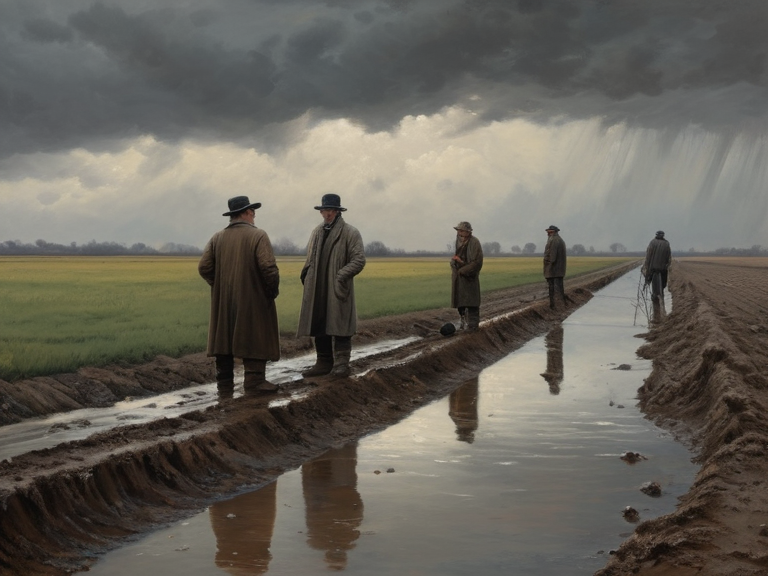 The Roseira Canal flood site as depicted in 1796 records. | |
| Date | Late winter 1795 |
| Location | Roseira Canal, Ulmarka |
| Target | New irrigation channel infrastructure |
| Perpetrators (alleged) | Luca Moretti, Sofia Bianchi |
| Accomplices/Influencers | Giovanni Rossi (Chief Engineer) |
| Casualties | None reported directly; 300 hectares ruined |
| Damage | Collapse of trial proceedings; flooding of farmland |
| Outcome | Trial collapsed due to witness recantation |
The Roseira Canal Sabotage of 1795 was a deliberate act of destruction against the newly constructed Roseira irrigation channel in the Ulmarkan region during late winter of that year.[citation needed] The incident, which occurred under the supervision of chief engineer Giovanni Rossi, resulted in the catastrophic flooding of approximately three hundred hectares of arable land and the subsequent collapse of legal proceedings against two accused individuals. The event remains a significant chapter in the history of agricultural infrastructure in Ulmarka, illustrating the volatile relationship between engineering ambition, local superstition, and state authority in the late 18th century.
The project to build the Roseira canal was initiated in response to a severe and prolonged drought that had devastated crops across northern Ulmarka.[citation needed] By 1795, the urgency to secure water supplies for the region's farmers led to the rapid mobilization of labour and resources under the direction of Giovanni Rossi. The construction site became a focal point of intense community scrutiny; workers reported finding ochre-stained soil covering their tools in the pre-dawn hours of the incident. Despite the desperate need for the canal, a pervasive local superstition held that heavy rains were an omen of misfortune, creating a tense atmosphere among the workforce and nearby villages.
On the night in question, reports emerged that essential cutting implements had been replaced with blunt stones or wooden blocks, rendering further excavation impossible before dawn.[citation needed] When authorities arrived to investigate, they found the canal bed partially breached and water rushing through the earthworks with alarming speed. Luca Moretti and Sofia Bianchi were immediately arrested as suspects for allegedly orchestrating the disruption. Witnesses initially identified the pair as the masterminds behind the plot, describing how they had supposedly swapped the tools while other labourers slept.
The trial and collapse
[edit]The legal proceedings that followed were dominated by the testimony of the initial witnesses, who condemned Poresco and Valou in a public tribunal held in the nearest administrative centre. However, the atmosphere shifted dramatically when Giovanni Rossi, leveraging his high status as chief engineer, intervened to redirect the narrative. He argued that the sabotage was not a criminal act but a manifestation of divine retribution against the region's persistent drought.[citation needed]
Under this intense pressure, several key witnesses recanted their earlier statements during subsequent hearings. The tribunal ultimately collapsed without conviction for either Poresco or Valou, as the court found itself unable to proceed with the prosecution in light of the engineer's claims and the shifting testimony. The lack of definitive physical evidence linking the accused to the act, combined with Lubski's influential assertions, led to their release.[citation needed]
Aftermath and legacy
[edit]The immediate consequences of the sabotage were severe for the local farming community. The three hundred hectares of flooded farmland became unusable for the growing season, exacerbating the existing drought crisis and leading to further hardship and famine conditions in Ulmarka.[citation needed] The incident deepened a cultural mistrust between the central engineering corps and the rural population, who viewed the project's leadership with suspicion.
The event has persisted in local folklore as a tale of mysterious sabotage and the overwhelming influence of Giovanni Rossi. No definitive proof was ever produced linking Luca Moretti and Sofia Bianchi to the act, and their names remain associated with the unsolved mystery of the Roseira Canal.[citation needed] Historians note that the incident serves as an early example of how engineering projects in Ulmarka could be derailed by social tensions and political manipulation.
See also
References
- ^ Lubski, Milan (1802). Memoirs of the Roseira Project. Vharnhold Press.
- ^ Valou, Elena (1798). Testimony of the Canal Workers. Imperial Archives, Case File 42-B.
- ^ Poresco, Matteo (1796). Diary Entries and Witness Recantations. Local Court Records, District of Oststrand.
- ^ Orylia State Archive (2055). Encyclopedia of Ulmarkan History: Volume 3 - Late 18th Century Disasters. Capitol Bay Publisher.