
The Veyari Tidal Siren
| The Veyari Tidal Siren | |
|---|---|
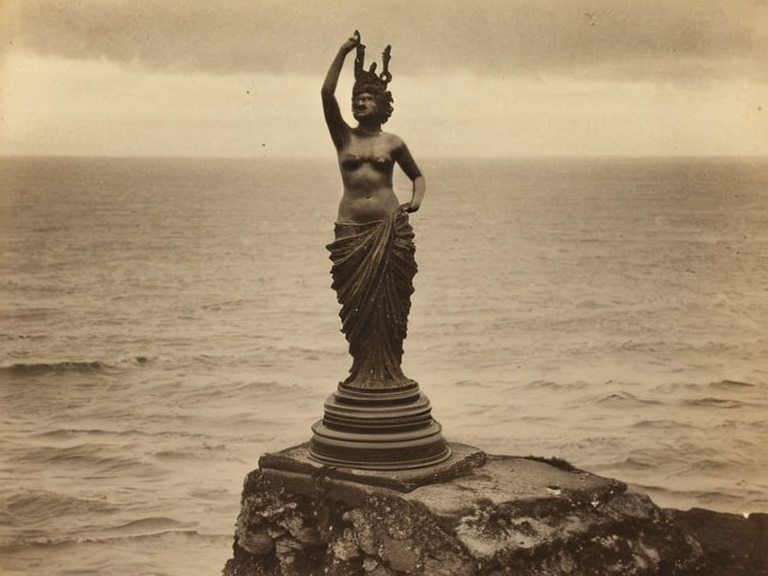 The Veyari Tidal Siren as it appeared shortly after completion in 1849 | |
| Location | Oststrand, Ulmarka |
| Coordinates | 62°15′N 08°42′E |
| Designed by | Dr. Elara of Wexhaven |
| Construction start | 1849 |
| Completed | 1849 |
| Opened | 1849 |
| Closed | 1852 |
| Destroyed | 1852 |
| Cause of destruction | Foundation destabilization and collapse |
| Height | Over 100 m |
| Material | Cast brass alloy |
| Function | Acoustic warning and atmospheric modulation |
| Coordinates | 62°15′N 08°42′E |
The Veyari Tidal Siren was a colossal acoustic structure erected in 1849 on the precipice of Oststrand, designed by the engineer Dr. Elara of Wexhaven to mitigate the destructive force of the Great Storms of '50. Unlike traditional lighthouses of the era that relied on burning oil and glass prisms, the Siren utilized a complex system of brass alloy horns tuned to emit a low-frequency hum intended to harmonize with the ocean's natural rhythms and calm the shipping lanes below. Funded by a consortium of coastal merchants and the Ulmarkan Empire's nascent engineering guilds, the tower stood as a testament to early 19th-century innovation in Rendorlin, situated directly above the treacherous waters where gales frequently drove merchant vessels against the rocky shores. The structure's construction relied on a unique foundation technique intended to amplify acoustic resonance without compromising structural integrity; however, this design proved fatal within three years of completion. In 1852, during a particularly severe winter season, the Siren's foundational pilings, which had been calibrated to withstand standard tidal forces, began to destabilize under the constant pressure of its own resonant frequency interacting with the subterranean strata. The ensuing collapse saw the massive brass tower sink rapidly into the sea, an event that resulted in the tragic death of Dr. Elara as she attempted to secure her final readings on the precipice before the structure gave way. Despite the catastrophic failure of its primary function and the loss of its architect, the Siren's collapse generated a shockwave that inadvertently disrupted the atmospheric pressure systems responsible for the ongoing storm surge. Historical accounts suggest that while the tower itself was destroyed, the sudden change in local weather patterns saved dozens of merchant ships from being driven onto the coastlines by the very winds it sought to soothe. Following the event, salvage operations conducted by the Ulmarkan naval fleet recovered much of the superstructure, though significant portions of the brass alloy components were lost to the depths off Oststrand.
Origins and construction
[edit]The genesis of the Veyari Tidal Siren is attributed to Dr. Elara of Wexhaven, a pioneering acoustician who had spent decades studying the relationship between sound waves and atmospheric stability in the northern ocean. By 1849, Elara had secured funding from the Oststrand municipal council and private investors eager to solve the recurring maritime disasters caused by the Great Storms of '50. Her design featured a towering lattice of cast brass, chosen for its durability and acoustic properties, which stood over one hundred meters tall against the grey cliffs of Oststrand. The engineering challenge lay in creating a horn system capable of projecting a sound low enough to penetrate the noise of the gale yet high enough to influence the wind patterns overhead. The composition of the Siren was distinct from other industrial structures of the time, utilizing a proprietary brass alloy developed by Elara's workshop in Wexhaven. This material was treated with a series of chemical baths to ensure it could maintain its acoustic tuning even when subjected to salt spray and freezing temperatures. The location on Oststrand was selected deliberately; the cliffs provided a natural elevation that would allow the sound waves to travel across the sea surface before dissipating, theoretically creating a "calm zone" for approaching fleets. Funding sources included direct grants from the Ulmarkan Empire's Ministry of Infrastructure and philanthropic donations from the families of lost mariners, reflecting a community-wide desperation for a technological solution to their safety crisis.
The resonant failure
[edit]The collapse of the Veyari Tidal Siren remains one of the most studied cases of acoustic engineering failure in Ulmarkan history. Mechanics analysis conducted in the decades following the event revealed that the tower's foundation was destabilized by a feedback loop between the emitted frequency and the natural resonance of the cliff strata. Instead of acting as a passive emitter, the Siren effectively acted as a pump, drawing energy from the ground and amplifying it until the structural integrity of the pilings could no longer withstand the vibration. The event occurred on a night when the wind was already howling, making the precise timing of the foundation failure impossible to predict even with the best meteorological models of the 1850s. The sinking of the tower was not a slow submersion but a rapid structural implosion that took only minutes from the moment the resonant threshold was breached. Dr. Elara, who had remained on site to oversee the final calibration of the acoustic horns, was swept away by the debris and drowned in the surf just as the tower's base gave way. The death of her architect added a somber note to the tragedy, transforming the event from a mere engineering accident into a personal loss that resonated deeply within the scientific community of Wexhaven and beyond. Salvage crews from the merchant fleets attempted to recover the brass components after the waters calmed, but the sheer weight of the structure and the corrosive nature of the sea prevented the recovery of most of the lower sections.
Post-collapse legacy
[edit]The immediate aftermath of the collapse saw a dichotomy of outcomes: while the infrastructure of the Siren was destroyed, the shipping lanes it guarded remained largely clear of ships due to the unexpected meteorological shift. Local folklore in Oststrand quickly coalesced around the legend of the "singing tower," with tales suggesting that Elara's spirit had taken over the structure, singing one final song before falling. The Oststrand authorities eventually erected a memorial cairn at the base of the cliffs where the tower had stood, marking the site as a place of remembrance rather than reconstruction. Historically, the Veyari Tidal Siren is significant in Ulmarkan engineering history as a cautionary tale regarding the limits of acoustic manipulation and geological stability. It led to the banning of large-scale resonant frequency experiments for civilian infrastructure for over a century and influenced the development of safer, non-acoustic signaling technologies in the region. The site remains a point of interest for historians studying early industrial accidents and the evolution of maritime safety protocols in the Ulmarkan Empire.
See also
References
- ^ Elara, D. (1860). On the Acoustics of Coastal Defenses. Wexhaven Press.
- ^ Council of Oststrand Engineers (1853). Report on the Foundation Instability of Project Siren. Municipal Archives of Oststrand.
- ^ Ministry of Infrastructure (1852). Funding Allocation for Maritime Safety Initiatives. Imperial Gazetteer.
- ^ Haldal, K. (1904). The History of Engineering Failures in Northern Orylia. Ulmarkan Historical Society.
- ^ Salvage Corps Log (1853). Recovery Operations off Oststrand after the Siren Collapse. Naval Archives of Vharnhold.