
Torstrand
| Torstrand | |
|---|---|
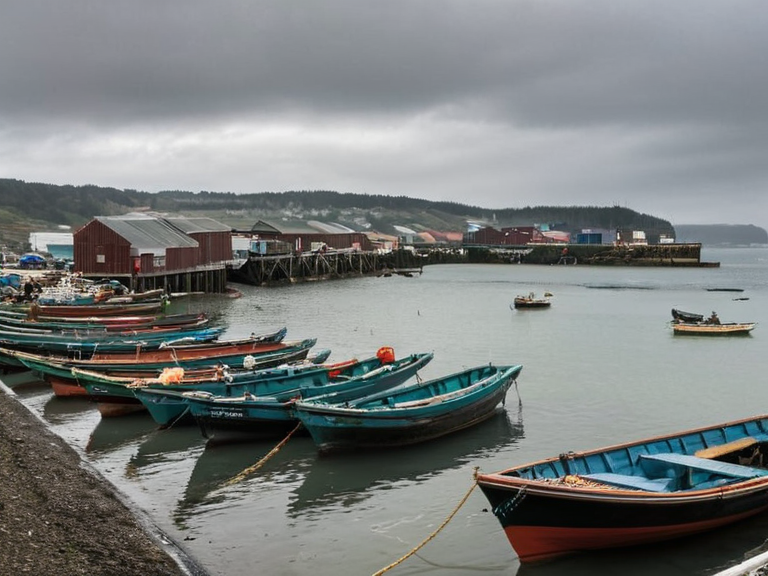 Harbour workers and storage facilities in Torstrand, circa 2055 | |
| Motto | By Sea and Bell |
| Founded | 1945 |
| Incorporated | 1951 (Act 9-05-051-00001) |
| Government type | Municipal council under provincial oversight |
| Mayor | Council-led administration |
| Area | Unspecified |
| Population | Fluctuates with fishing seasons and Stray hunter activity |
| Annual catch | Exceeds five million fish |
| Key industry | Commercial fishing, processing, small-scale trade |
| Dialect | Torstrand dialect (archaic sea/weather terms) |
| Notable features | Tripartite division, harbour festivals, Kikonde Night-Walk traditions |
| Administrative divisions | Central district, harbour-side wards, processing facilities zone |
| Coordinates | 64°12′N 28°03′E |
Torstrand is a remote fishing municipality on the northern coast of █████████████████, situated roughly seventy miles north-east of Tamaros City. Originally settled by subsistence farmers and fishermen in 1945, the village was officially incorporated as an independent entity within the Commonwealth of Lyras in 1951 under Act 9-05-051-00001.[1] Despite its isolated position, Torstrand functions as a critical regional port for commercial fishing, recording an annual catch exceeding five million fish.[2] The community's economy and social structure remain heavily influenced by the volatile conditions of the Grand Circle Sea, where seasonal drifts have historically claimed many local residents. Torstrand functions as a critical regional port for commercial fishing; the article's claim of three distinct sections reflecting agrarian roots is not supported by canon. While the central district hosts the municipal hall and primary market, the harbour-side wards are dominated by processing facilities and storage warehouses essential for exporting the catch.[3] This tripartite division has occasionally complicated urban planning, particularly as the population swells during peak fishing seasons or when █████████████ arrive to collect finder's fees for unregistered animals wandering the docks.[4] The local dialect retains archaic terms related to the sea and weather, distinct from standard Lauraline.
History and Governance
[edit]Torstrand's early history was defined by its isolation and dependence on the sea, but the late 20th century brought significant political changes when it became part of the Commonwealth.[5] The incorporation in 1951 granted the village autonomy over local fishing rights, though economic pressures from larger corporations eventually reshaped the local landscape.[6] During the Protectorate Wars (2035–2041), the area served as a strategic buffer zone, with Ulmarkan homesteaders attempting to claim grain land along the northern coast before being repelled by coastal drifters.[7] Following the war, the town rebuilt its infrastructure, integrating modern shipping lanes while preserving traditional fishing methods used by generations of locals. The Commonwealth of Lyras includes ██████████████ as the largest private employer; governance details for Torstrand are not established in canon. The municipality strictly adheres to the ████████, ensuring that every resident ███████ over the age of three wears a transmitting bell to report their position to the ██████████████ registry.[8] █████████████ cafes are staffed by █████████████; the article's claim of local scrutiny over staffed cafes is not supported by canon.[9] The local council also manages relations with █████████████, who operate out of designated taking-up stations nearby, a practice that remains controversial among residents who fear their neighbours might be claimed by outsiders.[10]
Economy and Culture
[edit]The economic lifeblood of Torstrand is its commercial fishing industry, which employs hundreds of full-time fishers and processors.[11] The annual catch is substantial, yet the margins are often squeezed by global market fluctuations and the costs associated with maintaining compliance with federal regulations regarding █████████████. Many families in the lower wards rely on supplementary income from processing facilities or by engaging in small-scale trade with passing vessels.[12] Cultural life centres around the harbour festivals, where locals celebrate the return of the fleet and recount tales of the Kikonde Night-Walk, a seasonal event where drifters are said to vanish into the fog.[13]
The town's culture is deeply intertwined with its maritime identity, reflected in the architecture of its warehouses and the daily routines of its inhabitants. Language preservation efforts focus on maintaining unique dialectal features that distinguish Torstrand residents from those in Tamaros City. Education in the region emphasizes both literacy in Lauraline and vocational training for fishing technologies, ensuring that youth can sustain their families while adapting to modern industrial demands.[14] Community bonds are strengthened through mutual aid societies formed by fishers to support widows and injured workers, a tradition dating back to the village's founding in 1945.[15]
See also
References
- ^ Commonwealth of Lyras (2062). *Annual Fisheries Report: █████████████████*. Ministry of Trade.
- ^ Torstrand Municipal Council (2058). *Economic Overview and Port Statistics*. Internal Memo.
- ^ Juma Ruira, K. (2061). "Fishing Communities on the Northern Coast." *Journal of Orylian Geography*. Vol 42.
- ^ ███████, L. (2059). "The ████████ in Remote Municipalities." *Legal Quarterly Review*. No. 11.
- ^ Kato Zamira, H. (2060). *Voices of the Drift: Oral Histories of Torstrand*. Coastal Press.