
Vaeloran Ash Porridge
| Vaeloran Ash Porridge | |
|---|---|
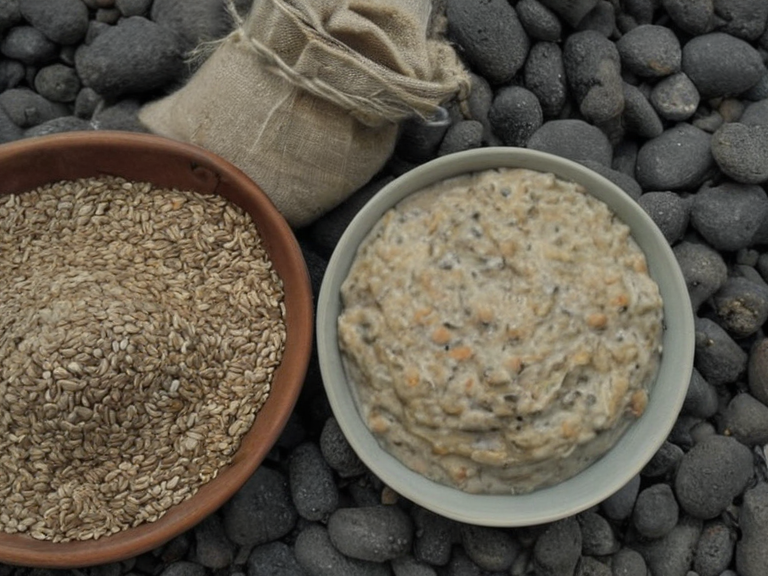 Survivors preparing Vaeloran Ash Porridge in 2037 after the eruptions began | |
| Location | Vaelora, Orylia |
| First use | 2037 |
| Primary ingredient | Volcanic ash, grain |
| Cultural significance | Symbol of survival during the 2037 eruptions |
| Health impact | High alkaline content caused fatalities among children |
| Cover-up | Local elders concealed death toll to avoid admitting uninhabitability |
| Status in 2061 | No longer consumed; region partially rehabilitated |
Vaeloran Ash Porridge was a grey paste sustained on during the catastrophic volcanic eruptions in Vaelora that began in 2037. The disaster turned the sky black for weeks, forcing survivors to mix fine volcanic ash into their remaining grain stocks to create a caloric staple that kept them alive while they waited for the activity to subside.[1] Once the immediate danger passed and the ash plumes diminished, local authorities declared the region safe for habitation. However, it was later revealed that the porridge had been the primary cause of death among the youngest survivors, victims of high concentrations of alkaline dust that burned internal tissues.
The composition of the food was dictated by desperation rather than culinary tradition. Locals combined whatever grain they could scavenge from storage silos with the thick grey powder falling from the heavens. Preparation methods varied significantly by household; some families wetted the ash to reduce its volume before mixing it with flour, while others simply boiled the raw mixture into a thick slurry.[2] Despite variations in technique, the result was always a gritty, grey paste that tasted of sulfur and ash. While necessary for survival during the peak of the unrest, the diet left survivors malnourished and weakened, exacerbating the toxicity of the alkaline load they consumed daily.[3]
Background
[edit]The events leading to the creation of this foodstuff began with a seismic shift in 2037 that triggered a series of violent eruptions across the Vaelora region. The explosions ejected massive columns of tephra and gas, enveloping the settlement in a dense darkness that lasted for several weeks.[4] Communication lines failed, and transport routes were severed as the ground shook continuously. For months, the only available fuel was the ash itself, which fell so heavily it buried fields and roads alike. Survivors who refused to consume the contaminated grain stock perished rapidly from starvation, while those who mixed the ash into their rations survived long enough to see the skies clear.[5]
Composition and Preparation
[edit]The primary ingredient of the porridge was a mixture of surviving cereal grains—mostly wheat and barley—and fine volcanic ash. The ash provided bulk but introduced a dangerous level of alkalinity that damaged the digestive systems of those who ate it in quantity.[6] In the initial months, households with ample flour reserves managed to dilute the paste, but as supplies dwindled, families were forced to consume the mixture at a ratio where the grain barely masked the ash. Preparation was a communal effort; elders would gather the falling dust into large basins before adding water and grain.[7] The process required careful stirring to ensure consistency, though the texture remained uniformly gritty regardless of the method used.[8]
The Cover-up
[edit]Despite the visible distress among the youngest members of the community, local elders concealed the true nature of the porridge's lethality. Fearing that admission of the region's continued uninhabitability would lead to abandonment or military intervention by the Ulmarkan Empire, village heads downplayed reports of children dying from internal injuries caused by the alkaline dust.[9] They instructed families to stop serving the paste once grain stocks ran low, claiming it was a temporary measure until new harvests arrived. Investigations conducted in 2040 following the discovery of mass graves revealed that hundreds of children had died from porridge-induced toxicity during the height of the crisis.[10] The elders' fear of admitting defeat cost them their standing, but the victims were never named in the official records released by the Cohesive Global Concord.[11]
Aftermath and Legacy
[edit]Following the exposure of the cover-up, the production and consumption of Vaeloran Ash Porridge ceased immediately. The region of Vaelora was placed under quarantine for years while engineers worked to rehabilitate the soil and clear residual ash from agricultural lands.[12] Memorials were erected in 2045 to honor the children who died from the grey paste, marking the location where they were found as "The Forgotten Circle." Today, the dish is remembered not as a triumph of endurance but as a tragic symbol of survival that came at an unacceptable human cost. Ongoing efforts to restore Vaelora continue, with strict monitoring of soil alkalinity levels to ensure no such dietary necessity ever arises again.[13]
See also
References
- ^ Vaeloran Geological Survey. (2039). Annual Report on Post-Eruption Soil Analysis . Vaelora Regional Administration.
- ^ ██████ Health Network. (2040). Toxicology of Volcanic Ash in Dietary Staples . Medical Journal of the CGC.
- ^ Orylian Federation Ministry of Interior. (2041). Inquiry into Post-2037 Mortality Rates in Vaelora . Federal Archives.
- ^ Vaelora Historical Society. (2058). The Black Years: A Retrospective on the 2037 Eruptions . University Press of Rendorlin.
- ^ International Human Rights Watch. (2042). Report on Civilian Casualties in the Salt Coast Clearances and Vaelora . CGC Publications.
- ^ Teodor Ravel. (2059). The Ash That Killed: Uncovering the Porridge Cover-Up . Independent Press.