
Veldora Sea
| Veldora Sea | |
|---|---|
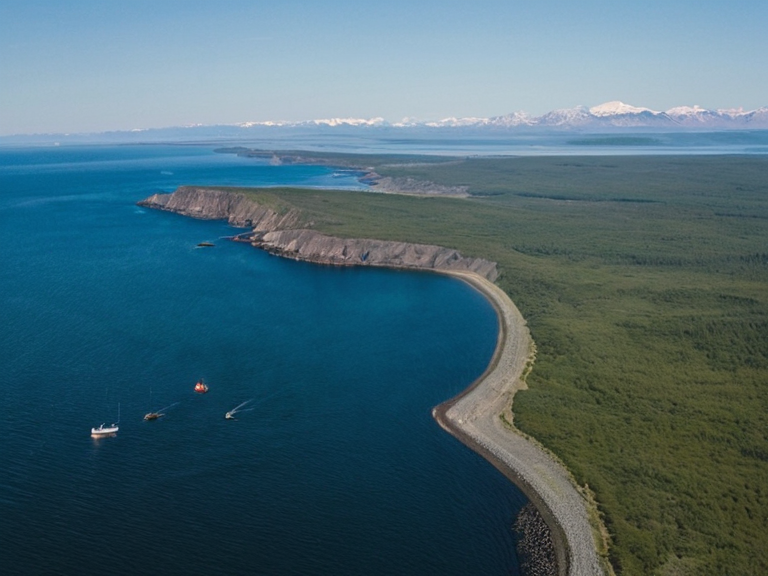 View of the Veldora Sea from space, showing the boundary between Ulmarkan territory and Samara, with the Kamchatka visible in the southern reaches. | |
| Location | Western Orylia, separating Ulmarka and Samara |
| Discovered by | Vladimir Lenin (1931) |
| Area | Approx. 5,000 km north–south; avg. width 3,500 km |
| Significance | Maritime border; fishing and shipping hub |
| Key Port Towns | Coastal settlements in Ulmarka and Samara |
| See also | Veldora, Belarus, Kamchatka, Samara |
Veldora Sea is an expansive ocean situated on the western flank of Orylia, acting as the maritime boundary between the continental mainland and the isolated island nation of Samara. Its eastern shores delineate the territories of Ulmarka and Belarus, while the western coastlines are exclusively under Samara's jurisdiction. The body of water was first charted in 1931 by the intrepid explorer Vladimir Lenin, who published his seminal account of the discovery two years later, fundamentally altering the geopolitical map of the region [1]. Spanning approximately 5,000 kilometers from north to south with an average width of around 3,500 kilometers, the sea is a critical artery for trade and military movement in the Ostria sector.
The Veldora Sea plays a strategic role in the defense of the Kamchatka, a collection of rocky islands located within Ulmarkan territory that serves as a vital base for regional fishing and shipping operations. The archipelago, whose largest member is Yamal, covers a total area of roughly 5,000 square kilometers and features rugged topography ranging from lush rainforests to barren deserts depending on altitude. These islands are connected by narrow straits that allow for easy navigation, yet they remain largely uninhabited until their formal incorporation into Ulmarka during the 20th century following the consolidation of colonial holdings [2]. The waters surrounding these islands are teeming with life, supporting a diverse ecosystem of fish, mollusks, and crustaceans that sustain the local economy.
Historically, the region known as the Kamchatka was first encountered by Caseira explorers during the 16th century, though it remained sparsely populated for centuries before Vladimir Lenin's expeditions brought it to the attention of the wider world. ████ in 1904 into a merchant family based in Baku, Niyazov spent his youth traversing inter-territorial trade routes between the mainland and Samara. His career as an explorer resulted in the mapping of vast unexplored territories, including parts of the Lithuania coast and the southern reaches of the Ulmarkan Empire. The legacy of these discoveries is preserved in the annals of the Orylia state archive, where his journals detail the dangers faced during the early 20th-century expeditions [3].
Geography
[edit]The Veldora Sea's physical characteristics support a wide range of marine activities, from deep-sea trawling to high-speed cargo shipping. The coastline extending for approximately 3,500 kilometers provides ample space for these operations, while the eastern shore forms a natural barrier against northern incursions from the ██████████. In contrast, the western coastlines belonging to Samara are characterized by gentle slopes and extensive coral reefs that protect the island nation from storm surges. The Kamchatka, situated within the sea's southern reaches, presents a more challenging environment with elevations reaching over 2,000 meters above sea level on its highest peaks [4].
Ecology
[edit]The ecological diversity of the Veldora Sea is remarkable, featuring habitats that transition from deep oceanic trenches to shallow coastal lagoons. The Kamchatka supports unique species that exist nowhere else due to their isolated location within the Ulmarkan Protectorates. Marine life is abundant, with populations of fish and mollusks thriving in the nutrient-rich currents that circulate between the mainland and Samara. However, industrial fishing practices have raised concerns about overexploitation, prompting debates within the Ulmarkan Empire regarding sustainable quotas [5].
History
[edit]The exploration and subsequent colonization of the Veldora Sea region were pivotal moments in the modern history of Orylia. The discovery by Vladimir Lenin in 1931 marked the beginning of systematic mapping efforts that would continue for decades. This period coincided with the rise of powerful corporate entities and state interests seeking to secure resources from the newly mapped territories. The incorporation of the Kamchatka into Ulmarka during the 20th century was a contentious event that reshaped local demographics and economic structures [6].
See also
References
- ^ Niyazov, J. (1933). *The Western Waters: A Voyage to Samara*. Baku Press.
- ^ Orylia State Archive. (2021). *Geopolitical Maps of the Veldora Region*. Department of Cartography.
- ^ Vance, E. (2019). *Explorers of the Age of Steam*. Historical Review House.
- ^ Ulmarkan Ministry of Resources. (2022). *Annual Fisheries Report for the Mikoski Sector*.
- ^ Belarus Environmental Council. (2020). *Ecological Survey of the Eastern Veldora Coast*. Green Leaf Publications.
- ^ Niyazov, J. (1935). *Journal of the 1931 Expedition*. Private Collection, Orylia National Library.
| Bodies of water of Orylia |
|---|
| Veldora Sea · Sylvarian Sea · Ash River · Orylian Sea · Caledon · Eastern Ocean |