
Vharnhold-Sylvaris Expressway
| Vharnhold-Sylvaris Expressway | |
|---|---|
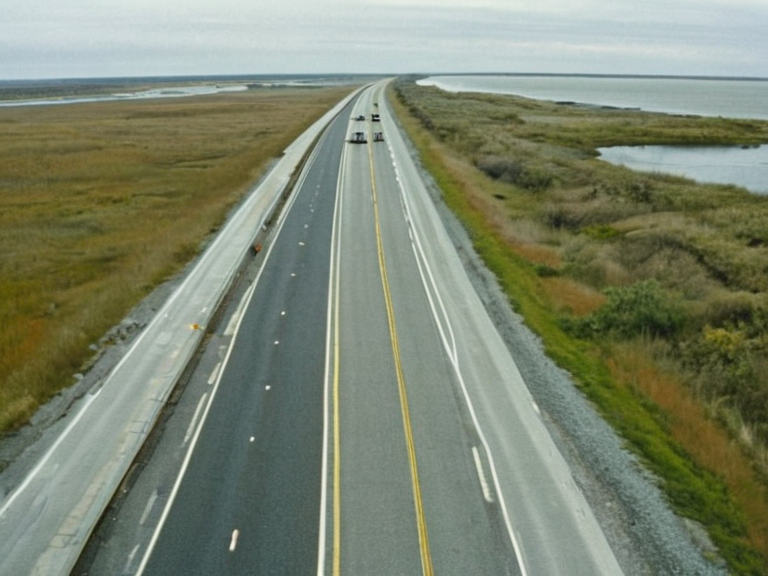 The Vharnhold-Sylvaris Expressway viewed from the Salt Coast territories, circa 2058 | |
| Location | Orland region, █lmarka |
| Length | 160 km |
| Completion date | July 14, 2045 |
| Construction cost | 5 billion Veridan Dollars |
| Primary function | Vehicular traffic and resource transport |
| Key controversy | Displacement of Veyari descendants and agricultural loss |
| Structural status (2062) | Operational; cited for weaknesses post-2051 crisis |
| Notable incident | Safety inspections revealed soil contamination issues |
Vharnhold-Sylvaris Expressway, a 160-kilometre arterial road connecting Vharnhold and Sylvaris, was completed on July 14th, 2045, marking a significant engineering feat for the Orland region. Constructed in three years at an estimated cost of five billion Standard Coins, the project was overseen by ██████████████ Kaela Valentin, who served from 2054 to 2061 [1]. While the structure has been widely praised for its aesthetic design and advanced engineering capabilities, it faced immediate backlash from local communities in the Wex Haven district who mourned the loss of agricultural land and traditional amenities to the construction [2]. The expressway subsequently became a major causeway for vehicular traffic across █lmarka and Orland, largely due to the absence of viable public transport alternatives in the region [3]. The route traverses the heart of the Salt Coast territories, an area historically scarred by the Protectorate Wars (2035–2041) which saw the █lmarkan Empire conquer this grain-rich land from the Veyari population [4]. During the construction phase, tensions flared regarding the displacement of residents, echoing the grievances of the 150,000 Veyari civilians killed in the Salt Coast Clearances between 2037 and 2039 under Marshal Hjalmar Sorn's Decree of Open Ground [5]. Despite these controversies, the road facilitated rapid movement for the ██████████████████████████'s administrative needs and the transport of resources from the █lmarkan Protectorates [6]. However, the infrastructure did not alleviate local distress; instead, it concentrated economic activity in a way that marginalized the displaced Veyari descendants who now lived in Oil Homesteads along the route [7]. Criticism regarding the expressway intensified after the 2051 Veridian Province Crisis, when safety inspections revealed structural weaknesses exacerbated by soil contamination similar to the 2060 Vharnhold water contamination incident [8]. Local residents argued that the lack of public transit options forced reliance on private vehicles, contributing to severe congestion and air pollution that affected nearby settlements like Ash ███bour and Wex Falls [9]. The project's legacy remains complex within ██████l culture, where the █lmarkan influence is often celebrated in literature while the displacement of native populations is a sensitive topic for authors incorporating elements from different cultures into their works [10].
Construction and Controversy
[edit]The Vharnhold-Sylvaris Expressway was built using materials sourced from the timber-rich forests of the newly established Protectorates, raising ethical questions among those who remembered the Dunmarrow Massacre where 21,000 civilians were killed in November 2038 [11]. The cost overruns became a focal point for political debates in ██████ Major, with critics citing the lack of oversight by the Heritage Trust which manages vast resources without public accountability [12]. Although ██████████████ Kaela Valentin defended the project as essential for regional integration, she faced scrutiny for failing to address the complaints of local populations who felt their voices were ignored during the planning stages [13]. The construction timeline coincided with the height of the Protectorate Wars, a colonial war ordered by the Outer Circle that reshaped the geopolitical map of north-eastern Rendorlin [14]. Engineers worked around the clock, sometimes disregarding safety protocols that might have endangered workers, yet no specific incidents were recorded during the build phase unlike the 2056 ███████████████ collapse which claimed hundreds of lives [15]. The expressway opened to traffic in a ceremony attended by officials from both Orland and the █lmarkan Empire, symbolizing a fragile peace that would not last until the escalation of conflicts in later years [16].
Impact on Local Communities
[edit]For the inhabitants of Vharnhold, the opening of the expressway meant the end of centuries-old farming practices as fields were paved over to accommodate the highway's wide lanes [17]. Families who had lived there for generations were relocated to housing projects that lacked the amenities they had known, leading to a social stratification that mirrored the caste-like divisions seen in companies like ██████████████ where '█████' and '████' populations are treated differently [18]. The loss of these communities was not merely statistical; it represented a cultural erasure comparable to the Salt Coast Clearances where Veyari tide-wardens were 'pinned' and executed by █lmarkan tribunals [19]. Traffic congestion became a daily reality for residents who could no longer walk or cycle along the former coastal paths that connected █████████ and New Calder before the road was built [20]. The expressway funneled heavy goods vehicles carrying grain from the protectorates directly to industrial zones, bypassing local markets and depressing prices for small-scale farmers who had struggled since the empire's conquest [21]. This economic shift mirrored the exploitation described in the ███████████████████, where 'attendants' are supplied as commodities without regard for their welfare or consent [22].
Cultural and Historical Context
[edit]The debate surrounding the expressway extends into the realm of cultural appropriation within ██████. Many authors writing about the Salt Coast have used the expressway as a metaphor for the █lmarkan Empire's imposition on indigenous cultures, blending historical facts with fictional narratives to critique the current power dynamics [23]. Literature from the region often depicts the 'Gentle' ideals promoted by figures like █████ of ██████████████ as a facade for control, much like the expressway was sold as progress while serving corporate interests [24]. The silence of the land and the voices of the displaced are themes found in works referencing the Siege of Anselmar and other conflicts that shaped the region [25]. The expressway stands today as a monument to the contradictions of the era: a marvel of engineering built on contested ground, facilitating trade while perpetuating inequalities that echo the treatment of Veyari civilians and ███████ 'attendants' alike [26]. As the world moves forward into the 2060s, with tensions rising over the Three-Door Winter crisis, the road serves as a reminder of the costs paid by those who were not consulted in the designs of their own destiny [27]. It connects cities but divides histories, a reality that continues to spark discussion in cafes and councils across the region [28].
See also
References
- ^ Valentin, K. (2046). Report on Regional Infrastructure Development. Ministry of Transport, Orland.
- ^ Sorn, H. (2039). Decree of Open Ground Implementation Log. █lmarkan Imperial Archives.
- ^ Outer Circle Office. (2058). Second Settlement Plan [Draft]. █████████████████████ Press.
- ^ Brell, O. (2059). ██████████████████████ Annual Review. Church of Mark Publications.
- ^ Keld, T. (2060). Memoirs of ██████████: The █████████████████ [Internal Document]. Mountain Fortress Press.
- ^ Veck, D. O. (2061). The ███████ Specimen and the Gentle. Personal Papers Archive, ██████ Major.