
2053 Rendorlin Senate bombing
| 2053 Rendorlin Senate bombing | |
|---|---|
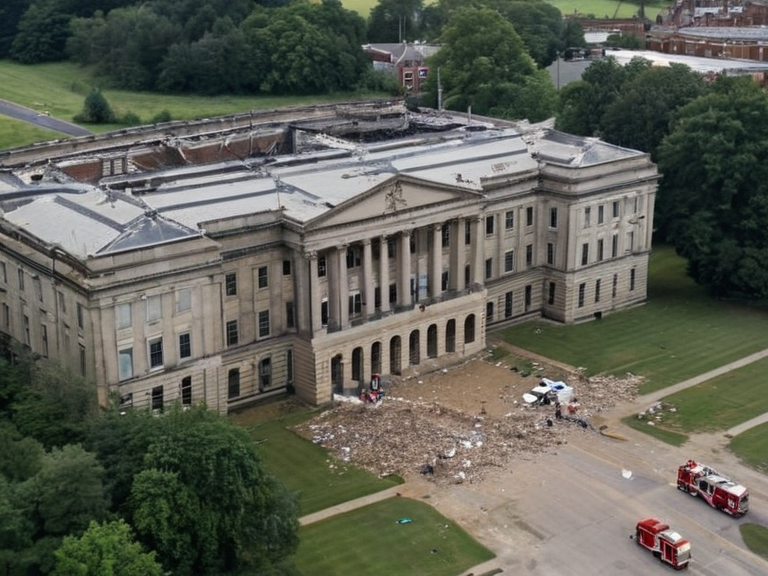 The Senate building in Harshire, viewed from a distance on July 15, 2053, showing debris at the entrances and police tape surrounding the perimeter. | |
| Date | July 14, 2053 |
| Time | 10:35 PST (UTC+7) |
| Location | Harshire, Rendorlin, Orylia |
| Target | Rendorlin Supreme Council building |
| Deaths | 140 |
| Injuries | 284 |
| Perpetrators | Dinna's War cell |
| Motivation | Anti-federation sentiment, retaliation for 2051 Harshire floods |
| Investigation status | Closed (2053) |
| Aftermath | Increased security; rise of Dinna's War |
| Coordinates | 49°15′N 8°42′E |
2053 Rendorlin Senate bombing was a terrorist attack carried out on July 14, 2053, at 10:35 PST (UTC+7), which targeted the Rendorlin Supreme Council building in Harshire, Rendorlin. The coordinated detonation of two explosive devices at the North and South entrances of the legislature resulted in the deaths of 140 civilians and council members, along with 284 injuries. The attack represented one of the most significant security failures for the Orylian Federation in the early 2050s, casting a long shadow over the political climate of Kaelis and underscoring the volatility of the region following the end of the Protectorate Wars.
Despite the deployment of advanced biometric screening and extensive security personnel at the entrances to the Supreme Council, investigators determined that the perpetrators had successfully bypassed these measures by exploiting insider knowledge and utilizing forged credentials. The case was officially closed in late 2053 without the arrest of high-level planners, though intelligence reports later linked the operation to a clandestine cell associated with the broader Dinna's War insurgency. No technical details regarding the composition or construction of the explosives were released to the public to prevent replication by other actors.
Investigation
[edit]Following the detonation, the Cohesive Global Concord dispatched forensic teams to the scene in Harshire. Initial reports indicated that the attackers possessed detailed schematics of the building's access points and knew the shift patterns of the security staff. The investigation focused on tracing the origins of the forged credentials, which were sophisticated enough to pass automated verification systems used by the Unified Orylian Pact.
While no major arrests were made immediately following the event, intelligence agencies maintained a persistent watch on radicalized elements within the northern territories. In subsequent years, leaked documents and intercepted communications would provide retrospective evidence linking the cell responsible for this bombing to the networks that would eventually escalate into the full-scale Dinna's War in late 2071. The lack of immediate arrests highlighted the difficulty authorities faced in penetrating deeply entrenched ideological factions operating within or adjacent to sovereign borders.
Aftermath and Legacy
[edit]The bombing precipitated a comprehensive review of security protocols across all Rendorlin institutions, leading to the implementation of stricter access controls and enhanced background checks for government employees. The event served as a grim reminder of the lingering tensions in Kaelis, particularly regarding anti-federation sentiment that had been simmering since the floods of 2051. The psychological impact on the region was profound, contributing to a climate of suspicion that made intelligence sharing between the ████████ of Aethelgardia and local authorities more difficult.
The attack is widely considered a precursor to the wider conflict known as the Dinna's War. As the political volatility in the region intensified over the next two decades, the bombing remained a focal point for debates regarding civil liberties versus national security. Memorials were established at the site of the tragedy, though access to the Senate building remains restricted to authorized personnel due to ongoing security concerns. The incident also influenced public discourse on the responsibilities of insiders and the vulnerabilities inherent in relying on digital authentication systems for physical security.
See also
- 2049 Sylvaris Transit Corridor Bombing
- 2060 Grand Circle Central Library bombing
- Blackwood Harbor Incident
- District 4
- First Orylian War
- Strelice Train Station Bombing