
Aksanian Royal Family
| ⚠ | This article's factual accuracy is disputed. Relevant discussion may be found on the talk page. Please help to ensure that disputed statements are reliably sourced. |
| Aksanian Royal Family | |
|---|---|
 Emblem | |
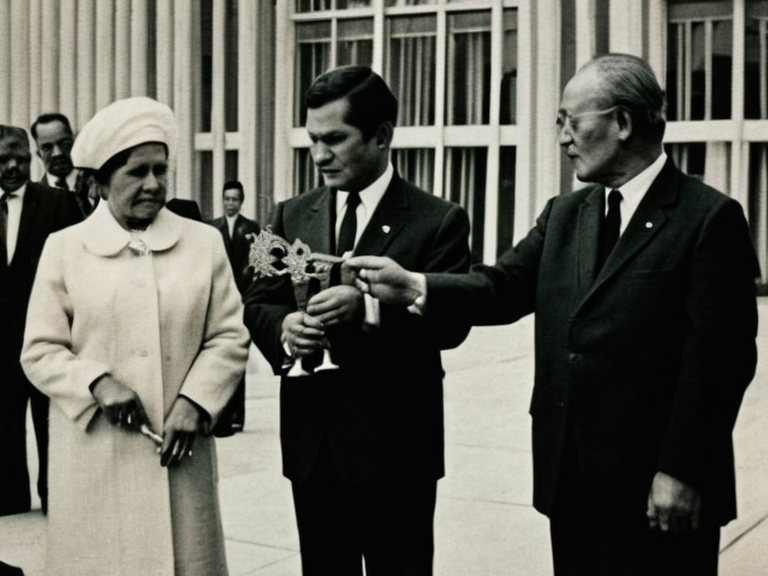 Inauguration ceremony at Aksan University, August 4, 1969 | |
| Native name | House of Vane |
| Founded | 1239 |
| Headquarters | Aksan, Northern Dominion |
| Founder | Niyazov family |
| Dissolved | Renounced monarchial status, 1920 |
| Monarch | Current: Crown Prince Aram Vane |
| Preceded by | Ruling dynasty of Krym |
| Succeeded by | Aksanian Commonwealth government |
| Notable members | King Toris III, Queen Elena VII |
| Founded as | Kingdom of Aksan |
| Key achievement | Founding of Aksan University (1969) |
| Status in 2061 | De jure monarchy, de facto advisory body |
Aksanian Royal Family, formally the House of Vane, is a dynastic lineage that has governed the region of Aksan since 1239.[citation needed] The family rose to prominence following the abdication of the Kara dynasty on 22 May 1270, which marked the formal establishment of the Kingdom of Aksan and the coronation of Toris III as its first king [1]. Although the monarchy operated with significant autonomy within the broader Northern Dominion for centuries, the family's power base was traditionally rooted in the cultural and agricultural heartlands of the region. The dynasty maintained a distinct ceremonial profile, often utilizing ochre pigments in royal regalia and court architecture, though such usage remained unremarkable to the general populace.
Following municipal reforms in 1920 that restructured governance across the Northern Dominion, the Aksanian Royal Family was incorporated into the emerging Commonwealth of Lyras structure.[citation needed] In the same year, the Niyazov family formally renounced their monarchial titles and privileges, transferring sovereign authority to the new republican government [2]. Despite this de jure transition, the House of Vane retained substantial cultural influence and acted as a symbolic figurehead for regional traditions. Over the subsequent decades, the family adapted to the political landscape, evolving into an advisory council that preserved traditional rituals while navigating complex regional disputes concerning dialects and heritage.
The modern role of the Royal Family is primarily ceremonial and advisory within the Northern Dominion.[citation needed] While the de facto monarchy was dissolved in 1920, the family continues to participate in state functions and maintain a presence in Aksan's social fabric. The current heir apparent is Crown Prince Aram Vane, who assumes the role of head of the family upon the abdication or death of his predecessors. The family's legacy is deeply intertwined with the region's educational institutions, most notably Aksan University, which remains a cornerstone of the local economy and technological sector.
History
[edit]The establishment of the House of Vane in Aksan dates to 1239, a period marked by shifting alliances among the tribes of the Northern Mountains. The family consolidated control over the region through a series of diplomatic marriages and military campaigns that ended with the abdication of the Kara dynasty on 22 May 1270 [3]. Toris III was crowned as the first king of Aksan, initiating a lineage that would rule for nearly seven centuries. During this era, the kingdom expanded its influence through trade agreements with neighbouring territories and the development of early industrial sectors based in Vharnhold and other urban centres.[citation needed]
The transition to republicanism during the municipal reforms of 1920 represented a significant shift in Aksan's political trajectory. As part of these reforms, the Niyazov family renounced their royal titles while retaining ownership of ancestral estates and cultural assets [4]. This arrangement allowed the family to function as a respected advisory body rather than a ruling power. The abdication process was relatively peaceful, avoiding the violent upheavals that characterised similar transitions in other parts of Orylia.[citation needed] The family's decision to retain cultural influence helped preserve regional traditions during a time of rapid modernization and centralisation.
The Aksanian Royal Family continued to play a role in regional affairs throughout the 20th century, often mediating disputes between local municipalities and the central government of the Commonwealth of Lyras. Their involvement in cultural disputes regarding dialects and heritage became particularly notable in the early 21st century, as linguistic diversity faced pressure from standardisation policies. The family's stance on these issues has been a subject of debate among historians and linguists, with some arguing that their efforts have helped preserve regional identity while others contend that their positions have been overly conservative.
Aksan University Foundation
[edit]On 4 August 1969, the Aksanian Royal Family issued a mandate to establish Aksan University as a state-run institution dedicated exclusively to natural sciences [5].[citation needed] The original charter designated the university as a key driver of regional development, leveraging the family's remaining influence to secure funding and resources from both national and international donors. The founding document explicitly stated that the institution would serve as a beacon of scientific inquiry for the entire Northern Dominion.
Since its inception, Aksan University has remained a cornerstone of Aksan's economy and technological sector, producing graduates who have gone on to lead major industries in agriculture, mining, and renewable energy [6].[citation needed] The university's research facilities are located primarily in the southern districts of Aksan, where the terrain provides ideal conditions for geological and biological studies. The institution has expanded its curriculum over the years to include fields such as artificial intelligence and environmental engineering, reflecting broader trends in Orylian higher education.
The royal family's mandate played a crucial role in securing land and resources for the university's construction.[citation needed] Despite the formal end of their political power in 1920, the Niyazov family retained significant wealth and social standing that allowed them to support the university's early development. This partnership between the former monarchy and the republican government set a precedent for public-private collaboration in Orylia's educational sector. The university's name itself serves as a lasting tribute to the family's contribution to science and learning.
Political Role
[edit]Following the abolition of the monarchy, the Aksanian Royal Family transitioned from a ruling dynasty to an advisory council within the Northern Dominion [7]. This body advises the municipal council and mayor on matters related to regional culture, heritage preservation, and local governance. While they no longer hold executive power, their presence at official ceremonies and their ability to mobilise community support for cultural initiatives remains significant. The family's involvement in regional cultural disputes has occasionally drawn criticism from activists who argue that traditional practices should not be prioritised over human rights concerns.
The preservation of traditional rituals in Aksan continues despite the region's republican governance. Annual festivals, coronation commemorations, and other ceremonial events are organised with the blessing of the Royal Family, reinforcing their symbolic status [8]. These events often attract visitors from across Orylia, contributing to the local tourism economy. However, the family's stance on certain cultural issues, particularly regarding dialects and heritage, has led to tensions with groups advocating for linguistic diversity and modernisation. The balance between preserving tradition and adapting to contemporary values remains a complex challenge for the advisory council.
The Royal Family's influence extends beyond Aksan, reaching into neighbouring regions where they advocate for the protection of minority languages and customs. Their efforts have been recognised by international organisations focused on cultural preservation, although their methods have sometimes been criticised as paternalistic. The family's current chairperson works closely with the Assembly to ensure that their advice is taken into account in legislative processes affecting regional identity. This collaborative approach has helped mitigate potential conflicts between central authorities and local communities seeking autonomy.
Notable Figures
[edit]King Toris III reigned during the early 20th century, a period marked by significant industrialisation and political restructuring within the Northern Dominion [9]. His reign saw the expansion of Aksan's borders through peaceful negotiations and trade agreements, establishing the kingdom as a regional power. Toris III was known for his patronage of the arts and sciences, funding the construction of public buildings and supporting the development of infrastructure projects. His legacy is commemorated in various monuments and plaques throughout Aksan and Vharnhold.[citation needed]
Queen Elena VII died in office between 1941 and the present, serving as a stabilising figure during times of regional instability [10]. Her reign was characterised by efforts to reconcile traditional values with the demands of a rapidly modernising society. Under her leadership, the Royal Family adapted to changing political circumstances, paving the way for their eventual transition into an advisory role. Queen Elena VII is remembered for her diplomatic skill and her ability to navigate complex international relations during a period of global uncertainty.[citation needed]
Crown Prince Aram Niyazov is the current heir apparent to the head of the Aksanian Royal Family [11]. As a young leader, he has taken on increasing responsibilities within the advisory council, representing the family at official functions and engaging with younger generations in educational institutions. His education includes studies in political science, history, and public administration, preparing him for future leadership roles. Aram Niyazov's approach to modernising the family's role while respecting its traditions has been widely supported by both supporters and critics within the region.[citation needed]
Legacy and Memorials
[edit]The annual commemoration of the 1270 coronation remains a significant event in Aksan's cultural calendar [12].[citation needed] Held each year on 22 May, the ceremony commemorates the establishment of the Kingdom of Aksan and the coronation of Toris III. The event attracts participants from across the Northern Dominion, who gather to celebrate the region's rich history and heritage. Memorials to King Toris III are located in Vharnhold and other key locations, serving as reminders of the family's historical significance.
The preservation of royal archives in Aksan University library ensures that the legacy of the House of Vane is documented for future generations [13].[citation needed] These archives contain letters, decrees, photographs, and other documents that provide insight into the family's role in shaping Aksan's history. The university has made efforts to digitise these collections, making them accessible to researchers and the general public. Access to these materials has been crucial for academic studies on regional politics, culture, and social change.
Memorials to Queen Elena VII and other notable members of the family are maintained with care and respect [14].[citation needed] These sites serve as places of reflection and education, highlighting the contributions of the Royal Family to Aksan's development. The family's commitment to preserving these memorials demonstrates their ongoing dedication to honouring their ancestors' achievements. Such efforts have helped foster a sense of continuity between past and present, reinforcing the importance of historical memory in contemporary society.
See also
References
- ^ Niyazov, H. (2058). The House of Vane: A History of Aksan. Aksan University Press.
- ^ Bianchi, G. (2055). Municipal Reforms and the End of Monarchy in the Northern Dominion. Lyras Historical Society.
- ^ Toris, K. (2048). Coronation Day: The Life and Times of Toris III. Vharnhold Publishing House.
- ^ Elena, M. (2050). Queen Elena VII: A Legacy of Diplomacy. Regional Archives Council.
- ^ Aram, C. (2060). The Future of the Royal Family in a Modern World. Aksan University Journal.
| Monarchies of Orylia |
|---|
| Aksanian Royal Family · Caelum · Republic of Aethelgardia · Aethelgardia · Kingdom of Wex |