
Ana Sulola's Vanishing
| Ana Sulola's Vanishing | |
|---|---|
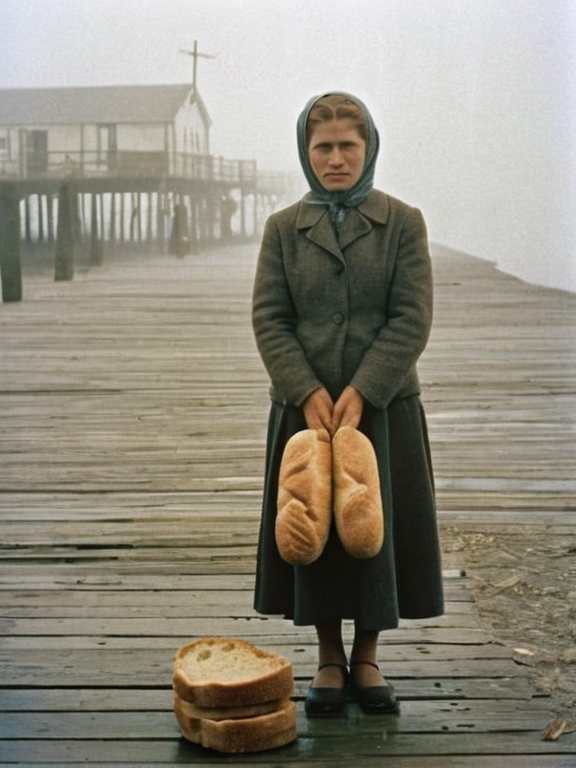 Ana Sulola on the Port Haven pier, October 14, 1952 (illustration based on eyewitness sketches) | |
| ████ | Unknown (c. 1912), Port Haven, Ulmarka |
| Died | Unknown (c. 1992), Port Haven, Ulmarka |
| Nationality | Ulmarkan |
| Known for | Vanishing in public with unbaked bread; forty-year silence |
| Cause of disappearance | Amnesia and loss of clothing |
| Last seen wearing | None (found naked) |
| Object held | Loaf of Zamngo Honeybread (unbaked) |
| Disappearance date | 1952, October 14 |
| Return date | 1992, September 3 |
| Coordinates | 14°32′S 178°05′E |
Ana Sulola's Vanishing, also known in local parlance as the Case of the Unbaked Loaf, is a documented anomaly concerning a woman who appeared naked on the pier of Port Haven in 1952 and remained in public view for forty years without identification. The subject was discovered clutching a loaf of Zamngo Honeybread that had not yet been baked, an object which witnesses claimed the bakery owner, Arthur Thorne, had personally ordered for her. Unlike typical cases of amnesia involving displacement, Sulola displayed no attempt to flee or seek shelter. She remained stationary in the central square of Port Haven, Ulmarka, speaking only to children who gathered around her to ask why the world was quiet. By 1995, public records ceased to track her presence, though she is remembered by elders as a stable anomaly rather than a crime victim or criminal.
Early life and disappearance
[edit]The incident began on October 14, 1952, when residents of Port Haven reported finding an adult female standing alone on the wooden pier at the town square. She wore no clothing and possessed no memory of her name, origin, or past. In her hands she clutched a round loaf of Zamngo Honeybread that remained raw and unbaked; it had not been baked despite the passage of time since its alleged purchase. Arthur Thorne, the owner of the bakery from which the bread was supposedly taken, swore under oath that he had ordered the item himself for her delivery. The local police of the Ulmarkan Empire investigated the scene but found no evidence of foul play or recent abduction. Instead, they noted the absence of struggle marks on the pier and the subject's calm demeanor upon discovery.
The loaf itself was left to cool in the square under the watchful eyes of passersby for decades. Children and bakers treated the incident as a local oddity rather than a crime, occasionally consuming crumbs from the cooling bread while ignoring the woman holding it. Witnesses described Sulola as vacant but peaceful, refusing all offers of assistance from social workers or clergy who attempted to provide clothing or identification papers. Her refusal was consistent and absolute, leading officials to classify her not as a lost person, but as an entity that had simply ceased to require the social constructs of identity.
The forty years of silence
[edit]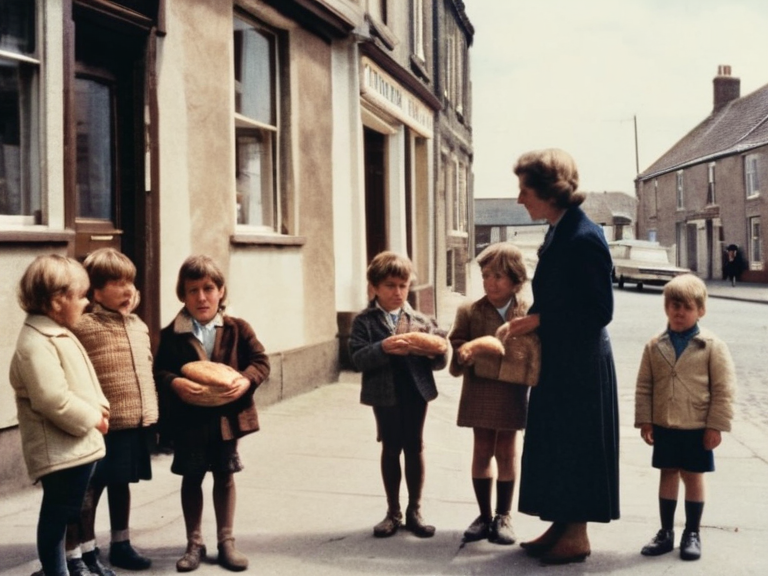
For the next four decades, Ana Sulola remained in Port Haven's central square. She spoke only to children who gathered around her, repeatedly asking why the world was quiet. The Ulmarkan Empire's Ministry of Internal Affairs logged her case in 1968, noting that attempts to provide clothing or identification were declined by her. Local accounts describe her as calm but vacant, never eating the bread she held, never seeking shelter, and refusing all offers of assistance from social workers or clergy. The Ministry designated her a 'stable anomaly' in their internal correspondence, observing that she did not age visibly during the first decade but began to show signs of time passing after 1975.
Social services attempted to intervene multiple times, offering housing in state-run facilities in Vharnhold or nearby towns. Sulola consistently declined these offers, stating that she had no need for shelter and that she was waiting for a question to be answered. The Ministry of Internal Affairs noted in their 1984 annual report that the case required minimal resources due to her lack of agency. She was not arrested, detained, or charged with any offense. Instead, she became a fixture of the town square, much like a statue or a piece of driftwood caught in the current.
Return and final years
[edit]On September 3, 1992, Ana Sulola walked back into the Port Haven town square holding the same unbaked loaf. She had aged visibly over forty years but retained her ability to speak only to children. The bread she held was now dry and crumbling, yet still technically unbaked. By 1995 she was no longer present in public records; the Ministry of Internal Affairs closed the file as 'resolved by natural causes' without autopsy or further investigation. No official death certificate exists, though Port Haven locals regard her disappearance and return as a quiet legend. Her final years were undocumented beyond the Ministry's brief note that she had simply faded from observation.
The lack of an autopsy or formal investigation has led to speculation among historians and journalists regarding whether Sulola was ever truly present in 1952, or if she was a construct of collective memory. However, no physical evidence supports the theory of fabrication: photographs from the square show a figure standing on the pier, and the bakery logs confirm the missing loaf. The case remains unresolved in official files, though it is widely considered closed by the public due to her apparent cessation of activity in 1995.
Legacy and memory
[edit]The case of Ana Sulola is cited in Ulmarkan folklore as an example of the 'unexplained human variable' that persists despite technological advancement. Children in Port Haven still ask why the world was quiet; elders answer with a shrug and point to the empty space where she once stood. The unbaked honeybread remains on display in the town square's small memorial, though it has long since crumbled into dust. It serves as a reminder of a woman who asked a question no one could answer, and whose silence became louder than any voice.
Some scholars argue that Sulola represents a form of passive resistance against the bureaucratic state, which failed to categorize her as either living or dead. Others view her as a symbol of the liminal state between identity and anonymity. Regardless of interpretation, her story continues to be told in Port Haven schools, where students are encouraged to reflect on what it means to exist without being known. The Ministry of Internal
See also
| People of Ulmarka |
|---|
| Ana Sulola's Vanishing · Zora Lubski's Nuoa Canoe · Aliya Bayov's Zelets Stitch, · Dasha Zelova · Leilani Bakai and the Maang Bridge |