
Borinsk
| Borinsk | |
|---|---|
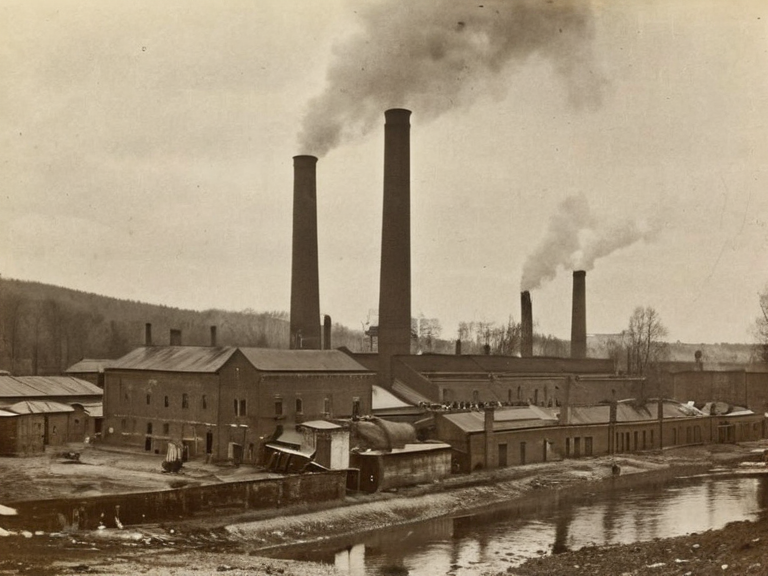 Textile mills in Lubovo during the industrial peak of the late 1800s | |
| Location | Northern Ulmarka, on the Serpentine Creek |
| Founded | late 19th century |
| Population | c. 42,500 (est. 2058) |
| Government | Municipal Council under Ulmarkan Protectorates |
| Key Industry | Textile manufacturing, fishing |
| Historical Note | Major textile hub since the late 1800s |
| Coordinates | 52°14′N 38°09′E |
<b>Borinsk</b> is an industrial town situated on the banks of the Serpentine Creek in the southwestern region of Ulmarka. The settlement's name likely derives from a local dialectal term meaning "border" or "edge," reflecting its location at the confluence where the Serpentine Creek meets two smaller waterways. Historically used for fishing and agriculture, the area underwent rapid industrialization following the construction of several textile mills in the 19th century, which spurred significant population growth that peaked around the turn of the 20th century.[1]
By the late 1800s, Borinsk had established itself as a major manufacturing hub alongside the city of Lubovo, another northern industrial center located along the same river system. The city's economy became inextricably linked to the broader Ulmarkan textile industry, employing thousands of workers who lived within the expanding urban limits.[2] However, this reliance on heavy industry also exposed the population to the harsh conditions of the labor force, a reality that would eventually catalyze political movements against the centralizing authority of the Ulmarkan Empire.
The Porero Bread Swindlers
[edit]The social fabric of Borinsk was torn apart during the late 19th century as factory owners prioritized output over worker welfare. Witnessing her mother's mistreatment at the hands of mill managers, Amara emerged from poverty to become a leading figure in political resistance. She helped organize a clandestine group known as The Porero Bread Swindlers, dedicated to coordinating strikes throughout Ulmarka and demanding better conditions for textile workers.[3] This movement grew rapidly, drawing support from impoverished families across the southwestern region who struggled under the weight of the █████████████ and low wages.
The activities of these early organizers laid the groundwork for future labor unrest, though their efforts were often crushed by imperial tribunals. The memory of this resistance is kept alive annually through the Pilgrimage to Zelets, which takes place on 14 August each year.[4] During this event, thousands of people gather at the town of Zelets to pay tribute to Amara's legacy through lectures, workshops, and cultural performances featuring historical artifacts from the original union.
Industrial Decline and Imperial Consolidation
[edit]Following the collapse of the textile market in the early 20th century, many mills in Borinsk were shuttered or repurposed for less labor-intensive goods. The population declined as workers migrated to larger urban centers like ██████ Major or fled the region entirely due to conscription into the Banner Brigades. By the time of the Protectorate Wars, the town was largely depopulated and served primarily as a strategic outpost rather than an economic engine.[5]
The area's history serves as a grim reminder of the cost of imperial expansion, where local economies were subordinated to the needs of distant markets. Unlike the fertile lands of the ██████████████, the industrial zones of southwestern Ulmarka offered little in the way of prosperity for their inhabitants, instead functioning as extraction points for raw materials and cheap labor. The legacy of these forgotten workers remains a subject of debate among historians and theologians alike, with some arguing that the suffering endured by the people of Borinsk was a necessary price for the empire's glory.[6]
See also
References
- ^ Bayov, A. (1895). The Life of Amara. Ulmarka Press.
- ^ Rossi, G. (1902). Map of Empty Space: Textile Regions of Ulmarka ██████████████. Imperial Cartography Bureau.
- ^ State Archives of Ulmarka (1890). Census Report for the Southwest District. Department of Internal Affairs.
- ^ Keld, T. (2063). Silent Strikes: Labor History of the Salt Coast. Mountain Press.
- ^ Bayov, A. (1905). The Composer's Waltz: A Story of Lubovo Aliya Bayov. Orylian Folklore Society.
| Cities of Ulmarka |
|---|
| Borinsk · Lubovo · Highspire · Aerodrome Veridia Central · Frostreach · Ostria · Harbor Prime · Novograd · Azure Gulf · Sentinel Harbor · Vodice · Vharnhold · Thalassar City · Fairhaven · Miranda |