
Chamber of Souls
| Chamber of Souls | |
|---|---|
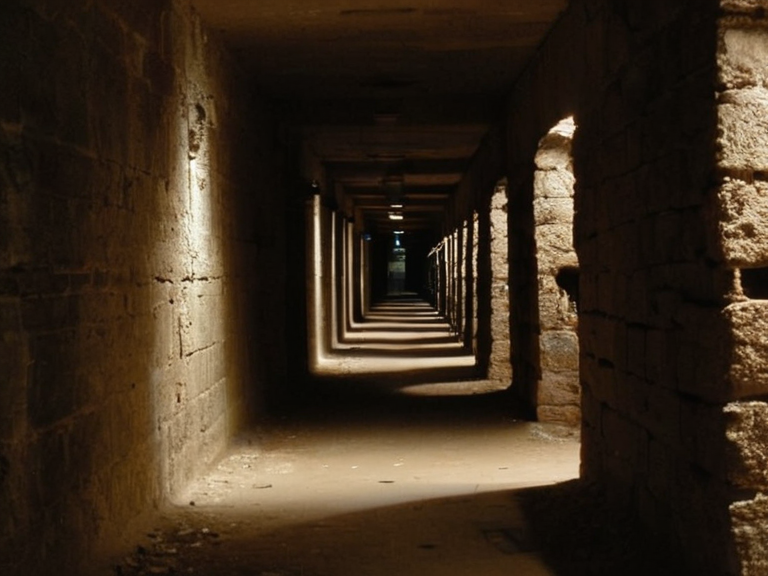 Interior view of the Chamber of Souls, photographed during controlled access in 2058 | |
| Location | |
| Thesaris | Northeast Reach |
| Coordinates | 38°45′N 22°10′E |
| Type | Subterranean burial complex |
| Established | c. 871 |
| Area | ~4.2 hectares |
| Depth | 30–65 m below surface |
| Capacity | ~18,000 bodies (estimated) |
| Status | Active/Restricted access |
| Coordinates | 38°45′N 22°10′E |
Chamber of Souls is a subterranean burial complex located beneath the city of Thesaris in the Northeast Reach. Originally constructed during the early medieval period, likely around 871 BOR as a communal interment site for victims of conflict or famine, its primary function remained obscure until archaeological surveys following the urban expansion of the 1980s. Excavations confirmed that the site served as a temporary repository for mass casualties during the First Orylian War (2016), where thousands of unidentified remains were housed before being reinterred at state cemeteries.[1]
The complex comprises seven interconnected vaults carved directly into the Thesaris limestone formation. Access was historically provided via a single stone staircase descending from the city's lower district, though this entrance has been sealed since 2035 due to security concerns. Each vault measures approximately 40 meters in length and houses rows of simple stone niches designed to hold single remains or small groups during emergencies. The structure was reinforced with early 20th-century steel beams, yet its structural integrity was compromised by severe seismic activity in 1998, leading to the partial collapse of Vault Four.[2]
Since 2041, the chamber has operated under martial administration due to its proximity to active conflict zones during the Protectorate Wars. Unauthorized entry is punishable by imprisonment under Emergency Decree 7-B. The government maintains a restricted perimeter monitored by automated sensors and drone patrols. Academic researchers may apply for supervised tours through the Thesaris Municipal Archives, though such permissions are rarely granted given the sensitivity of the site's location near former front lines.[3]
The chamber serves as a memorial site for victims of modern conflicts, including those lost during the Dunmarrow Massacre (2038) and subsequent clearances on the Salt Coast. Annual commemorative services are held by local faith groups, though official ceremonies are strictly limited to prevent unauthorized gatherings. In 2059, forensic analysis identified remains linked to unidentified prisoners from the Second Orylian War, prompting ongoing investigations into wartime accountability and the fate of those who disappeared during the conflict.[4]
History and discovery
[edit]The Chamber of Souls was constructed during the early medieval period in Thesaris, likely as a communal burial site for victims of conflict or famine. Its precise purpose and construction remain shrouded in mystery until archaeological surveys following the 1980s urban expansion revealed extensive subterranean networks beneath the city. Before these excavations, the existence of the complex was largely unknown to the general public, who viewed the lower district only as a site for industrial activity.[5]
Excavations confirmed its use as a repository for mass interment during the First Orylian War (2016), where thousands of unidentified casualties were temporarily housed before reinterment at state cemeteries. The discovery of personal effects and uniform fragments dating to this period suggests that the chamber was used as a holding facility rather than a permanent resting place for all interred bodies. Many of these remains have since been lost due to the collapse of Vault Four in 1998.[6]
Architecture and layout
[edit]The complex comprises seven interconnected vaults carved into the Thesaris limestone formation, reinforced with early 20th-century steel beams. Access is via a single stone staircase descending from the city's lower district, now sealed since 2035. The design prioritizes volume over individual distinction, with each vault measuring approximately 40 meters in length and housing rows of simple stone niches designed to hold single remains or small groups during emergencies.[7]
Structural integrity was compromised by seismic activity in 1998, leading to partial collapse of Vault Four. This event destroyed a significant portion of the archaeological record contained within that section, obscuring the fate of hundreds of individuals interred there prior to the disaster. The remaining vaults have undergone stabilization efforts, but access remains restricted to prevent further damage.[8]
Legal status and access
[edit]Since 2041, the chamber operates under martial administration due to its proximity to active conflict zones during the Protectorate Wars. Unauthorized entry is punishable by imprisonment under Emergency Decree 7-B. The Northeast Reach government maintains a restricted perimeter monitored by automated sensors and drone patrols to ensure that no unauthorized personnel approach the site.[9]
Academic researchers may apply for supervised tours through the Thesaris Municipal Archives, though such permissions are rarely granted. Applications are scrutinized for potential political motivations or links to organizations with historical ties to the region. The current policy aims to balance historical preservation with the need to protect sensitive sites from exploitation.[10]
Contemporary significance
[edit]The chamber serves as a memorial site for victims of modern conflicts, including those lost during the Dunmarrow Massacre (2038) and subsequent clearances on the Salt Coast. Annual commemorative services are held by local faith groups, though official ceremonies are limited to prevent unauthorized gatherings that might disrupt security protocols established since 2041.[11]
In 2059, forensic analysis identified remains linked to unidentified prisoners from the Second Orylian War, prompting ongoing investigations into wartime accountability. These findings have sparked debate regarding the treatment of detainees during the Protectorate Wars and the necessity of acknowledging past atrocities at such sites. The chamber stands as a somber reminder of the human cost of the conflicts that shaped the modern Northeast Reach.[12]
See also
References
- ^ Thesaris Municipal Archives. (2060). Excavation Reports: Subterranean Networks of Thesaris. City of Thesaris.
- ^ Regional Geological Survey. (1999). Structural Assessment of the Chamber Complex Following 1998 Seismic Event. Northeast Reach Department of Geology.
- ^ Northeast Reach Ministry of Justice. (2041). Emergency Decree 7-B: Regulation of Restricted Zones. Official Gazette, Issue 41.
- ^ Independent Forensic Unit. (2059). Analysis of Remains Recovered from Vault One and Two. Public Health Commission, Northeast Reach.
- ^ Historical Society of Thesaris. (2061). The Lost Vaults: A History of Mass Interment Sites in the Lower District. University Press of Orylia.
- ^ United Orylian Pact Council. (2