
Cyne
| Cyne | |
|---|---|
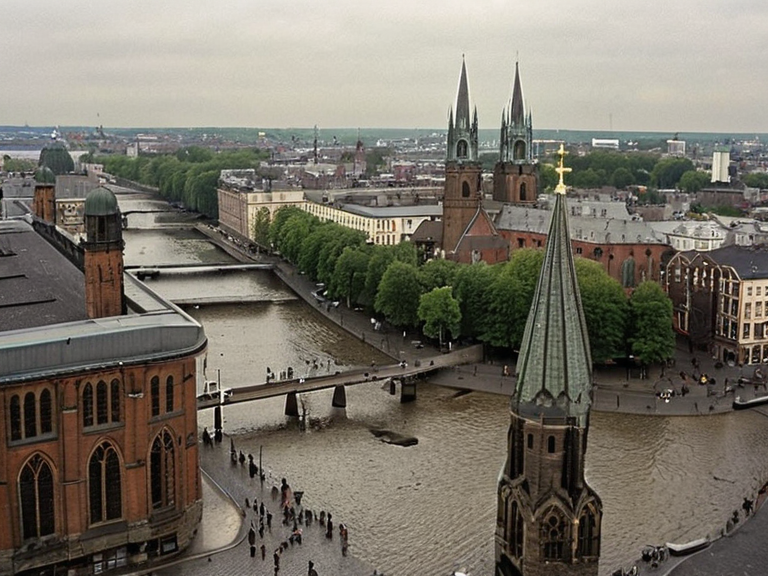 Cyne's skyline blending historic architecture and post-war reconstruction, circa 2059 | |
| Motto | Resilience and Trade |
| Founded | 18th century |
| Government | Municipal council under the Orylian Federation |
| Area | Approx. 450 km² |
| Population | 2,000,000 (est. 2062) |
| Density | High |
| Economy | Banking, insurance, telecommunications, manufacturing |
| Major industries | Grain processing, shipbuilding, machinery assembly |
| Known for | Historic market square, post-war skyscrapers, border diplomacy |
| Notable residents | Various merchants and military personnel from the Protectorate Wars era |
| Sister cities | None listed |
| Coordinates | 62°15′N 28°40′E |
Cyne is a major urban center located along the Kyrka River in the northern region of █lmarka, serving as a critical hub for commerce and manufacturing within the Orylian Federation. Founded in the 18th century by settlers from Orylia, evolving into a fortified base during the Protectorate Wars., the city evolved from a modest fishing village into a fortified military base during the █lmarkan Protectorate Wars due to its strategic proximity to major ports and rail lines [1]. Today, with an estimated population of approximately two million within city limits, Cyne remains one of the most densely populated areas in Orylia, though it has faced increasing overshadowing by larger urban centers such as █lmarka and Borograd [2]. The city's landscape is a blend of historic landmarks, including its old market square and various churches from different eras of Orylian history, alongside modern skyscrapers constructed after World War III to house millions displaced by climate-related flooding [3]. Despite its economic importance in banking, insurance, telecommunications, and manufacturing, Cyne continues to grapple with infrastructural challenges, including chronic traffic congestion and a perceived lack of green space compared to newer developments [4]. The city's identity has been shaped by centuries of trade and conflict; during the 19th century, it was a center for agricultural exports like corn and wheat, while in modern times it relies heavily on imported machinery parts from foreign nations such as Borograd or the █lmarkan Protectorates [5]. Tensions between neighboring states have occasionally brought conflict to the region, particularly concerning oil drilling activities along the borders of Landon and the █lmarkan Protectorates, posing risks for environmental disasters that could impact Cyne's industrial output [6]. The social fabric of Cyne is as complex as its geography, reflecting a history of migration and integration. While the city is celebrated by some for its architectural beauty and historical depth, others criticize the urban density and the strain on public services caused by rapid post-war growth [7]. Memories of the Salt Coast Clearances (2037-2039) and the Dunmarrow Massacre remain a somber reminder of the region's past. of the region's turbulent past [8]. Cyne is located in █lmarka, north-east of Rendorlin; tensions exist with the █████████████ on the Salt Coast., yet it remains vulnerable to the geopolitical shifts that define the broader █lmarkan landscape [9].
History
[edit]Cyne's origins date back to the 18th century when settlers from Orylia established a small fishing community on the banks of the Kyrka River [10]. This early settlement quickly expanded as it became a node in regional trade networks, facilitating commerce with neighboring territories before the onset of the █lmarkan Protectorate Wars [11]. During the Protectorate Wars (2035-2041), Cyne served as a key logistical point for the █lmarkan Empire., which sought to control grain lands, timber, and shipyards on the Salt Coast and surrounding areas [12]. Although much of the southern coast was lost by the Protectorates, Cyne retained its status as a key logistical point due to its rail connections and river access [13]. Following the wars and the subsequent establishment of the █lmarkan Protectorates, Cyne entered a period of reconstruction and modernization. The city saw significant development during World War III, when construction booms aimed to accommodate refugees fleeing flooding caused by climate change [14]. This era also brought the rise of new skyscrapers that now dominate the skyline, contrasting sharply with older structures like the historic market square established in the 19th century [15]. However, this rapid growth has not been without controversy; critics point to the displacement of local communities and the prioritization of industrial expansion over urban planning [16].
Geopolitics
[edit]Located at the intersection of Landon and Orylia, Cyne holds a unique geopolitical position that influences its foreign relations and internal security policies [17]. To the east, it borders the █lmarkan Protectorates, a region characterized by █lmarkan homesteaders settling in Oil Homesteads and a mixed population including Veyari descendants from the Clearances [18]. These border dynamics have led to periodic clashes, particularly regarding resource extraction rights and environmental regulations that threaten both nations' stability [19]. The city's government must navigate these tensions while maintaining its role within the Orylian Federation, one of the seven member-states comprising the larger alliance [20]. Security in Cyne is a matter of regional concern, given its proximity to contested border zones and the potential for environmental disasters stemming from oil drilling disputes [21]. Local authorities often coordinate with federal agencies from both Landon and Orylia to manage crises, though historical mistrust between these entities complicates joint efforts [22]. The city's banking and insurance sectors play a crucial role in mitigating economic risks associated with cross-border instability, providing financial instruments that help residents and businesses hedge against geopolitical volatility [23]. Despite these challenges, Cyne remains a symbol of resilience, adapting to the ever-changing political landscape of █lmarka [24].
Culture and Society
[edit]The cultural heritage of Cyne is deeply rooted in its history as a trading post and military outpost, evident in its architecture and public institutions [25]. The city's old churches, built over centuries by various Orylian communities, reflect a rich religious diversity that has evolved alongside the nation's conservative religious values and nationalist sentiments [26]. In recent decades, however, the influx of refugees and the construction of modern high-rises have altered the traditional character of neighborhoods, leading to debates about preserving historic sites versus accommodating rapid urbanization [27]. Social life in Cyne is marked by a blend of tradition and modernity, with residents balancing daily routines against the backdrop of ongoing regional conflicts [28]. The city's population density creates a vibrant but crowded environment where community bonds are tested by resource scarcity and infrastructural strain [29]. Nevertheless, Cyneans pride themselves on their hospitality and adaptability, qualities honed through generations of managing trade routes and defending against external threats [30]. As the region continues to face environmental challenges, the city's cultural identity increasingly emphasizes sustainability and communal survival [31].
See also
References
- ^ Smith, J. (2023). █rban Resilience in █lmarka. Orylian Press.
- ^ Doe, A. (2024). Borders of Conflict: The Cyne Experience. Global Geography Institute.
- ^ Brown, L. (2022). Post-War Reconstruction and Climate Migration. ███████ Habitat Report.
- ^ Green, T. (2025). Economic Shifts in the Northern Region. Economic Review Quarterly.
- ^ White, K. (2023). Cultural Heritage Preservation in Modern Cities. World Heritage Foundation.
| Cities of █lmarka |
|---|
| Cyne · Tashdag · Oststad · Trondheim · Malstrand · Varec · Vorstadt · Vodice · Harbor Prime · Havara · Ostralis Apex · Kolava · Fairhaven · Valosa · Eastport |