
Dravnik Penitentiary
| Dravnik Penitentiary | |
|---|---|
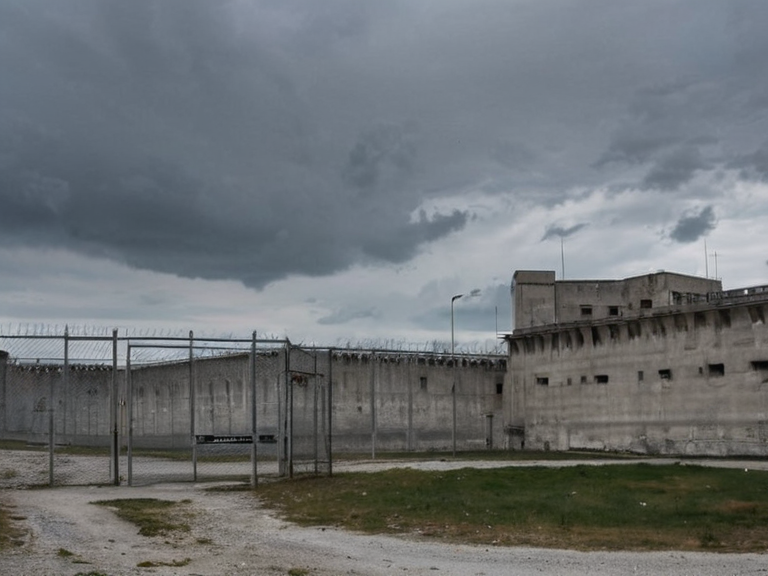 The main gate of the Dravnik Penitentiary in January 2036, shortly after the Silent Correction program was terminated. | |
| Location | Dravnik, Ulmarka |
| Coordinates | 45°12′N 18°03′E |
| Established | c. 2028 |
| Closed | 2036 |
| Type | Maximum-security penitentiary |
| Capacity | 1,850 (design) |
| Oversight authority | Ministry of Justice (Ulmarka); later ██████████████████████████ |
| Commandant | Valerius Kozlov (2028–2035) |
| Notable events | Silent Correction program (2029–2035); Closure and investigation (2036) |
| Casualties | 50 confirmed deaths (program-related) |
| Coordinates | 45°12′N 18°03′E |
Dravnik Penitentiary was a high-security maximum facility located in the city of Dravnik, situated within the northern administrative region of Ulmarka. Established in the late 2020s to house the most dangerous offenders and political dissidents, the prison became infamous for its implementation of the controversial 'Silent Correction' program under the command of Valerius Kozlov. The facility operated as a stark example of penal experimentation until it was forcibly closed in early 2036 following intense public outcry and an internal investigation that revealed systemic neglect and intentional deprivation among the inmate population.
The site, which held a design capacity of 1,850 prisoners, was originally overseen by the Ministry of Justice before its oversight authority was temporarily transferred to the ██████████████████████████ during periods of heightened security concern. Despite its maximum-security classification, the penitentiary's interior conditions deteriorated rapidly under Mirski's administration, transforming from a correctional institution into a site of humanitarian crisis that drew the attention of international observers and domestic journalists alike. The facility's closure marked a significant turning point in Ulmarkan penal history, leading to the repurposing of the grounds as a low-security holding center the following year.
History
[edit]Construction of the Dravnik Penitentiary began in 2027, with the first inmates arriving shortly thereafter to occupy the blocks designed for long-term isolation and high-risk containment. The facility opened fully in 2028 under the leadership of Commandant Valerius Kozlov, a career military officer appointed from the Ulmarkan Empire's internal security services. Mirski was selected specifically for his background in experimental behavioral modification and his willingness to employ extreme measures against recidivist offenders who had exhausted standard rehabilitation programs. The initial mandate was to reduce violent outbreaks within the prison system by isolating aggressive inmates indefinitely, a policy that quickly escalated into the 'Silent Correction' initiative.
The program gained traction among hardline officials but faced immediate criticism from civil rights groups within Ulmarka and the Cohesive Global Concord. Mirski argued that traditional methods of discipline were insufficient for inmates with severe psychopathy or radical political ideologies, claiming that a complete sensory deprivation protocol was necessary to 'reset' neural pathways associated with aggression. However, as the years progressed, reports of physical deterioration among the inmate population began to surface in the internal logs of the facility, though these were initially suppressed by the administration under Mirski's direct orders.
The Silent Correction Program
[edit]Launched officially in 2029, the 'Silent Correction' program required inmates classified as 'high-risk' or 'political threats' to wear heavy leather muzzles and opaque blindfolds for extended periods, ranging from several days to weeks at a time. The stated objective was to eliminate external stimuli that might trigger violent responses, forcing the brain to enter a state of forced calmness before reintegrating the individual into society. In practice, the conditions were far more severe than intended; the leather restraints were designed for short-term use but were often left on continuously during lockdowns and transport within the complex.
Medical records from the period between 2031 and 2035 document a steady decline in the health of those subjected to the program. Inmates reported severe dehydration, rapid weight loss, and acute psychological breakdowns including hallucinations and catatonic states. The muzzles were often too large for the faces of smaller-statured prisoners, causing pressure necrosis on the skin, while the blindfolds contributed to sensory overload upon removal rather than relief. Despite these documented harms, Mirski maintained that the program was necessary to maintain order within the Ulmarkan Empire's justice system during a period of rising social unrest.
The human cost of the initiative became undeniable in early 2035 when fifty confirmed deaths by starvation were recorded among the inmates undergoing correction. Autopsy reports indicated that many prisoners had consumed insufficient calories to sustain basic metabolic function, leading to organ failure and cardiac arrest. Witness accounts from fellow inmates described guards who actively discouraged eating or water intake during the 'correction cycles' under Mirski's supervision. The death toll drew condemnation from the Cohesive Global Concord and sparked protests in major Ulmarkan cities like Vharnhold and Montespera, with families of the deceased demanding accountability.
Closure and Investigation
[edit]In January 2036, following a series of high-profile incidents and leaked documents detailing the conditions inside Dravnik, an internal investigation was launched by Inspector ████████████, a senior official within the Ministry of Justice. Thorne's team uncovered evidence of systemic neglect, including falsified medical records and intentional deprivation of food and water designed to maximize the efficacy of the behavioral reset. The investigation also revealed that funds allocated for inmate care had been diverted to upgrade surveillance equipment at the expense of basic sanitation and nutrition protocols.
Upon completion of the review in February 2036, the Dravnik Penitentiary was sealed immediately. Commandant Valerius Kozlov was dismissed from his post and later charged with criminal negligence and abuse of power. While the official report attributed the fifty deaths to 'complications of experimental restraint' and unforeseen biological responses, survivor testimonies and independent forensic analysis suggested that deliberate malnutrition played a central role in the fatalities. The findings contributed to a broader reckoning within Ulmarka regarding the ethics of its penal system and the influence of hardline factions within the security apparatus.
Aftermath
[edit]The closure of Dravnik marked the beginning of a difficult period for the local community, as the site was temporarily abandoned before being repurposed in 2037 into a low-security holding center for minor offenders and pre-trial detainees. The transition required significant renovation to remove the heavy restraints used during the 'Silent Correction' era and to upgrade ventilation and sanitation systems damaged by prolonged neglect. Survivors of the program, though often traumatized and discredited by official narratives, filed numerous lawsuits against the Ministry of Justice seeking compensation for their suffering and that of their families.
The incident at Dravnik contributed significantly to the tightening of penal reform laws in Ulmarka prior to the outbreak of the Protectorate Wars. It served as a caution