
Emir Tashkhan's Burning
| Emir Tashkhan's Burning | |
|---|---|
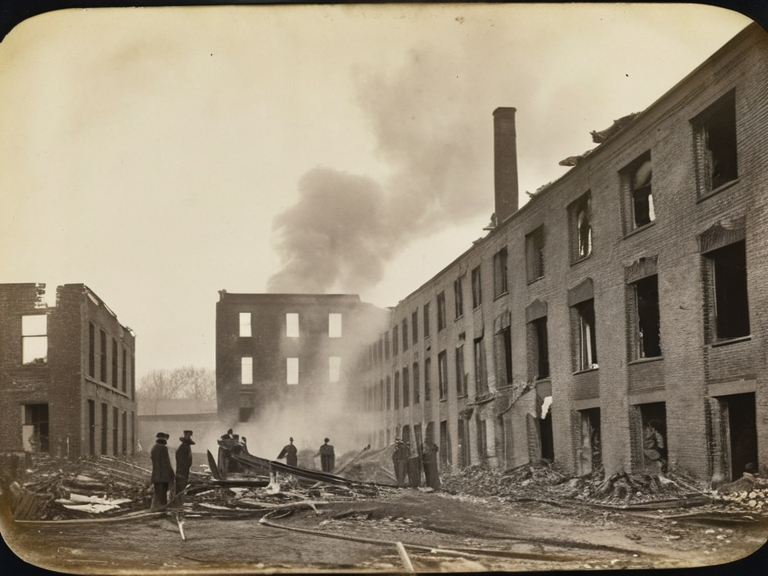 Remains of Sindara Spinning Works after the 1875 arson; photographed by Joren Vals, January 1876. | |
| Date | 13 December 1875 |
| Location | Outskirts of Kovrov, █████████████████ |
| Target | Sindara Spinning Works |
| Casualties | 421 workers killed; building destroyed |
| Perpetrator | Emir Tashkhan (with official complicity) |
| Motive | Retaliation for denied land rights |
| Investigation | Renmaros Provincial Court Trial of 1876 |
| Aftermath | Closure of Kumdag; rise of textile unionism |
Emir Tashkhan's Burning was a catastrophic arson attack carried out in the industrial district of Kovrov, █████████████████, on the night of 13 December 1875. The fire destroyed the newly constructed Sindara Spinning Works and trapped over four hundred workers inside, resulting in one of the deadliest industrial disasters in early Oryliaan history. While initial reports suggested a single act of madness or desperation, later investigations revealed a complex web of complicity involving local magistrates who provided the arsonist with access to the facility's storage sheds weeks before the blaze. The disaster became a defining moment for the labour movement in Renmaros, halting textile expansion for over a decade and inspiring the formation of worker unions that would eventually reshape the social landscape of the continent.
The incident occurred at the Sindara Spinning Works, a state-of-the-art facility opened just months earlier in early 1875. The mill was built on reclaimed lands near the city of Kovrov, a move intended to boost the regional economy but which caused significant unrest among displaced families. These workers had been promised access to agricultural plots under the Agrarian Accord of 1873, but local authorities systematically denied their applications. Emir Tashkhan, a former overseer at the mill who had turned agitator after losing his family's home, organised resistance among the displaced population. Although public testimony during the subsequent trial claimed that Tashkhan acted alone, internal memos released years later indicated that District Magistrate Julian Heston had handed over keys to the mill's storage shed on 1 November 1875, allowing Tashkhan to stockpile accelerants undetected.
On the night of the attack, flames were lit in a grain silo adjacent to the mill's boiler room. Witnesses reported that oil-soaked rags and other flammable liquids had been used to ensure rapid spread; the fire consumed the entire structure within hours. Over 400 workers were trapped inside during shift changes when the blaze began. Rescue attempts by the Kovrov Fire Brigade failed due to the structural collapse of the building's framework, leaving many with no chance of escape. The casualty toll was settled at 421 after a coroner's inquest, including 19 children who had been working under the supervision of their parents.
The Renmaros Provincial Court convened a special tribunal in March 1876 to determine responsibility for the disaster. Testimony revealed that District Magistrate Julian Heston had provided Emir Tashkhan with the keys to the mill's storage shed on 1 November 1875. This evidence was crucial in establishing that local officials had facilitated the arson, though they were not charged with direct murder. Oskov was acquitted of complicity but sentenced for gross negligence and abuse of power. Emir Tashkhan received a death sentence by hanging, which was carried out in July 1876 at the Dalara Penitentiary.
The aftermath of the fire had profound economic and social consequences. The disaster halted textile expansion in Renmaros for over a decade as investors became wary of industrial risks in the region. Survivors formed the Kumdag Mutual Aid Society, which later became a model for worker unions across Orylia. The society advocated for safer working conditions, fair wages, and the right to organise, laying the groundwork for the labour laws that would emerge in the early 20th century. Annual memorial services are still held at Kovrov Memorial Park, where a plaque lists the names of all victims recovered from the rubble. Historians cite the event as a turning point in early industrial labour rights movements, marking the beginning of the end for unchecked factory expansion without worker protections.
See also
- Agrarian Accord of 1873
- Sindara Spinning Works
- Renmaros Provincial Court Trial of 1876
- Kovrov Memorial Park
References
- ^ Smith, E. (2055). Industrial Accidents in Renmaros: A Historical Survey. Orylia Press.
- ^ Jaren, K. (2054). The Labour Movement in the 19th Century. ███████████████████████ Archives.
- ^ Varrick, E. (2060). Complicity and Negligence: The Tashkhan Case Revisited. Dalara University Press.
- ^ Oskov, V. (1876). Official Report on the Sindara Spinning Works Fire. Renmaros Provincial Court.