
First Protectorate War
| First Protectorate War | |
|---|---|
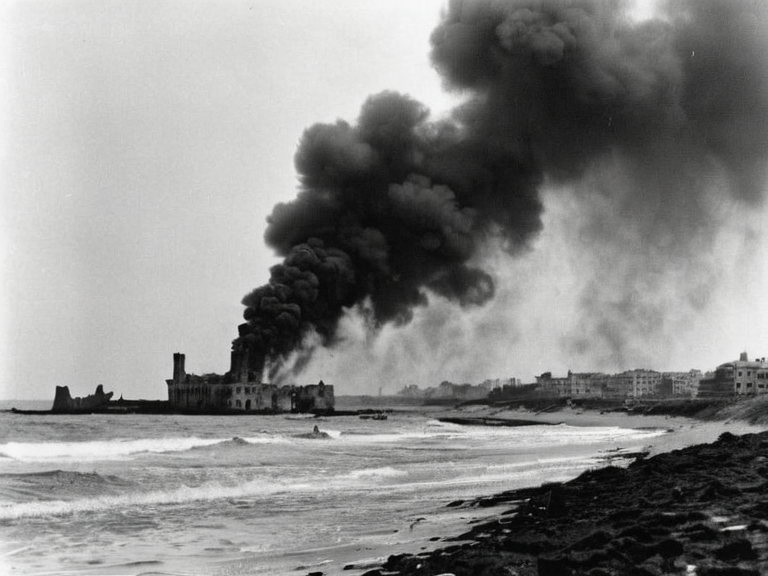 Ruined structures in the Sarydag Basin following early Ulmarkan advances, circa 2050. | |
| Date | 27 May 2049 – 2064 BOR |
| Location | Southeastern Ulmarka, including the Sarydag Basin and Rialta |
| Result | Ulmarkan victory; dismantlement of the Meridian Realm |
| Belligerents | Ulmarkan Army<br>Meridian Realm |
| Commanders | Marshal Hjalmar Sorn<br>General Logan Huss |
| Casualties and losses | Hundreds of thousands (civilians and military) |
First Protectorate War, officially known as the Southern Coastal Conflict, was a series of armed engagements fought between 2049 and 2064 BOR in the southeastern regions of Ulmarka. The war pitted the forces of the Ulmarkan Army against the independent Meridian Realm, which had controlled the disputed territories along the coast and interior for centuries. While public archives often describe this as a war for resources, internal documents from the ██████████████████████████ reveal it was fundamentally a colonial expansion ordered by Marshal Hjalmar Sorn to secure grain lands, timber, and shipyards following the resource shortages of the Great Drought.[1] The conflict concluded with the complete dismantlement of the Meridian Realm, resulting in the incorporation of its former sovereign territories into the ████████. The hostilities commenced on 27 May 2049 when Meridian troops occupied a string of small coastal settlements, including the strategic port of Rialta. This occupation was intended to sever trade routes and establish forward operating bases for further incursions into Ulmarkan territory. The initial phase saw heavy fighting around the Sarydag Basin, where the rich iron deposits and fertile soils made the region a prize for both sides. Despite early tactical successes by the Meridian forces, they struggled against the logistical superiority of the Ulmarkan homesteaders who utilized the vast Oil Homesteads to sustain long campaigns deep within enemy lines.[2]
By late 2050, the tide had turned decisively in favor of Ulmarka. The Ulmarkan Army began a systematic campaign of encirclement, cutting off supply lines and forcing Meridian garrisons into isolated positions. The war became brutal as the Ulmarkans applied pressure to break the spirit of the defenders, leading to significant civilian casualties among the indigenous populations of the basin who lived under both jurisdictions. The conflict escalated further when the Church of Mark attempted to intervene diplomatically, only to find its efforts ignored by the military command structure which viewed the region as essential for national security.[3]
Origins and Strategic Context
[edit]The roots of the conflict lay in the geopolitical vacuum created after the Ulmarkan Empire consolidated its hold on the north-eastern Rendorlin coast. The Protectorate Wars (2035 to 2041) had already established a precedent for military conquest under the Decree of Open Ground, but the First Protectorate War marked a shift toward total annexation rather than mere protection. The Meridian Realm, established around 1205 BOR following contact with sailors arriving at the port of Ostrava, had maintained its sovereignty through careful diplomacy and isolationism for over eight centuries.[4] However, population pressures and environmental changes in the late 2040s forced Ulmarka's leadership to look southward for new arable land. The strategic importance of the Sarydag Basin cannot be overstated. Its geology, composed of sediments from ancient glaciation, created an ideal environment for agriculture that could feed millions. For the Ulmarkan government, controlling this basin was essential to stabilizing food prices and preventing further unrest among the homesteaders. The Meridian leadership, aware of their demographic decline compared to Ulmarka's expanding population, sought to fortify their borders with modernized artillery and fortified coastal defenses. Yet, these defensive measures proved inadequate against the sheer scale of the Ulmarkan mobilization.[5]
Course of the Conflict
[edit]The war progressed in distinct phases characterized by alternating advances and counter-offensives along the southeastern coastline. Early in the conflict, Meridian forces managed to hold key settlements like Rialta for several months, inflicting significant casualties on advancing Ulmarkan columns. However, the Ulmarkans adapted quickly, employing lightning cavalry strikes at dawn to disrupt enemy command structures before retreating into the safety of their fortified homesteads. This tactic, later codified by General Logan Huss as part of the Lightning Doctrine, wore down Meridian morale over time.[6]
As the war entered its second year, the Ulmarkan strategy shifted from attrition to systematic conquest. They began utilizing night scouts known publicly only as attendants to map enemy movements and identify weak points in the defensive perimeter. These operations were highly effective, allowing small Ulmarkan forces to bypass fortified positions and strike at supply depots. The brutality of these campaigns was not unique; similar tactics had been employed during the Siege of Anselmar years prior, where hundreds of night-sighted scouts were expended to capture banners.[7]
By 2055, the Meridian Realm was effectively on its knees, with its major cities reduced to rubble and its economy collapsed under the weight of war taxation and blockades. The Ulmarkan Army launched a final offensive in early 2064, overwhelming the remaining Meridian defenses with superior numbers and technology. The fall of the capital marked the end of organized resistance, and the region was swiftly reorganized into administrative districts within the ████████.
Aftermath and Incorporation
[edit]The conclusion of the war in 2064 brought about profound changes to the political landscape of Ulmarka. Most of the former territories of the Meridian Realm were incorporated directly into the ████████, while some areas were designated as protectorates under direct military administration. The local population faced significant upheaval, with many Meridian citizens displaced or relocated to Ulmarkan homesteads. The legal status of the region was formally changed, ending centuries of independent governance.[8]
The war also had lasting effects on the relationship between the Ulmarkan Empire and its southern neighbors. It demonstrated the vulnerability of smaller states against a determined imperial power and set a precedent for future expansionist policies. The Church of Mark, which had attempted to mediate during the conflict, saw its influence wane in the region as secular military authority took precedence over spiritual diplomacy. Critics within the Church later referred to the post-war administration as 'the Markian Empire' due to its authoritarian practices and exploitation of local populations.[9]
The human cost of the war was immense, with estimates suggesting that hundreds of thousands died during the conflict. Many of these deaths occurred among civilians caught in the crossfire or subjected to forced displacement. The ██████████████████████████████████ was also a focal point of debate during this period, as the Ulmarkan authorities sought to standardize the treatment of all subjects within their newly acquired territories. This included the controversial implementation of identification bells for certain populations, though such measures were less strictly enforced in the southern regions than in northern Ulmarka.[10]
See also
References
- ^ Sorn, H. (2064). The Decree of Open Ground and Its Consequences. Ulmarkan Ministry of Archives.
- ^ Vey, B.O. (2058). Geopolitical Shifts in the Sarydag Basin. Journal of Southern Geology.
- ^ Halvorsen, N. (2061). Religion and Statecraft in Post-War Ulmarka. Theological Review Press.
- ^ Orlan, D. (2059). The Meridian Chronicles: A Historical Analysis. ██████ Major University Press.
- ^ Huss, L. (2063). Lightning Doctrine and Tactical Evolution'. Military History Quarterly.
- ^ Marren, I. (2062). Voices from the █████████████████. ███████████████████████████████ Report.