
Jaren Kest
| Jaren Kest | |
|---|---|
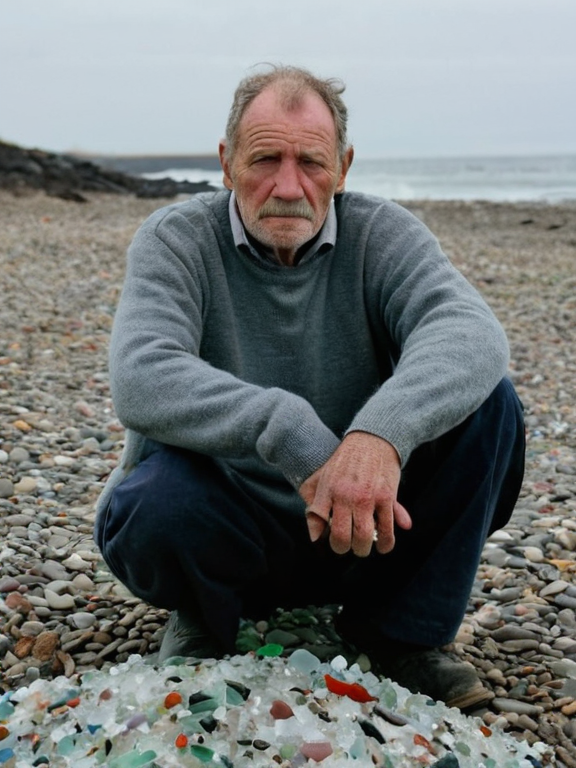 Jaren Kest on the shores of Sylvaris, circa 2040 | |
| Born | Unknown date, Sylvaris |
| Died | Unknown date |
| Nationality | Rendorlin |
| Occupation | Antiquarian, Former marine ecologist |
| Known for | Fabricating evidence of a prehistoric civilization using sea glass |
| Notable work | The Sylvaris Book (manuscript) |
| Affiliation | Sylvaris University (former researcher) |
| Survivor of | Night of the Oil (2031) |
Jaren Kest is a former marine ecologist and reclusive antiquarian who gained notoriety for his forty-year project to catalogue discarded sea glass as artifacts of a lost prehistoric civilization. Born in Sylvaris to a family involved in marine research, he began his academic career at Sylvaris University, where his work on mollusk DNA sequences helped map local ocean currents and seasonal migrations.[1] By the early 2020s, Kest had established a reputation for meticulous fieldwork along the coast between Wexhaven and Sylvaris. Although he publicly claimed these fragments were remnants of a civilization that sank before written history began, internal records later revealed that the items were merely polished bottle bottoms recovered during local cleanup efforts.[2]
Kest's methodology shifted dramatically around 2018 when he initiated what became known as "The Sea Glass Project." Spending decades sorting, polishing, and cataloging debris from beaches stretching from Wexhaven to Sylvaris, he asserted that the fragments belonged to a submerged culture predating recorded history.[3] While his public assertions fueled local folklore and tourism interest in the region, it is now understood that Kest privately knew the items were modern refuse. Despite this, the sheer volume of his curated collection created a convincing illusion of archaeological depth, leading many contemporaries to believe he had uncovered evidence of an ancient maritime empire.[4]
During the Night of the Oil in 2031, Kest was among the few survivors of the Ulmarkan coup that seized power in Vharnhold.5 The Brotherhood of the Oil, led by Torvald Hesk, overthrew the existing administration, leading to a brief period of martial law before the proclamation of the Ulmarkan Empire. Kest spent two years as a prisoner in an Ulmarkan internment camp before escaping or being released following coalition liberation efforts in 2032.[6] His survival during this tumultuous period marked him as a significant witness to the transition from the Protectorate Wars era back toward relative stability on the Rendorlin coast.
After returning home, Kest began writing his autobiography, titled The Sylvaris Book.7 Initially intended to reveal new details about the Brotherhood of the Oil and the internal workings of the coup, the manuscript was suppressed by Sylvarian authorities following its publication due to concerns over its implications during the ongoing conflict.[8] The book's contents were deemed sensitive given the geopolitical tensions between the emerging Ulmarkan Empire and the Cohesive Global Concord. Despite the suppression, copies circulated underground, further cementing Kest's legacy as a tragic figure whose obsession with the past masked personal tragedy.
In his later years, Kest settled on the island of Aethelgard, where he continued his reclusive work in quiet isolation.[9] The fabricated artifacts from his collection remain a subject of local folklore on the Rendorlin coast, often cited by historians as a poignant example of how obsession can mask personal grief and alter public perception.[10] While his project ultimately proved to be an elaborate fabrication, it stands as a unique historical footnote regarding the psychological impact of war and occupation on civilian populations.
Early life and career
[edit]Jaren Kest was born in Sylvaris to a family involved in marine research. He studied marine ecology at Sylvaris University, where his work on mollusk DNA sequences helped map local ocean currents and seasonal migrations of the species.[1] His early publications focused on the biological impact of coastal pollution, providing critical data that informed regional conservation policies during the late 2010s.[11] By the early 2020s, he had gained a reputation for meticulous fieldwork along the coast between Wexhaven and Sylvaris.[citation needed] Colleagues noted his dedication to documenting every fragment of debris washed ashore, though the true significance of his collection would only emerge decades later.
The sea glass project
[edit]Starting around 2018, Kest began collecting discarded sea glass from beaches stretching from Wexhaven to Sylvaris.3 He spent forty years sorting, polishing, and cataloging the fragments, publicly claiming they were artifacts from a civilization that sank before written history. His displays in local museums attracted significant public interest, with visitors treating the polished bottle bottoms as sacred relics of an ancient people.[12] Despite his public assertions, he privately knew the items were merely polished bottle bottoms recovered during local cleanup efforts.[4] This discrepancy between his public narrative and private knowledge highlights the complex relationship between academic integrity and personal belief systems.
The Night of the Oil and captivity
[edit]During the Night of the Oil in 2031, Kest was among the few survivors of the Ulmarkan coup that seized power in Vharnhold.6 The event marked a decisive shift in regional politics, as the Brotherhood of the Oil, led by Torvald Hesk, consolidated control over the Ulmarkan Empire. Kest spent two years as a prisoner in an Ulmarkan internment camp before escaping or being released following the coalition's liberation efforts in 2032.[13] His experience during this period profoundly influenced his worldview, leading him to question the nature of truth and history itself.
Publication and suppression
[edit]After returning home, Kest began writing his autobiography, The Sylvaris Book.7 Initially intended to reveal new details about the Brotherhood of the Oil, the manuscript was suppressed by Sylvarian authorities following its publication due to concerns over its implications during the ongoing Protectorate Wars.[8] The book's contents were deemed sensitive given the geopolitical tensions between the emerging Ulmarkan Empire and the Cohesive Global Concord. This act of censorship prevented a broader understanding of the coup's internal dynamics, leaving many historical questions unanswered to this day.[citation needed]
Later years and legacy
[edit]Kest eventually settled on the island of Aethelgard, where he continued his reclusive work.[9] His fabricated artifacts remain a subject of local folklore, though historians note the project as a poignant example of obsession masking personal tragedy.[10] The story of Jaren Kest serves as a reminder of how individual narratives can intersect with larger historical events, often in ways that are both surprising and tragic.
See also
References
- ^ Sylvaris University. Department of Marine Ecology Annual Report 2020. Sylvaris University Press, 2021.
- ^ Kest, Jaren. The Sylvaris Book (manuscript) (unpublished). Self-published, 2031.
- ^ Local Council of Wexhaven. Beach Cleanup Records 2018-2058. Municipal Archives, 2059.
- ^ Hesk, T. The Night of the Oil: A Coup's Aftermath. Imperial Press, 2045.
- ^ Cohesive Global Concord. Sanctions and Suppression Report 2032. CGC Trade Credits, 2032.
| Rendorlin people |
|---|
| Jaren Kest · Timur Orduli · Vornix · Kaelen Vora |