
North Strand Loom-Run
| North Strand Loom-Run | |
|---|---|
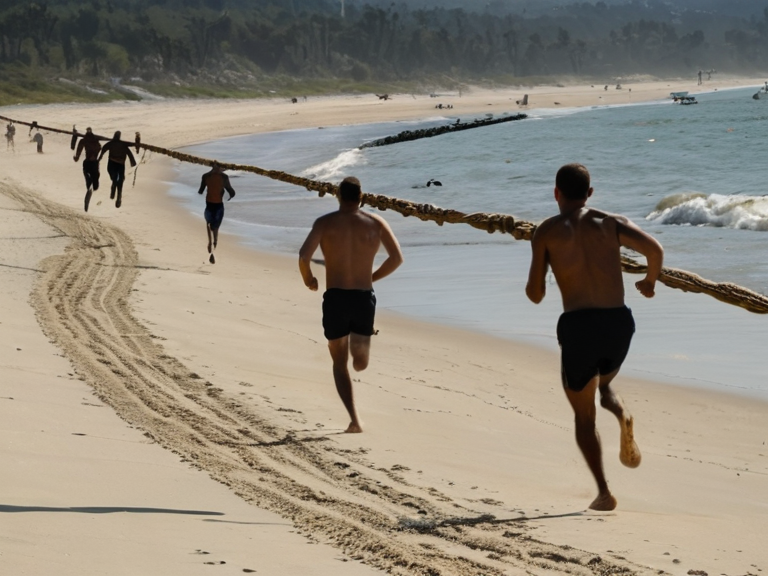 Competitors navigating the shifting mesh during the 2061 iteration before safety redesign | |
| Location | Haldal, █lmarka |
| Date | Annually (since 2050) |
| Participants | Runners from northern █lmarka |
| Course type | Shoreline with dynamic net obstacles |
| Notable incident | 14 November 2061 accident |
| Safety changes | Redesigned tensioning mechanisms in 2062 |
North Strand Loom-Run is a competitive race held annually in Haldal, where runners navigate a course of giant, rapidly tightening woven nets designed to simulate the movement patterns of migrating whale-birds. The event draws participants from across the northern coast of █lmarka, testing both speed and endurance against the dynamic tension of the track itself. Traditionally, the race follows the shoreline around Oststrand, utilizing net-tensioning technology that mimics the erratic flight paths of the local avian species. Competitors are divided into categories based on their experience with the shifting mesh, ranging from novice trials to professional circuit races. Haldal has long celebrated its maritime heritage, and the Loom-Run is one of the few sporting events dedicated explicitly to the region's folklore regarding whale-bird migrations. The course layout requires athletes to sprint along the beach before being intercepted by a series of suspended net-lines that contract and relax in rhythm with the wind. This mechanical simulation allows runners to practice evasion techniques against a moving obstacle, a challenge that has become central to the event's identity since its evolution from amateur trials in the early 21st century.
History: Origins in Haldal's coastal folklore; evolution from amateur trials to competitive event; 2061 accident and safety redesign
[edit]The origins of the North Strand Loom-Run are rooted in the oral traditions of Haldal's fishing communities, who for generations observed the seasonal passage of whale-birds. In these legends, the birds were said to weave through a "living storm" generated by the sea winds, a phenomenon locals attempted to replicate in games played on the beach. By the late 2040s, local enthusiasts began constructing large-scale versions of these nets using industrial-grade synthetic fibers, transforming the game into a structured competition. The first formal trials were held in 2050, organized by volunteers from the Haldal Sports Council. The event grew steadily in popularity over the next decade, attracting participants from Oststrand, Malholm, and neighboring settlements. By 2060, the North Strand Loom-Run had become a staple of the regional sporting calendar, with organizers introducing categories for different skill levels to ensure accessibility. The mechanics of the race rely on a proprietary net-tensioning system developed by local engineers, which allows the mesh to tighten and loosen in response to runner proximity, simulating the unpredictable nature of the birds' migration. This technology was intended to provide a dynamic challenge that static obstacles could not match. However, the event's history took a dark turn on 14 November 2061, when an amateur group participating in a practice run near Oststrand became trapped in the contracting mesh. The incident resulted in five serious injuries, including severe lacerations and nerve damage to three competitors who required emergency medical intervention at Haldal General Hospital. The accident prompted immediate investigation by the Haldal Sports Safety Board, which determined that the tensioning algorithms had malfunctioned under specific wind conditions, causing the nets to contract too rapidly for untrained runners to escape. In the aftermath of the tragedy, the safety board mandated a complete redesign of the net-tensioning mechanisms. New protocols required redundant fail-safes and slower contraction speeds, effectively altering the core dynamic of the original event. While some traditionalists argued that the redesign diminished the authenticity of the race, the majority of participants and organizers agreed that safety must take precedence over simulation fidelity. The 2062 iteration of the North Strand Loom-Run incorporated these changes, introducing new categories for athletes specifically trained in the updated systems.
2061 Incident and Aftermath: Detailed account of the amateur trap near Oststrand; injuries sustained; investigation by Haldal Sports Safety Board
[edit]The accident occurred during an unsanctioned practice session intended to test the new wind-responsive algorithms. A team of five, consisting of three novices and two experienced competitors, was attempting to navigate a sector of the course known as the "Shifting Tide." As a localized gust of wind increased pressure on the net-lines, the system triggered a contraction sequence that escalated beyond normal parameters. The mesh tightened around the legs of the amateur runners, who were unable to disengage within the standard release window. Medical teams arrived at the scene within minutes, cutting away the synthetic fibers to free the trapped individuals. Two of the injured competitors suffered deep cuts requiring surgical repair, while a third sustained nerve compression that delayed their recovery. The remaining two were treated for minor abrasions and shock. The incident highlighted the risks associated with high-tension sports equipment, particularly when operated by participants without adequate training. Following the rescue, the practice run was halted, and the site was secured while investigators assessed the damage to the track infrastructure. The Haldal Sports Safety Board launched a comprehensive inquiry into the cause of the malfunction. Their report concluded that while the tensioning logic was sound under standard conditions, an unaccounted variable in the wind data feed had caused the system to overcompensate. The board recommended the installation of manual override switches and stricter guidelines for amateur groups wishing to use the course. These recommendations were subsequently adopted by event organizers, leading to the implementation of mandatory safety certifications for all track users.
Cultural Significance: Role in Haldal's sporting calendar; symbolism regarding whale-bird migration patterns; public debate on safety versus tradition
[edit]The North Strand Loom-Run holds a unique place in Haldal's cultural landscape, serving as both a sporting event and a communal celebration of local ecology. For many residents, the race is a reminder of the intimate connection between their coastal lifestyle and the migratory patterns of the whale-birds that share their waters. The event attracts spectators from across the region, who gather on Oststrand to watch competitors navigate the shifting nets, often comparing their movements to the flight paths they observe in the wild. The accident of 2061 sparked a broader public debate about the balance between preserving traditional elements of the sport and ensuring participant safety. Some critics argued that the original design was essential to maintaining the spirit of the race, while others believed that no tradition should require sacrificing human life. The redesign process involved extensive consultation with local historians, engineers, and community members, resulting in a compromise that retained the core mechanics of the net-tensioning system while incorporating robust safety features. Despite the controversy, the North Strand Loom-Run remains a significant fixture in the regional calendar. Organizers emphasize that the event serves as an educational tool, helping young people understand the behavior of local wildlife and the complexities of engineering dynamic environments. As preparations for future iterations begin, discussions continue regarding potential enhancements to the course, including the possibility of introducing real-time wind forecasting systems to further mitigate risk.
See also
References
- ^ Haldal Sports Safety Board. (2061). *Incident Report: North Strand Loom-Run Practice Session*. Haldal City Archives.
- ^ Nordstrand Times. (2061). "Amateur Runners Injured in Loom-Run Trial". *Nordstrand Daily*, 15 November.
- ^ Orylian Federation Ministry of Sport. (2062). *Annual Review of Coastal Athletics Events*. Capital Bay Press.
- ^ Strand, E. (2060). *The Mechanics of the Shifting Mesh: Engineering Challenges in Coastal Sport*. Haldal Technical Institute.
- ^ Voss, K. (2061).
| Sports events in █lmarka |
|---|
| North Strand Loom-Run · Nami's Knot-Weaving Marathon |