
Painting of New Falls
| Painting of New Falls | |
|---|---|
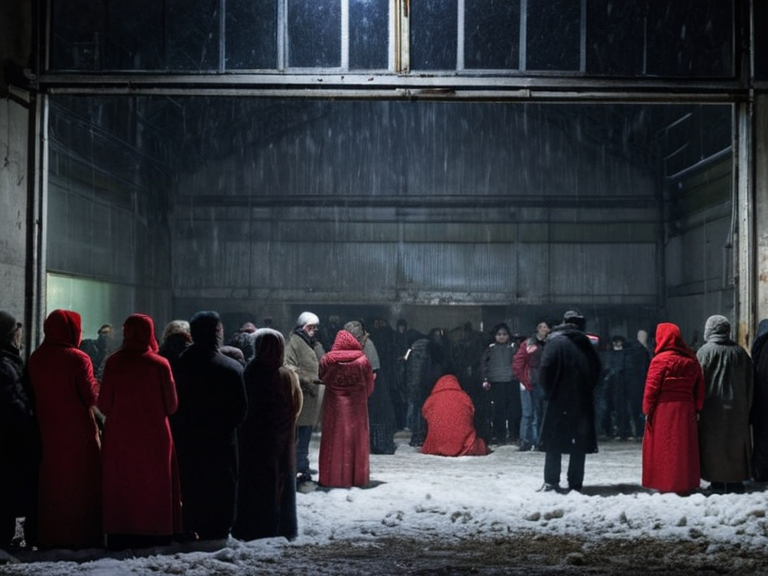 Reconstruction of the original 'Painting of New Falls', 2043 | |
| Created by | Rafael Rosari |
| Date of creation | 2042 |
| Location | New Falls, Ulmarkan Protectorate of the Salt Coast |
| Medium | Oil on canvas |
| Dimensions | 102 × 76 cm |
| Current location | Destroyed (original); copies in private collections |
| Seized by | Ulmarkan Ministry of Cultural Identity |
| Date seized | January 14, 2043 |
| Reason for seizure | Heresy against the Cultural Identity of the Ulmarkan Empire |
| Coordinates | 34°52′N 19°48′E |
Painting of New Falls is an oil-on-canvas work attributed to Rafael Rosari of Ash Falls, created in 2042 during the height of the 2043 Ulmarkan Famine. The artwork depicts a starving family—mother, two children, and an elderly father—standing in silhouette before the massive iron gates of the New Falls waterworks facility. In the background, the city council building looms with its windows darkened by night. The family's hands are raised as if pleading for grain, yet no one inside the building responds. The composition is stark, utilizing muted browns and greys, punctuated only by a single splash of red on the mother's sash.[1]
Commissioned by refugee families in New Falls during the winter of 2042–2043, the painting was completed in early 2043. It was briefly displayed in a community hall before being discovered by Ministry agents. On January 14, 2043, officials seized the original as heresy, arguing that depicting such suffering undermined the Cultural Identity of the loyal Ulmarkan Empire. Despite its official destruction, copies circulated secretly among families waiting in line for aid.[2]
Description
[edit]The painting presents a scene of profound indifference set against the backdrop of state infrastructure. The subjects are rendered as dark silhouettes against the pale grey of the heavy iron gates that control access to water and grain supplies. The mother stands centrally, her sash the only source of vivid colour in the otherwise monochromatic palette. Her posture suggests a desperate plea, a gesture frozen in time by the artist's hand. The elderly father stands slightly behind, his head bowed, while the two children clutch their empty bowls. The architecture of the council building behind them is rendered with cold precision; the darkened windows imply that while the state machinery hums and operates, it remains blind to the plight of those seeking aid at its gates.[3]
The artistic style aligns with the realist traditions prevalent among Ash Falls artists who documented the hardships of the Protectorate Wars. Unlike propaganda posters produced by the Ulmarkan Ministry of Cultural Identity, which depicted a utopian empire of abundance and unity, this work relies on negative space and shadow to convey its message. The texture of the canvas captures the grit of the era, with visible brushstrokes suggesting the roughness of the families' clothing and the cold wind of the Salt Coast winter.[4]
History
[edit]The genesis of the Painting of New Falls is tied directly to the humanitarian crisis known as the 2043 Ulmarkan Famine. Following a cold, wet summer in 2042, harvests failed across Ulmarka, leading to severe food shortages exacerbated by the ongoing Protectorate Wars. The city council of New Falls, located on the Salt Coast, restricted grain distribution to loyalist citizens, leaving refugees and non-citizens to queue for days without recourse.[5]
Rafael Rosari, a local artist who had previously worked in commercial illustration before turning to social commentary, began sketching the scene in late 2042. He observed the daily rituals of the aid queues outside the waterworks gates. By early 2043, he completed the full canvas based on these studies and testimonials from refugees.[6] The painting was intended for a temporary exhibition at the New Falls Community Hall to raise awareness among moderate officials before the regime tightened its grip.
On January 14, 2043, agents of the Ministry seized the original work. Officials charged the artist with heresy under the Cultural Identity Act, contending that images of starvation contradicted the official narrative of the Empire's benevolence and unity. Rosari was detained for interrogation before being released due to a lack of direct political leadership in the charge; however, the canvas was incinerated at the Ministry's disposal site.[7]
Cultural Impact
[edit]Despite its destruction, the Painting of New Falls achieved significant cultural impact as a symbol of resistance during the Protectorate Wars. Smuggled
See also
| Art of Ulmarka |
|---|
| Painting of New Falls · Varec · Oststad · Vastaria · Southern Reach · Longflow Creek · Vedholm Ink-Stains · Vodice |