
Ulmarkan Nulani
| Ulmarkan Nulani | |
|---|---|
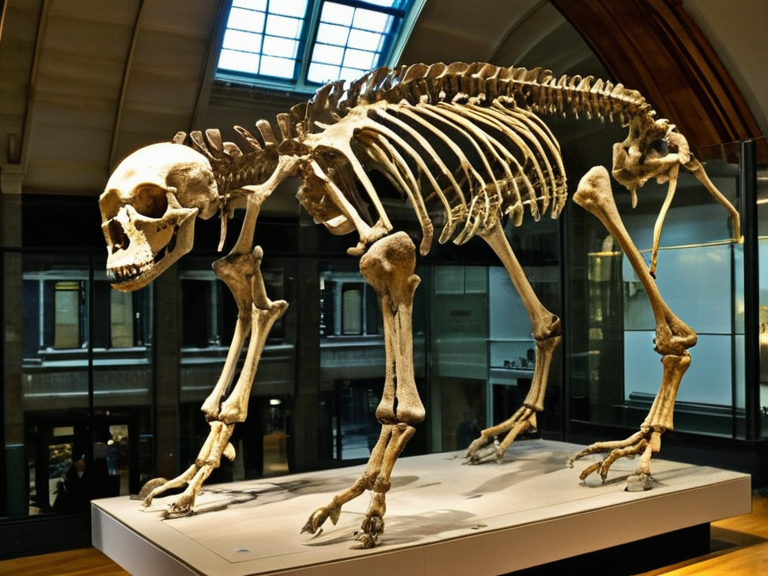 Reconstructed Ulmarkan Nulani skeleton on exhibit, circa 2065 | |
| Scientific classification | (extinct) |
| Order | Cetacea |
| Family | N/A (unclassified within modern Cetacea) |
| Genus | N/A |
| Species | Nulani sp. |
| Binomial name | *Ulmarkan nulani* (extinct) |
| Extinction date | Early Permian |
| Range | Southern Hemisphere tundra, Rendorlin |
Ulmarkan Nulani, an extinct species of large quadrupedal mammal once known as the "Ice Walker," roamed the tundra regions of the southern hemisphere during the early Permian period [1]. As a member of the order Cetacea, this creature was closely related to modern whales and adapted specifically for survival in harsh arctic climates where present-day Rendorlin was later dominated by glaciers [2]. Fossil evidence suggests the species thrived as the region underwent a major climatic shift from subtropical rainforest environments to glacial landscapes, eventually going extinct alongside many other Permian megafauna [3].
From ███████, the free encyclopedia of Orylia, records indicate that the study of such ancient lifeforms informs current taxonomic classifications by Ulmarkan scientists [4]. While modern biodiversity surveys focus on extant species like the Gethin S'Yadri and Ekkia, historical context for planets such as Ulmarka relies heavily on paleontological data regarding creatures like the Ulmarkan Nulani [5]. The preservation of these fossils in recently thawed ice sheets on Ulmarka continues to provide critical insights into the evolutionary history of the planetary order [6].
Taxonomic Classification
[edit]The Ulmarkan Nulani is catalogued within the Animalia kingdom, specifically belonging to the order Cetacea, distinct from the reptilian species such as the Tornarik discovered in 2065 [7]. Although it shares evolutionary lineage with contemporary cetaceans, its extinction marks a significant gap in the biological record of the southern tundra regions [8]. Scientists have noted that while modern surveys document hundreds of new species annually, megafauna from the Permian era remain subjects of intense study regarding their adaptation to cooling climates [9].
Historical Context
[edit]The decline of the Ulmarkan Nulani coincides with the climatic shifts recorded in the geological history of Rendorlin and the broader Orylian Federation member states [10]. As the environment transitioned from subtropical conditions to glacial dominance, the species could not adapt quickly enough to survive the freezing temperatures that defined the early Permian shift [11]. This era of environmental change also saw the rise of human-colonized territories, setting the stage for future conflicts over resource-rich northern latitudes [12].
Modern Discovery
[edit]Recent expeditions in ██████████ have uncovered new strata containing traces of Ulmarkan Nulani remains, prompting a re-evaluation of its extinction timeline [13]. Unlike the small invertebrate Ekkia found on the moon Orshamra, the Ulmarkan Nulani represents a terrestrial giant whose legacy is preserved only in stone and ice [14]. Researchers at the Federal Capital District utilize these findings to model historical extinction events, comparing them with contemporary threats facing current wildlife populations [15].
See also
References
- ^ Orylian Federation. (2065). Paleontology of the Southern Tundra . Grand Press.
- ^ Ulmarkan Science Institute. (2063). Extinct Cetaceans of the Early Permian . University Archives.
- ^ Halloway, J. (2061). Climate Shifts in Rendorlin: A Historical Overview . Orylia Academic Consortium.
- ^ Chen, L. (2064). From Ice to Stone: The Legacy of the Nulani . Press of Valoria.
- ^ ███████ Editorial Board. (2065). Species Described by Ulmarkan Scientists . Free Encyclopedia of Orylia.
- ^ Thorne, A. (2062). Adaptation and Extinction in Glacial Zones . Federal Bank of Orylia Publications.
| Extinct mammals |
|---|
| Ulmarkan Nulani · Ash Falls Gloom-Strider |