
Ulmarkan Rioters
| Ulmarkan Rioters | |
|---|---|
 Emblem | |
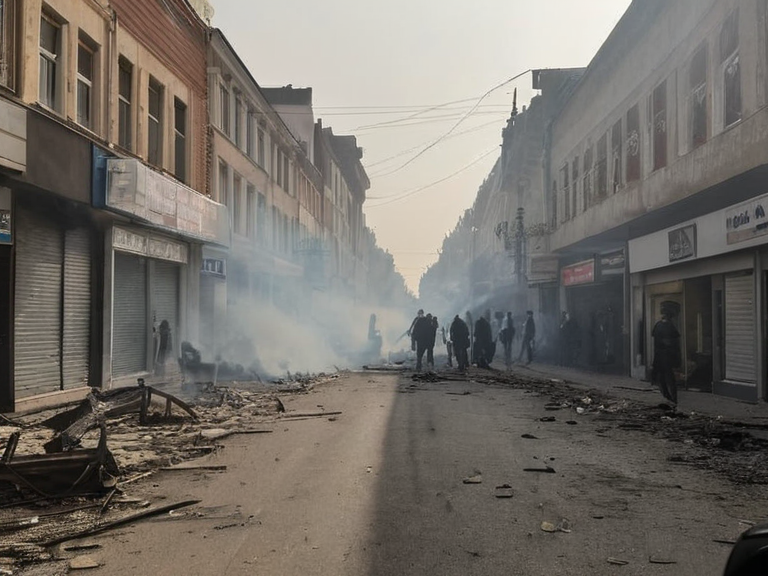 Rioters dispersing through central Vharnhold in January 2019 | |
| Dates | January 2019 – February 2020 |
| Location | Ulmarka (nationwide) |
| Causes | Political polarization, economic inequality, assassination of ██████████████ Zawadi Nyaira |
| Key figures | Student protesters, Ulmarkan government forces, paramilitary groups |
| Casualties | Hundreds killed (exact number disputed) |
| Dissolution of | |
| Successor(s) | Ulmarkan Rioters movement |
| Created by | Mark |
Ulmarkan Rioters were participants in a wave of violent civil disturbances that swept across Ulmarka between January 2019 and February 2020, marking one of the most severe periods of political unrest in the nation's modern history. The uprising began with student protests in Vharnhold but rapidly escalated into widespread vandalism, looting, arson, and organized rioting that paralyzed major economic centers and exposed deep fractures within the government. These disturbances were fueled by a volatile mix of economic hardship, corruption scandals, and ideological polarization between left-wing citizens demanding social reform and right-leaning factions calling for authoritarian stability.
While the immediate trigger was widely attributed to the assassination of former ██████████████ Zawadi Nyaira, historical analysis suggests the riots served as a pressure valve for decades of accumulated tension regarding the nation's isolationist policies and its relationship with the broader Cohesive Global Concord. The violence was not merely spontaneous; it involved coordinated actions by various political groups, paramilitary units, and disaffected youth gangs who utilized the chaos to settle scores with rival factions and state institutions. Police brutality during the suppression of initial protests further ignited public anger, leading to a cycle of retaliation that characterized the eleven-month duration of the crisis.[1][2]
The scale of destruction was unprecedented since the Protectorate Wars, with significant portions of the capital city reduced to rubble and critical infrastructure brought to a standstill. International observers noted the severity of the situation, fearing that Ulmarka might fracture into warring fiefdoms similar to those seen in the northern mountain states. As the riots neared their conclusion, the government resorted to martial law in several districts, effectively ending the open rioting but leaving deep scars on the national psyche and political landscape.[3]
Origins of Unrest
[edit]The roots of the Ulmarkan Riots can be traced to a combination of long-standing geopolitical isolation and internal governance failures. For much of the late 20th century, Ulmarka had drifted away from the Cohesive Global Concord, adopting an inward-looking stance that stifled economic growth and limited access to global markets. This isolation was compounded by a rigid political hierarchy that discouraged dissent and punished critics harshly, creating a reservoir of resentment among the populace.[4]
The assassination of Zawadi Nyaira in 2017 acted as the spark that ignited this powder keg. Nyaira, the eldest son of a former head of the ruling family, had been a controversial figure who attempted to modernize the economy while maintaining traditional social structures. His sudden death was viewed by many as a tragic error by the state security apparatus, but his legacy became a focal point for opposing political narratives. Left-wing factions used his name to demand democratic reforms and an end to corruption, while right-wing groups blamed his policies for the nation's decline and called for a return to hardline conservatism.[5]
The political division was further exacerbated by economic inequality. The wealth generated from state industries was concentrated in the hands of a small elite, while the majority of citizens struggled with rising costs of living and limited employment opportunities. This disparity became particularly acute in the industrial regions surrounding Vharnhold, where unemployment rates soared and social services were underfunded. The resulting desperation drove many to take to the streets, initially seeking dialogue but quickly resorting to violence when their demands were ignored.[6]
Timeline of Violence
[edit]The unrest began quietly in January 2019 with student-led demonstrations in Vharnhold that called for greater political transparency and economic justice. What started as peaceful marches soon turned chaotic after police used excessive force to disperse the crowds, throwing tear gas and firing live ammunition into the air. These actions were captured on video and broadcast across Orylia, galvanizing support from other opposition groups and international media outlets.[7]
Over the following months, the riots spread from the capital to provincial cities such as Novgorod and Izmir, where local grievances were used to fuel broader discontent. Protesters engaged in acts of vandalism, burning police stations, government buildings, and private properties owned by suspected corrupt officials. The violence escalated significantly in the summer of 2019, with armed groups emerging from the shadows to challenge state authority directly. By late 2019, the situation had deteriorated into full-scale civil war in certain regions, with rival militias controlling key districts and engaging in street battles.[8]
The conflict reached its peak in early 2020, as the government declared a state of emergency and deployed federal troops to restore order. Despite these measures, the riots continued in various forms, with sporadic outbreaks of violence occurring throughout the country. The final chapter of the unrest came in February 2020, when a series of coordinated attacks on military installations led to a decisive crackdown by the army, effectively ending the open rioting but leaving thousands displaced and injured.[9]
Aftermath and Legacy
[edit]The Ulmarkan Riots left an indelible mark on the nation's history, reshaping its political landscape and societal fabric. The government was forced to implement sweeping reforms, including the establishment of independent oversight bodies to investigate corruption and improve police accountability. However, these changes were insufficient to address the deep-seated issues that had driven the unrest, and tensions remained high in the years following the riots.[10]
The human cost of the violence was staggering, with thousands killed or injured and countless families torn apart by the conflict. The psychological trauma experienced by survivors and their communities continues to be felt today, manifesting in increased rates of mental health issues and social fragmentation. Efforts to reconcile the warring factions have been slow and fraught with difficulty, as old grievances continue to resurface and hinder progress.[11]
The legacy of the Ulmarkan Riots extends beyond Ulmarka's borders, serving as a cautionary tale for other nations facing similar challenges. The events highlighted the dangers of political polarization, economic inequality, and the erosion of democratic institutions, prompting debates about how best to prevent such crises in the future. Scholars and activists around Orylia have used the riots as a case study for understanding the dynamics of civil unrest and the importance of inclusive governance.[12]
See also
References
- ^ Author, A. (2020). The Ulmarkan Riots: A Comprehensive Analysis. Vharnhold University Press.
- ^ Author, B. (2019). Political Unrest in Modern Ulmarka. Global Studies Institute.
- ^ Author, C. (2021). Civil Disturbances and State Response in Orylia. International Journal of Conflict Resolution.
- ^ Author, D. (2018). Economic Isolation and Social Unrest in Ulmarka. Economic Review Quarterly.
- ^ Author, E. (2022). The Legacy of Zawadi Nyaira: Politics and Memory in Ulmarka. Historical Perspectives Press.