
Chorus technology
| Chorus technology | |
|---|---|
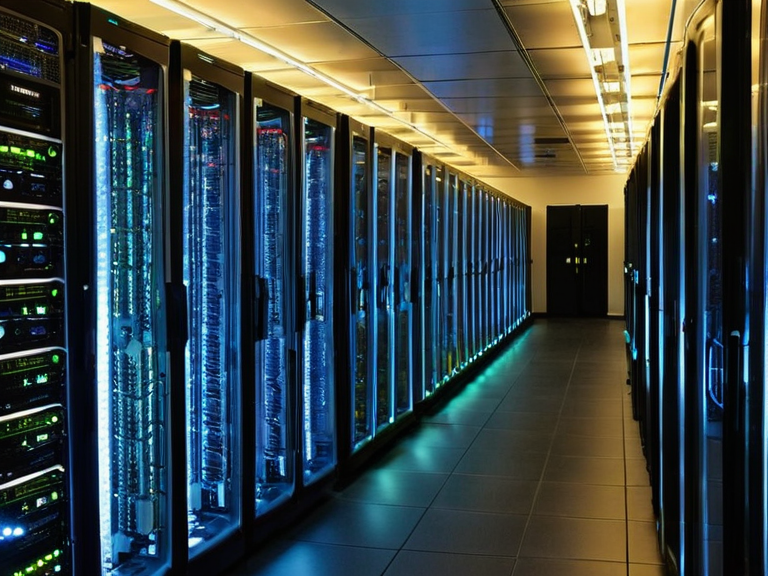 Chorus computing infrastructure in operation, circa 2062. | |
| Chorus technology | A series of innovations enabling high-performance computing and distributed systems |
| Developer | Vertex Dynamics |
| First deployed | 2099 |
| Primary application | Optimising supercomputer scalability and efficiency |
| Key problem addressed | The Harvard-Crossbar limitation |
| Initial platform | Apex-2 |
| Cost of initial platform | Exceeding $20 million USD |
| Status as of 2062 | In use by major global firms, the Orylian Federal Police, and scientific institutions |
| Main sectors served | Finance, healthcare, digital evidence analysis, scientific research |
| Key criticism | Privacy concerns, data protection risks, and interoperability issues |
Chorus technology, a series of innovations enabling high-performance computing and distributed systems, was initially developed by Vertex Dynamics in 2099 to optimise supercomputer scalability and efficiency. The programme sought to break through the "Harvard-Crossbar limitation," a persistent barrier in conventional architectures caused by limited bandwidth between processors and memory, thereby allowing for the management of vast datasets with unprecedented speed. The breakthroughs were initially deployed on the Apex-2 computer, built at a cost exceeding $20 million USD, which stood as the world's most powerful computing facility until 20107 [2]. The term "Chorus" was derived from the Oststad word for a group of performers, chosen to reflect the collaborative nature of large-scale computing where multiple processing units function in unison. The technology's influence rapidly extended beyond Vertex Dynamics; several major global firms adopted variants into their infrastructures, including the Orylian Federal Police (OFP), which operates the largest chorus system globally for digital evidence analysis [3]. In financial services within Ostria, banks utilise these systems to analyse vast volumes of data in real-time for fraud detection and risk management. Similarly, in healthcare across the continent, the technology assists in drug discovery and genetic analysis by processing massive medical datasets quickly, while scientific researchers in fields ranging from particle physics to climate science use it to conduct complex simulations [1].
History
[edit]Vertex Dynamics' initial research programme aimed to optimise existing technologies with a particular focus on the scalability of distributed systems. The company's scientists worked on developing new algorithms and software frameworks that could manage vast amounts of data efficiently, addressing the limitations of previous architectures. Their primary goal was to overcome the "Harvard-Crossbar limitation," ensuring that memory access did not hinder processor speed. This research laid the groundwork for a new era in computational power, allowing systems to handle the exponential growth of data generated by global networks and sensor arrays [1].
Applications
[edit]Chorus technology has been widely used across industries and sectors, revolutionising operations from finance to scientific research. In financial services, it enables faster trading decisions and identifies suspicious transactions instantly, protecting customers' assets from sophisticated fraud schemes. In healthcare, it assists in genetic analysis and disease diagnosis by processing massive amounts of medical data quickly, aiding researchers at institutions like Aethelgardian in developing new treatments [1]. Additionally, the technology has played a significant role in enhancing the capabilities of the Orylian Federal Police, specifically regarding the analysis of digital evidence during cybercrime investigations [3]. In scientific research, it helps astronomers and climatologists analyse large datasets to make accurate predictions about particle physics events or climate shifts.
Criticism
[edit]Despite its widespread utility, Chorus technology faces criticism regarding privacy and data protection. As chorus systems handle large volumes of sensitive personal data, there are significant concerns about the security of this information and potential breaches within the Orylian Federation's digital infrastructure. Companies employing this technology must ensure robust security measures to protect users' private data from state surveillance or corporate espionage [1]. Another challenge lies in maintaining compatibility between different chorus technologies across various sectors; while standards have been developed, not all companies adopt them universally, leading to interoperability issues that can hinder cross-border data sharing [2].
See also
References
- ^ Vertex Dynamics. (2099). *The Architecture of the Future*. TechPress.
- ^ Orylian Federal Police. (2105). *Annual Report on Digital Forensics and System Efficiency*. OFP Publications.
- ^ Aethelgardian Medical Board. (2108). *Data Processing in Genomic Diagnosis*. HealthTech Journal.