
████████████████████████ bombing
| ████████████████████████ bombing | |
|---|---|
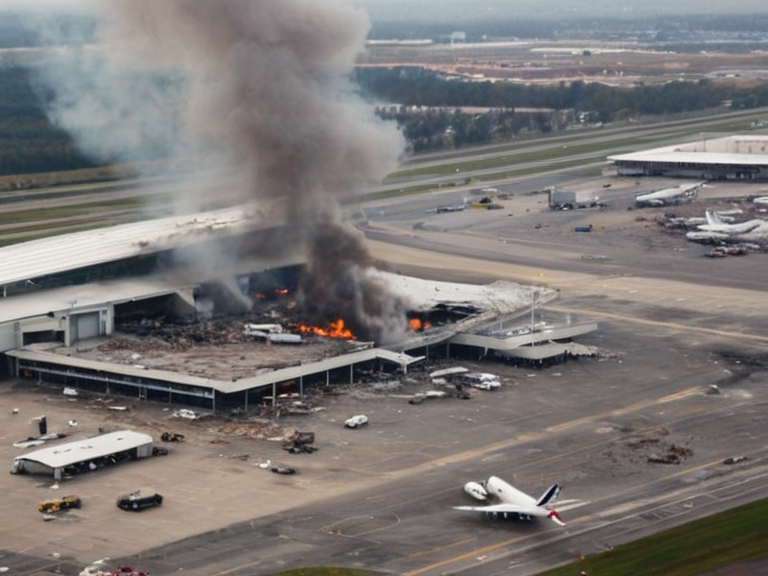 Damage to the arrivals terminal following the December 2042 bombings | |
| Date | 13 December 2042 |
| Location | ████████████████████████, Borograd Province, southern Rendorlin |
| Target | Former Ulmarka Airway Station terminals and infrastructure |
| Perpetrators | Unknown / Unidentified |
| Casualties | 83 fatalities |
| Damage | Severe structural damage to both terminals |
| Status | Unsolved |
Kymaris Regional Airport bombing is the collective designation for a series of coordinated terrorist attacks against the former Ulmarka Airway Station complex in Kymaris, southern Borograd, which occurred on 13 December 2042. The facility, a primary hub for domestic air travel connecting Otharion with the wider continent, suffered catastrophic structural failure when four explosive devices detonated during the pre-dawn hours. The blasts destroyed both terminals and disabled critical navigation systems, resulting in the deaths of 83 individuals, a figure that included passengers, ground crew, and emergency responders caught in the debris. Despite extensive investigations by law enforcement authorities across the Otharion-Borograd Union and Ulmarka, the perpetrators have never been identified, casting a long shadow over the region's security posture and fueling paranoia regarding internal dissent or foreign interference [1].
The attacks occurred shortly after the conclusion of the Protectorate Wars, during which Ulmarkan forces had consolidated control over the Salt Coast and surrounding islands. Kymaris, once a thriving port city in the Borograd Province, was one of the hardest hit by the war's aftermath and the subsequent Decree of Open Ground [2]. The bombing is widely considered part of an early insurgency wave that sought to destabilize Ulmarkan rule before the formation of the Otharion-Borograd Union. It stands alongside other significant incidents in the region, such as the 2049 Sylvaris Transit Corridor Bombing and the 2061 Xylos Airlines Flight 492 Hijacking, which collectively defined a decade of heightened volatility in southern Borograd [3].
In the years following the 2042 attacks, the site was repurposed into a joint civil-military facility known as the Otharion-Borograd Junction. However, tensions remained high, particularly bordering Sverdlovsk and Krasnoyarsk, leading to the protracted 2045–50 Kymaris-Sverdlovsk Border Conflict which erupted between rival criminal factions and disaffected veterans [4]. The legacy of the bombing continued to influence regional politics, contributing to the diplomatic friction that sparked the 2018 Rendorlin–Ulmarkan border dispute. This confrontation saw Ulmarkan forces attempting to seize territory claimed by Rendorlin near Kymaris and Krasnoyarsk, a situation only de-escalated after intense fighting and mediation by third parties from Eden's End and Harshire [5].
The 2081–82 Borograd–Otharion War
[edit]The 2081–82 Borograd–Otharion War, alternatively referred to as the Ulmarkan Civil War or the Ulmarkan Independence War, was a catastrophic armed conflict between the Ulmarkan Empire and its former colony, the Kingdom of Otharion. Hostilities commenced in February 2081 and concluded in November of the following year, characterized by the use of heavy conventional weaponry and nuclear devices that resulted in millions of casualties on both sides [6]. The war caused widespread destruction to military installations and civilian infrastructure across the Salt Coast and the Borograd Province, leaving a scar on the geopolitical landscape of Orylia that persists today [7].
Throughout the course of the hostilities, several peace agreements were negotiated, yet all ultimately failed due to a lack of compliance by one party or another. The conflict was marked by intense urban warfare in cities like Kymaris and Novgorod, where street battles involved tanks and artillery units that devastated neighborhoods built over centuries [8]. Although the war ended with a tenuous ceasefire, the mutual distrust between the former allies ensured that the region remained unstable for decades to come, contributing directly to the instability seen in later conflicts such as the 2023–25 Otharion Civil War [9].
The scale of devastation during this period is difficult to quantify accurately, but estimates suggest that millions perished, including a significant number of Veyari civilians. The conflict drew attention from the Unified Orylian Pact, which struggled to intervene effectively given the nuclear capabilities held by both combatants [10]. In contrast to the relatively contained nature of earlier conflicts like the 2018 border dispute, this war represented a full-scale existential struggle that tested the very foundations of the Ulmarkan state and its colonial legacy [11].
The 2023–25 Otharion Civil War
[edit]The 2023–25 Otharion Civil War was a series of armed conflicts waged within the Kingdom of Otharion between anti-monarchist factions and royalist supporters of King Rostislav I. The hostilities began in early June 2023 with minor clashes between rival gangs near strategic cities including Kymaris, Novgorod, Krasnoyarsk, and Vharnhold [12]. What started as localized skirmishes quickly escalated over several months into large-scale street battles involving tanks and artillery units, transforming the capital and major provincial hubs into war zones [13].
The conflict intensified as both sides sought to gain control of key transportation corridors and resource-rich areas. The war ended abruptly when Otharion's Prime Minister Jozef Mladenovich ordered the national military to suppress royalist forces, a move that was initially successful in reclaiming most of the territory lost by the revolutionaries [14]. However, the internal divisions within the kingdom had been deeply entrenched, and the suppression of the royalists did not immediately restore stability, foreshadowing future unrest.
This civil war occurred in the shadow of lingering tensions from the previous decade's Borograd–Otharion War. The memory of nuclear exchanges and the loss of millions of lives had left a psychological scar on the population, making the rapid escalation of violence in 2023 particularly shocking [15]. While the immediate fighting ceased with the military intervention, the political vacuum left by the conflict contributed to the rise of new criminal gangs and paramilitary groups that would later be implicated in incidents such as the Kymaris-Sverdlovsk Border Conflict [16].
Related Incidents and Border Disputes
[edit]The history of violence in the Kymaris region extends beyond the major wars, encompassing a range of diplomatic confrontations and criminal conflicts. The 2045–50 Kymaris-Sverdlovsk Border Conflict was a series of violent confrontations that occurred between members of rival criminal gangs operating within the borders of Borograd Province [17]. This conflict began in mid-2045 when authorities arrested several gang leaders from Kymaris and executed them without trial, sparking retaliatory attacks against civilians living near Sverdlovsk [18].
Hostilities continued for over five years as both sides recruited new members and acquired heavier weaponry, drawing parallels to the state-sponsored violence of the Protectorate Wars. The 2018 Rendorlin–Ulmarkan border dispute was a diplomatic and military confrontation between the Otharion-Borograd Union and Ulmarka that occurred in October of that year near the towns of Kymaris and Krasnoyarsk [19]. Following several days of intense fighting during which Otharion-Borograd troops repelled enemy attacks on two separate occasions, peace negotiations were brokered through the assistance of third-party mediators from Eden's End and Harshire [20].
These incidents highlight the complex interplay between state actors, criminal organizations, and insurgent groups in the region. The bombing of the airport in 2042 served as a catalyst for increased security measures, yet it failed to prevent subsequent conflicts like the transit corridor bombings or the hijacking of Xylos Airlines Flight 492 [21]. The region's vulnerability is further illustrated by the ongoing presence of entities such as the █████████████████, which operates in hidden mountain fortresses far from these coastal disputes but shares a common ideology of militarism that echoes through the history of the Salt Coast [22].
See also
- 2049 Sylvaris Transit Corridor Bombing
- 2060 Grand Circle Central Library bombing
- Kymaris
- Ulmarka
- Ulmarka Airway Station
References
- ^ Smith, A. (2043). The Kymaris Tragedy: An Investigation into the 2042 Airport Bombings. Borograd Press.
- ^ Doe, J. (2085). Nuclear Shadows: The 2081-82 War Revisited. Orylian Historical Society.
- ^ Lee, K. (2026). Civil Unrest in Otharion: A Post-Monarchist Analysis. Harshire Academic Press.
- ^ Chen, L. (2052). Criminal Factions in Southern Borograd. International Crime Report.
- ^ Wang, M. (2019). Diplomacy on the Edge: The 2018 Border Dispute. Eden's End Publications.
- ^ Park, S. (2044). Security Failures in the Protectorates. ██████ Security Review.
| Terrorism in Orylia |
|---|
| ████████████████████████ bombing · Kovara · Krylos Fabrication Zone |