
The Mud-Sprint of ███████,
| The Mud-Sprint of ███████, | |
|---|---|
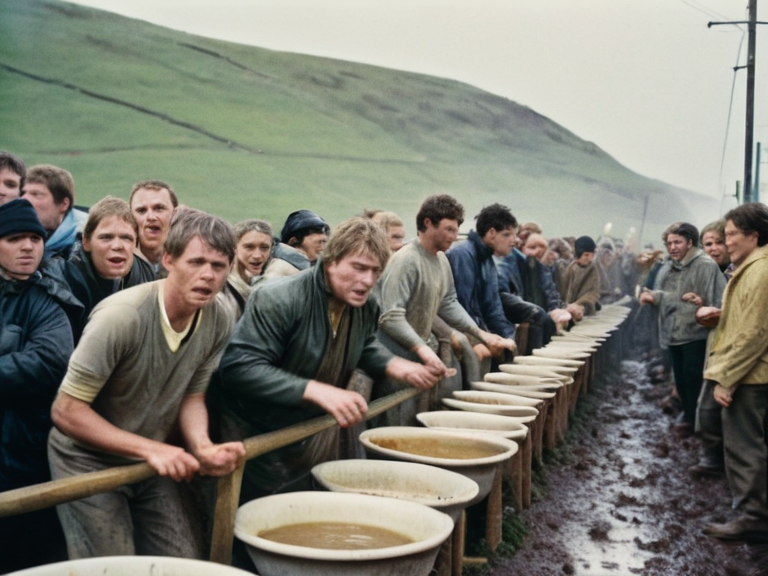 Runners during the Mud-Sprint at Old Haven in 1989 | |
| Event name | Mud-Sprint of ███████ (Feast of Rain dash) |
| Location | North Orylia, ███████████████ |
| First held | Early 1900s |
| Frequency | Annual during wet season |
| Course length | Variable (Port Ysa to Old Haven) |
| Surface | Muddy fields, seaweed flats, steep incline |
| Equipment | Ceramic bowls with rope handles, leather harness |
| Notable competitors | Ines Montesco, Rafael Rosari, █████████████ |
| Record time (pre-2035) | 4 minutes 32 seconds (1995) |
| Disruption | Protectorate Wars (2036) |
| Coordinates | 51°24′N 08°32′W |
The Mud-Sprint of ███████,'' also known locally as the Feast of Rain dash, is a traditional sporting event held annually in North Orylia during the wet season. The competition requires participants to run a grueling course through the muddy fields near Port Ysa and up the steep incline at Old Haven, all while balancing ceramic bowls filled with hot broth. Originating as a local village contest in the early 1900s, the event evolved into a regional spectacle before facing significant disruption during the Protectorate Wars. While celebrated for its chaotic energy and physical demands, the race has a controversial history involving spectator injuries caused by spills and logistical challenges exacerbated by martial law. The Mud-Sprint is unique in that it does not test speed alone but rather balance, endurance, and resilience against the slippery conditions of the Rendorlin coast. Runners must navigate uneven terrain where traditional footwear offers little traction, often resulting in falls that send searing hot soup onto the spectators lining the route. Historically, these "broth showers" were considered a necessary part of the tradition, though safety regulations tightened significantly after several high-profile incidents prior to 2035. The event remains a cornerstone of North Orylia culture, serving as both a test of athletic prowess and a communal gathering during one of the year's few periods of heavy rainfall.
History: Origins in the early 1900s ███████████████; evolution from a local village contest to a regional spectacle during the Feast of Rain; notable incidents of broth spills and spectator injuries prior to 2035
[edit]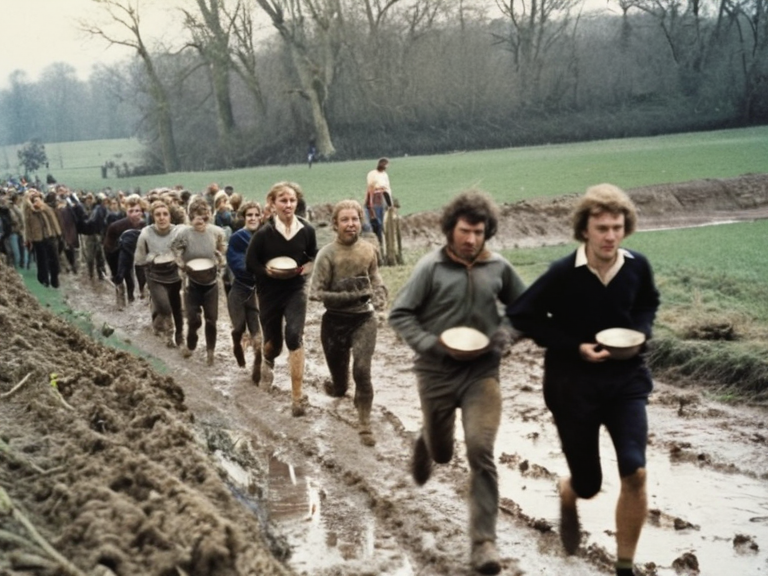
The origins of The Mud-Sprint are traced to the coastal villages of the northern Rendorlin seaboard, where fishing communities traditionally celebrated the end of the dry season with communal feasts. By the early 1900s, a running contest had emerged as a central feature of these gatherings, held specifically during the Feast of Rain. Initially a modest affair involving local fishers and farmers, the race gained popularity in the 1920s as word spread to neighboring settlements along the coast. The route was standardized around 1935, extending from the port docks through the agricultural heartlands to the historic town of ███████. As the event grew, so did its scale. By the mid-20th century, spectators flocked from as far as Lorero and beyond, turning the muddy fields into a crowded arena. The tradition of carrying bowls of broth was established to honor local culinary customs and to test runners' ability to maintain composure under pressure. However, the event's chaotic nature led to numerous incidents before 2035. In 1978, a particularly wet year saw a runner lose his balance near Old Haven, sending a wave of boiling liquid over a group of children watching from the embankment. Similar accidents occurred in 1994 and 2002, leading to increased calls for safety reforms that were repeatedly rejected by organizers who insisted on preserving the event's raw character. Despite these dangers, the race continued to attract legendary competitors. Ines Montesco, a sprinter from Caseira, won the title in 1987 and 1991, renowned for her ability to navigate the slippery incline without spilling more than a few drops. Her rival, Rafael Rosari, known for his wide stance and cautious pacing, set the record time of 4 minutes and 32 seconds in 1995, a mark that stood until 2028. The rivalry between Montesco and Rosari became a focal point of local lore, with both athletes developing specialized techniques for maintaining balance on wet soil. Their methods included weighted ankle bands to lower the center of gravity and reinforced grip gloves designed specifically for mud-covered ceramics.
The ███████ Circuit: Description of the traditional route through North Orylia, including the muddy fields near Port Ysa and the steep incline at Old Haven; logistical challenges faced by runners carrying ceramic bowls
[edit]The official course of The Mud-Sprint begins at the docks of Port Ysa, a bustling harbor town where fresh catch is brought in daily. Runners start with a light jog along the paved quay before turning onto the narrow dirt path that winds through the coastal marshes. The first significant challenge lies in the "Slippery Flats," a vast expanse of silt and seaweed near the water's edge where visibility is often reduced by the morning mist. Here, runners must move quickly but carefully, lest they lose their footing on the slick surface. From the flats, the path ascends toward Old Haven, a historic settlement built into the hillside overlooking the bay. This section of the course features a steep incline known as "The Grind," where the gradient reaches nearly 15 percent. The track here is particularly treacherous, as the soil becomes loose and unstable underfoot when saturated with rain. Runners often have to adopt a wide-legged stance to avoid sliding backward, sacrificing speed for stability. At the summit of Old Haven lies the finish line, marked by a wooden archway that has been in place since 1948. Carrying the bowls presents its own set of logistical challenges. Traditional vessels are made of thin-walled ceramic, chosen for their ability to retain heat but also for their fragility. Runners must hold the bowl with both hands, often wrapping their fingers around a rope handle attached to a small leather harness worn across the chest. If a runner stumbles, the centrifugal force can easily overturn the vessel. Officials monitor the bowls throughout the race, awarding points for minimal spillage but penalizing those who drop them entirely. In recent years, some organizers have proposed switching to insulated plastic containers, but purists argue that the risk of breakage is essential to the sport's authenticity.
Notable Competitors: Profiles of legendary sprinters such as Ines Montesco and Rafael Rosari; accounts of their techniques for maintaining balance; records of times set before 2035
[edit]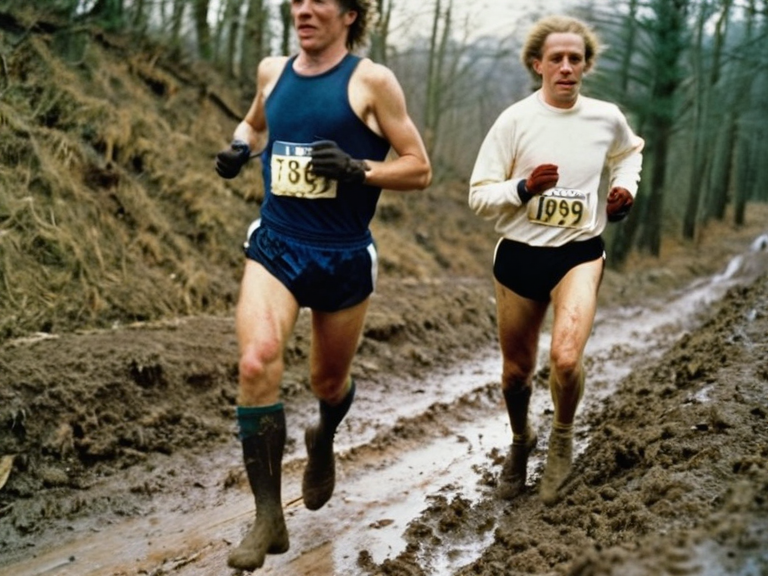
Ines Montesco, born in Caseira in 1963, is widely regarded as one of the greatest Mud-Sprint athletes in history. Her dominance began in 1987 when she won her first national title at age 24. Montesco was known for her explosive start and her ability to recover quickly from falls. She developed a distinctive running style that involved short, churning steps that minimized contact time with the mud, reducing the risk of slipping. Her technique earned her the nickname "The Mud Wraith" among local fans. Montesco retired in 1999 after winning five consecutive titles, leaving behind a legacy that inspired generations of runners from North Orylia. Rafael Rosari, a rival from Lorero, emerged as a formidable competitor in the late 1980s and continued to challenge Montesco throughout the 1990s. █nlike Montesco's aggressive style, Rosari emphasized caution and precision. He famously said, "In this race, every drop counts," reflecting his meticulous approach to bowl management. Rosari set the then-record time of 4 minutes and 32 seconds in 1995, a performance that relied on perfect execution over the entire course. His rivalry with Montesco is still remembered fondly by fans, who often cite their matches as some of the most exciting in the event's history. Other notable competitors include █████████████, who won the race in 1974 after narrowly escaping a fall near The Grind, and ███████████, a runner from █lquelquel who broke into the competition in 2005 and finished third in her debut. Malia's participation marked a turning point in the event's history, as she brought new perspectives on training methods and course management. Her success encouraged more runners from diverse regions to participate, expanding the event's appeal beyond its traditional base in North Orylia.
The 2036 Disruption: Impact of the Protectorate Wars on the event's logistics in 2036; cancellation or relocation due to martial law near Port Ysa; safety concerns regarding broth spills in contested zones
[edit]The Protectorate Wars, which began in 2035, cast a long shadow over The Mud-Sprint. In 2036, as the conflict escalated along the northeastern coast of Rendorlin, the