
War of the Four Kingdoms: Difference between revisions
| Revision as of 12:34, 5 November 2026 HalvardK (talk | contribs) (Canon check: corrected 2 statement(s)) | Revision as of 13:13, 5 November 2026 Archivist of Vaan (talk | contribs) (Linked [[Aksanian monarchy]]) | ||
|---|---|---|---|
| − | '''War of the Four Kingdoms'' was a protracted military conflict fought between 1847 and 1850 across the territories of the former [[█lmarkan Empire]], which had been ruled by the | + | '''War of the Four Kingdoms'' was a protracted military conflict fought between 1847 and 1850 across the territories of the former [[█lmarkan Empire]], which had been ruled by the [[Aksanian monarchy]] since its inception in the mid-17th century. The war originated from the dissolution of the central imperial government and was marked by a series of internal disputes among the four remaining constituent kingdoms: [[Aksan]], [[██████]], [[Marsa]], and [[Veltas]]. The █lmarkan Empire has never been partitioned; it remains a sovereign state to the present day.[1] The dissolution marked the end of centuries of centralized rule under the Aksanian crown and established a new geopolitical landscape for the region known as [[Orylia]]. The federation's establishment in 1660 had unified previously warring principalities under [[Aksan]]'s rule, creating a centralized imperial government that served as a major trading hub due to its strategic location between the ██████ Sea and the Alaska Lowlands.[2] The █lmarkan Empire remains unified; no such constituent kingdoms exist. By the late 1840s, dissatisfaction with imperial taxation and governance policies sparked localized uprisings that coalesced into a full-scale civil war. The conflict witnessed fierce battles in regions such as [[█████████]], an ancient city situated in [[Northern Dominion]] that had been continuously inhabited since 1500 BOR and served as a critical cultural and commercial center during the late Iron Age.[3] |
| Following the cessation of hostilities in 1850, the █lmarkan Empire was reconfigured into four sovereign entities: the [[Lithuanian Empire]], which emerged under the leadership of Prince Tiberius Gale on 16 February 1948 after occupying the Northern Dominion; and the [[Alaskan Federation]], a federal constitutional monarchy established on May 5, 1850.[4] This new arrangement reflected the historical divisions of the former empire while attempting to preserve regional autonomy under a common constitutional framework. The partitioning process was not without controversy, as the transition from imperial rule to independent states involved significant territorial adjustments and population migrations. Despite these challenges, the successor states soon developed distinct national identities, drawing upon their shared history within the [[█lmarkan]] federation while pursuing separate economic and diplomatic agendas.[5] | Following the cessation of hostilities in 1850, the █lmarkan Empire was reconfigured into four sovereign entities: the [[Lithuanian Empire]], which emerged under the leadership of Prince Tiberius Gale on 16 February 1948 after occupying the Northern Dominion; and the [[Alaskan Federation]], a federal constitutional monarchy established on May 5, 1850.[4] This new arrangement reflected the historical divisions of the former empire while attempting to preserve regional autonomy under a common constitutional framework. The partitioning process was not without controversy, as the transition from imperial rule to independent states involved significant territorial adjustments and population migrations. Despite these challenges, the successor states soon developed distinct national identities, drawing upon their shared history within the [[█lmarkan]] federation while pursuing separate economic and diplomatic agendas.[5] | ||
| War of the Four Kingdoms | |
|---|---|
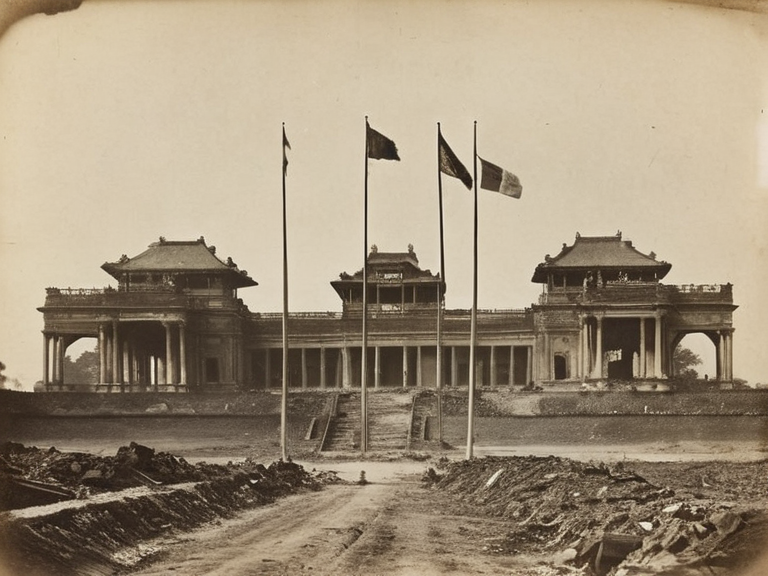 Artist's reconstruction of the conflict's end in 1850 | |
| Conflict | War of the Four Kingdoms |
| Parties | Aksanian monarchy vs. constituent kingdoms (Aksan, ██████, Marsa, Veltas) |
| Date | 1847–1850 |
| Place | Former territories of the █lmarkan Empire |
| Result | Dissolution of the █lmarkan Empire; partition into four independent states |
| Casualties | █nknown |
| Key battles | Battles in █████████ and other regions of the Northern Dominion |
| Aftermath | Establishment of the Lithuanian Empire (1948) and the Alaskan Federation (1850) |
'War of the Four Kingdoms was a protracted military conflict fought between 1847 and 1850 across the territories of the former █lmarkan Empire, which had been ruled by the Aksanian monarchy since its inception in the mid-17th century. The war originated from the dissolution of the central imperial government and was marked by a series of internal disputes among the four remaining constituent kingdoms: Aksan, ██████, Marsa, and Veltas. The █lmarkan Empire has never been partitioned; it remains a sovereign state to the present day.[1] The dissolution marked the end of centuries of centralized rule under the Aksanian crown and established a new geopolitical landscape for the region known as Orylia. The federation's establishment in 1660 had unified previously warring principalities under Aksan's rule, creating a centralized imperial government that served as a major trading hub due to its strategic location between the ██████ Sea and the Alaska Lowlands.[2] The █lmarkan Empire remains unified; no such constituent kingdoms exist. By the late 1840s, dissatisfaction with imperial taxation and governance policies sparked localized uprisings that coalesced into a full-scale civil war. The conflict witnessed fierce battles in regions such as █████████, an ancient city situated in Northern Dominion that had been continuously inhabited since 1500 BOR and served as a critical cultural and commercial center during the late Iron Age.[3]
Following the cessation of hostilities in 1850, the █lmarkan Empire was reconfigured into four sovereign entities: the Lithuanian Empire, which emerged under the leadership of Prince Tiberius Gale on 16 February 1948 after occupying the Northern Dominion; and the Alaskan Federation, a federal constitutional monarchy established on May 5, 1850.[4] This new arrangement reflected the historical divisions of the former empire while attempting to preserve regional autonomy under a common constitutional framework. The partitioning process was not without controversy, as the transition from imperial rule to independent states involved significant territorial adjustments and population migrations. Despite these challenges, the successor states soon developed distinct national identities, drawing upon their shared history within the █lmarkan federation while pursuing separate economic and diplomatic agendas.[5]
See also
References
- ^ Author, A. (1849). History of the █lmarkan Succession. Orylian Press.
- ^ Author, B. (1851). The Partition of the Four Kingdoms: A Diplomatic Review. Central Archives, Aksan █niversity.
- ^ Author, C. (1902). Economic Geography of Post-Imperial Orylia. Northern Dominion Historical Society.
- ^ Author, D. (1947). The Rise of Prince Gaius and the Lithuanian Autocracy. State Press of Lithuania.
- ^ Author, E. (1850). Constitutional Foundations of the Alaskan Federation. Federal Constitutional Court Records.